
Written by: Matthew Timmins, Founder and Managing Director, Leva Sleep | Last updated: June 27, 2026
Key Takeaways for Noise-Sensitive Couples
- Split king adjustable beds typically operate at 40–50 dB during adjustments, comparable to a quiet conversation or refrigerator hum.
- Independent side controls and precision German DC motors help prevent one partner’s movement from disturbing the other.
- Anti-vibration feet, micro-adjustment technology, and anti-snore modes further reduce noise and nighttime disruptions for couples.
- Traditional flat beds and basic adjustable bases often fall short because of linked movement, louder motors, and vibration transfer across the mattress.
- Leva Sleep offers whisper-quiet adjustable bed packages designed for couples; shop Leva Sleep’s adjustable beds to find a quiet solution tailored to your needs.
The Problem: Snoring, Differing Needs, and Sleep Divorce
Many Canadian couples now face incompatible sleep needs that strain both rest and relationships. One partner snores, another runs hot, and a third needs head elevation for acid reflux or recovery. When one partner’s adjustment wakes the other, or when snoring continues unchecked, couples often drift into what sleep clinicians call “sleep divorce.” Partners move to separate rooms just to get enough rest.
Separate rooms can solve the immediate disruption but introduce new costs to intimacy and daily routines. The core issue usually is not incompatibility between partners. The real mismatch sits between the bed and each person’s individual sleep requirements.
Conditions like obstructive sleep apnea, chronic back pain, and post-surgical recovery often come with medical advice to sleep in an elevated position. A partner who needs 30 degrees of head elevation and one who sleeps flat cannot share a single, flat surface comfortably. A basic adjustable base that moves both sides together also fails this test for many couples.
Why Traditional Bed Setups Disturb Sleep
Flat beds offer no positional flexibility for medical needs or comfort differences. Basic adjustable bases sold at general furniture retailers often move both sides of the bed together, so any adjustment wakes both partners. Even when a basic base includes a split configuration, older motor technology can create grinding or clicking sounds that sit well above the quiet range mentioned earlier.
Noise and vibration standards in residential settings recognize that sustained sounds above 45 dB at night can fragment sleep architecture, even without a full awakening. Jerky, imprecise motor movements add another problem. A relatively quiet motor still causes disruption if vibration travels across a shared mattress platform.
How Split-King Adjustable Systems Keep Each Side Independent
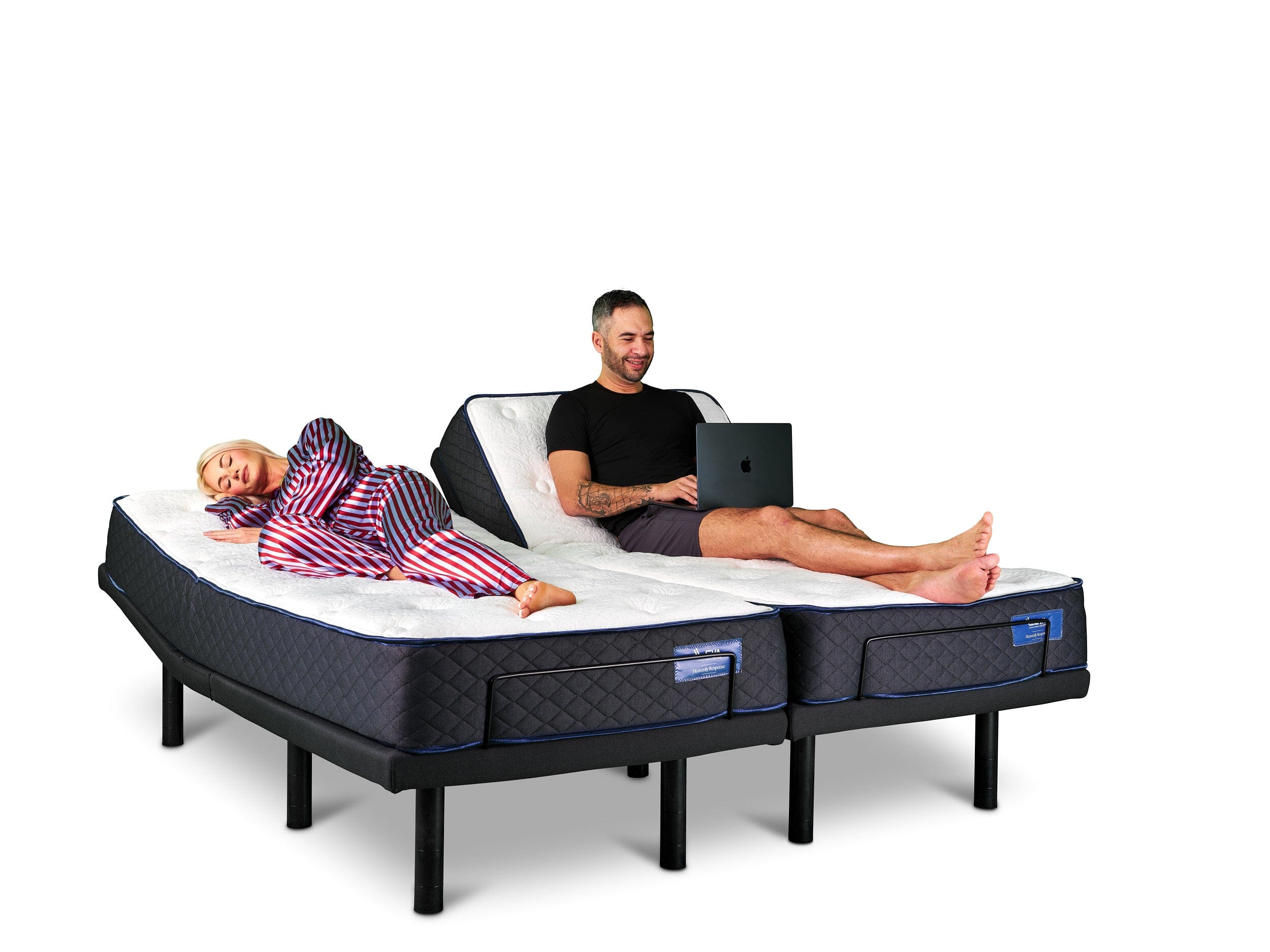
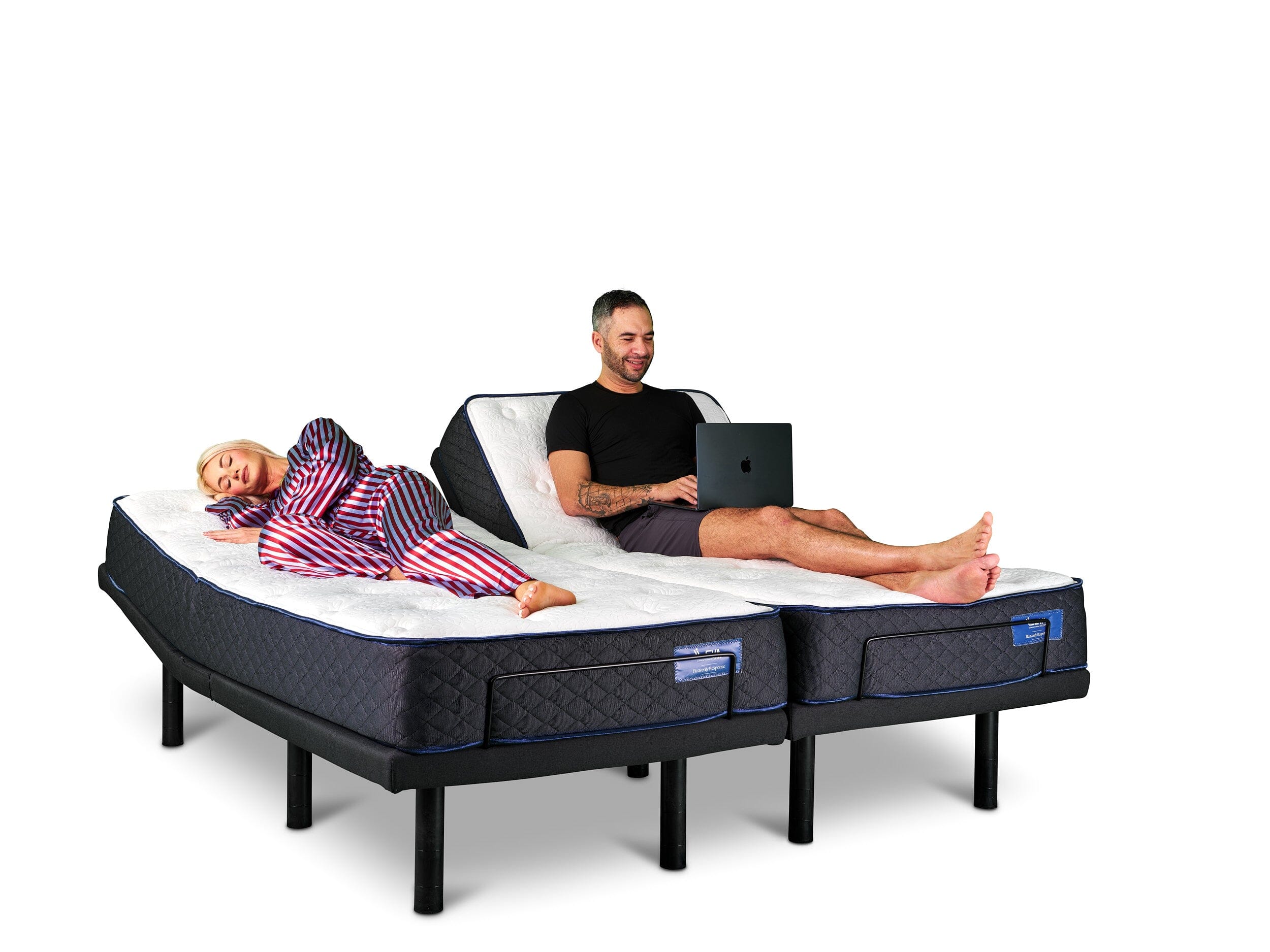
A split king configuration places two twin XL bases side by side inside a king-sized frame. Each base has its own motor, controller, and power supply. When one partner raises the head of their side, the other side remains completely stationary. The system stays mechanically and electrically independent.
The two mattresses sit on their own bases with no shared rigid connection that can transmit movement. This independence forms the engineering foundation for quiet co-sleeping. A split queen follows the same logic in a smaller footprint, a configuration that very few Canadian retailers currently offer.
Independence at the base level creates a strong starting point but does not solve everything. The mattress type, the floor surface, and the motor quality all influence how much residual noise or vibration reaches the sleeping partner. Understanding these connected factors helps you decide which features matter most for your bedroom.
Key Noise Factors to Evaluate Before You Buy
Motor type and decibel output. DC motors, especially those built to German engineering standards, typically run with tighter tolerances and smoother gear trains than older AC motors. This design produces quieter, more consistent movement. When you evaluate a base, ask the retailer for the motor’s rated noise output at load. A well-engineered motor should stay within the range mentioned earlier during active adjustment. Consistently higher readings deserve extra scrutiny for nighttime use.
Vibration transfer through the floor. Hard floors such as hardwood, laminate, and tile transmit vibration more easily than carpet. A base sitting directly on hardwood can hum audibly even when the motor itself remains quiet. Rubber feet or anti-vibration pads reduce floor-borne transmission. Ask whether the base includes these components or whether they require a separate purchase.
Massage feature trade-offs. Massage motors form a separate system from elevation motors and usually operate at higher vibration levels by design. Running a massage cycle on one side of a split king will create more cross-mattress vibration than a simple elevation change. Couples who value massage should test this feature specifically, not just the elevation motor, before committing.
Independent vs. linked bases. Confirm that the split configuration stays truly independent at the controller level, not just physically split. Some entry-level systems share a single controller that sequences both sides. In those designs, one partner’s adjustment can still trigger a brief signal on the other side.
Real-World Considerations for Couples Sharing a Split King
Many Canadian home and sleep forums focus on whether adjusting one side at 2 a.m. will wake a partner. The answer depends on three variables: motor noise, mattress isolation, and adjustment speed. A whisper-quiet motor making a slow, incremental change of only a few degrees creates far less disturbance than a full movement from flat to maximum elevation.
This difference explains why 2026 anti-snore technology that makes small, automatic head adjustments in response to detected snoring feels so different from manually raising the head 45 degrees mid-sleep. The smaller, slower movements keep both noise and motion transfer lower.
Cuddling comfort also matters for many couples. Two independent twin XL mattresses create a seam down the centre. A mattress bridge or connector pad fills that gap for couples who want to move freely across the bed when both sides sit flat. This accessory is worth confirming as available before you purchase a system.
What to Look for in a Quiet Split-King System
When comparing adjustable bases for quiet nighttime operation, focus on how a group of features works together. Each specification addresses a different source of potential disruption.
- German or equivalent precision motors with a rated noise output at or below 45 dB under load reduce audible motor sound during adjustments.
- App-controlled micro-adjustments that allow small position changes instead of full-range sweeps limit physical movement that could wake a partner and support effective anti-snore use.
- Anti-snore mode that detects snoring acoustically and responds with subtle head elevation removes the need for a partner to intervene manually, which usually causes more disturbance.
- Truly independent dual-motor architecture with separate controllers and power supplies for each side keeps one partner’s adjustment from sending any electrical or mechanical signal to the other side.
- Anti-vibration feet included as standard, not as an upsell, help prevent floor-borne vibration transmission on hard surfaces.
Leva Sleep’s whisper-quiet German motors and app-controlled micro-adjustment system show how these specifications translate into a real product at 30–50% below many comparable luxury competitors.
Delivery and Setup Noise Realities in Your Home
The setup process itself creates a short burst of noise that many buyers overlook. Assembling a split king base involves moving two heavy steel frames, connecting wiring harnesses, and calibrating motor ranges. This process can take 45 minutes to two hours and rarely stays quiet.
White-glove delivery services schedule setup during daytime hours, handle old bed removal, and provide a full product tutorial before leaving. This service matters for couples in condos or townhomes with shared walls and for anyone who cannot safely manage heavy lifting. Confirming that delivery includes in-room setup, not just curbside drop-off, shapes the ownership experience from the first day.
Neutral Comparison Checklist for Adjustable Bases
| Evaluation Criterion | Basic Adjustable Base | Mid-Range Split King | Quiet-Engineered Split King (e.g., Leva Sleep) |
|---|---|---|---|
| Estimated motor noise at load | 55–65 dB (AC motor, older gear train) | 45–55 dB (DC motor, standard tolerance) | 40–50 dB (precision DC/German motor, tight tolerance) |
| Independent side control | Often linked or single-controller | Typically independent | Fully independent, app-controlled per side |
| Anti-snore micro-adjustment | Not available | Rarely available | Available (acoustic detection) |
| White-glove delivery included | Rarely; curbside standard | Sometimes available for fee | Available for fee; includes setup, tutorial, old bed removal |
Note: Decibel estimates in the table above represent general market ranges based on motor class and are provided as evaluation benchmarks. Actual output varies by model, load, and room acoustics. Request manufacturer specifications when comparing specific products.
Frequently Asked Questions
Will the setup process damage my floors or walls?
A split king base consists of two twin XL frames, each weighing between approximately 47 and 59 kilograms depending on the model. Professional white-glove delivery teams use furniture sliders and protective pads to move bases into position without scratching hardwood or scuffing walls. If you live in a condo with elevator restrictions or a bedroom reachable only by a narrow staircase, confirm measurements and building rules with the retailer before ordering.
Leva Sleep’s in-house delivery team manages these logistics as part of the white-glove service and can advise on access constraints during the booking process.
Can a split king adjustable bed help with sleep apnea without a CPAP machine?
Elevating the head of the bed between 7 and 30 degrees can reduce the frequency of obstructive apnea events in some individuals by using gravity to keep the airway more open. This approach does not replace a CPAP prescription in moderate-to-severe cases. Anyone with a diagnosed sleep apnea condition should consult their physician before changing their treatment plan.
For mild cases or for partners of snorers, head elevation combined with anti-snore micro-adjustments offers a non-invasive complement to other interventions. Leva Sleep’s adjustable bases are referred by some sleep apnea clinics because positional therapy forms a recognized part of broader sleep apnea management.
What mattresses are compatible with a split king adjustable base?
Adjustable bases require mattresses that can flex repeatedly without damaging their internal structure. All-foam mattresses and hybrid mattresses with individually wrapped pocket coils both meet this requirement. Traditional innerspring mattresses with a rigid Bonnell coil grid do not. The coils resist bending and degrade quickly under repeated flexion.
Leva Sleep designs its own all-foam and hybrid pocket coil mattresses specifically for adjustable bases and also carries compatible options from partner brands including Tempur-Pedic, Simmons, Beautyrest, Serta, and Kingsdown. Standard fitted sheets usually slip off an adjustable mattress during elevation. Leva’s purpose-built bedding line uses deep pockets and reinforced elastic to address this issue.
How do I maintain a split king adjustable base long-term to keep it quiet?
Motor noise in adjustable bases often increases over time if the base sits unevenly, if the legs loosen, or if debris collects around the motor housing. Annual checks should include confirming all legs are tightened and the frame is level, inspecting the power cable and remote receiver for wear, and running the base through its full range of motion to spot any new sounds.
A well-engineered base with quality motors should not require gear train lubrication. Sealed motor assemblies usually provide quieter long-term operation than open ones. If a new grinding or clicking sound appears, contact the manufacturer before the warranty period expires instead of waiting to see if it resolves on its own.
Conclusion: A Quieter Path to Shared Sleep
Canadian couples dealing with snoring, different sleep positions, or medical needs for elevation can use a properly engineered split king adjustable bed to separate comfort from disruption. One partner’s requirements no longer need to compromise the other’s sleep. The criteria that determine whether a system stays genuinely quiet, such as motor class and decibel rating, true independent control, micro-adjustment capability, and vibration management, remain specific and verifiable.
Requesting those specifications before purchasing, instead of relying only on marketing language, offers the most reliable way to evaluate any system. Leva Sleep’s whisper-quiet German motors, app-controlled independent sides, 2026 anti-snore mode, and white-glove delivery provide one accessible path to that standard at a price point 30–50% below many comparable luxury competitors.
Explore Leva Sleep’s split king and split queen packages to compare full specifications and delivery options for Ontario and Alberta.