Written by: Matthew Timmins, Founder and Managing Director, Leva Sleep
Key Takeaways for Canadian Couples
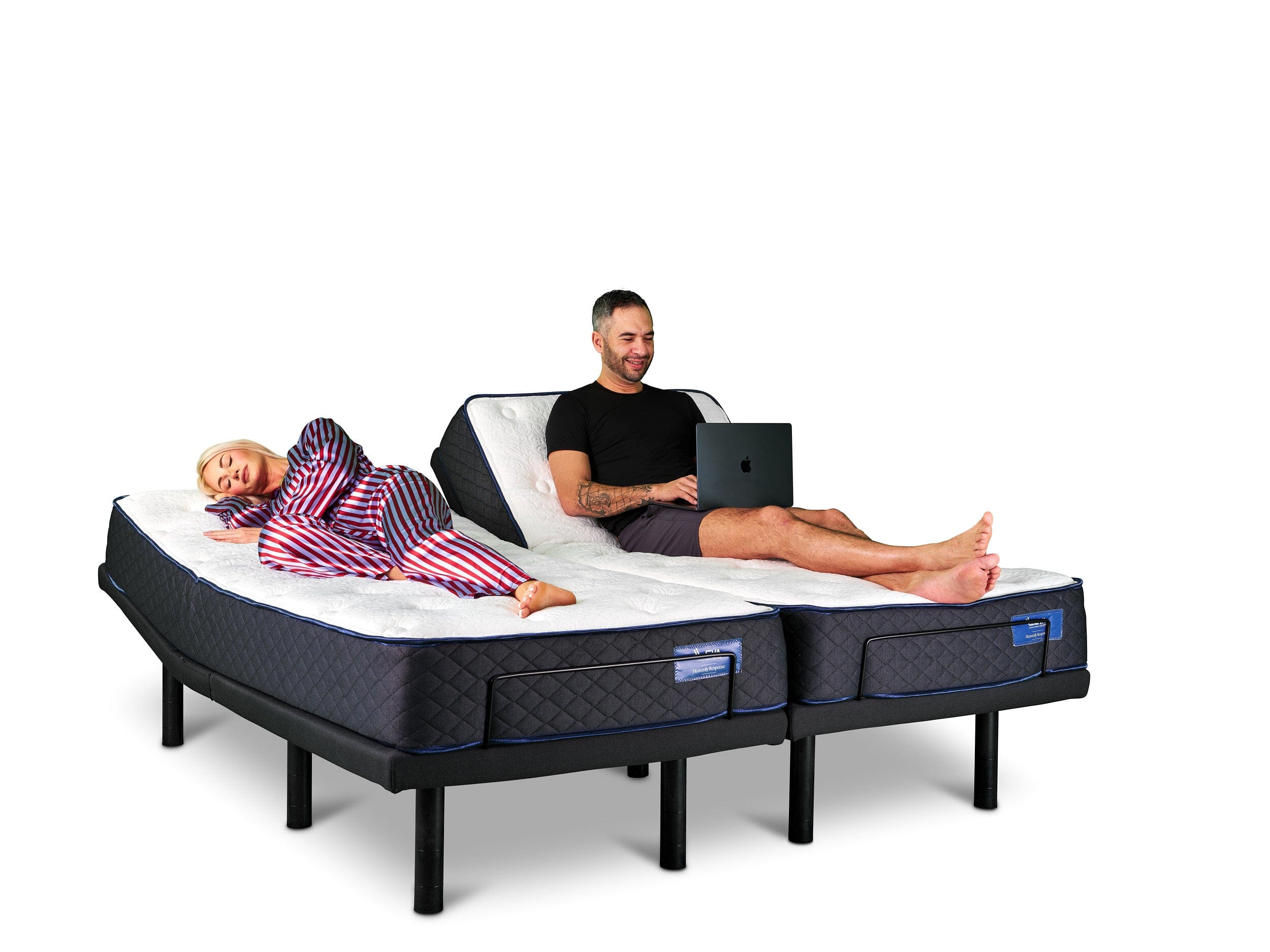
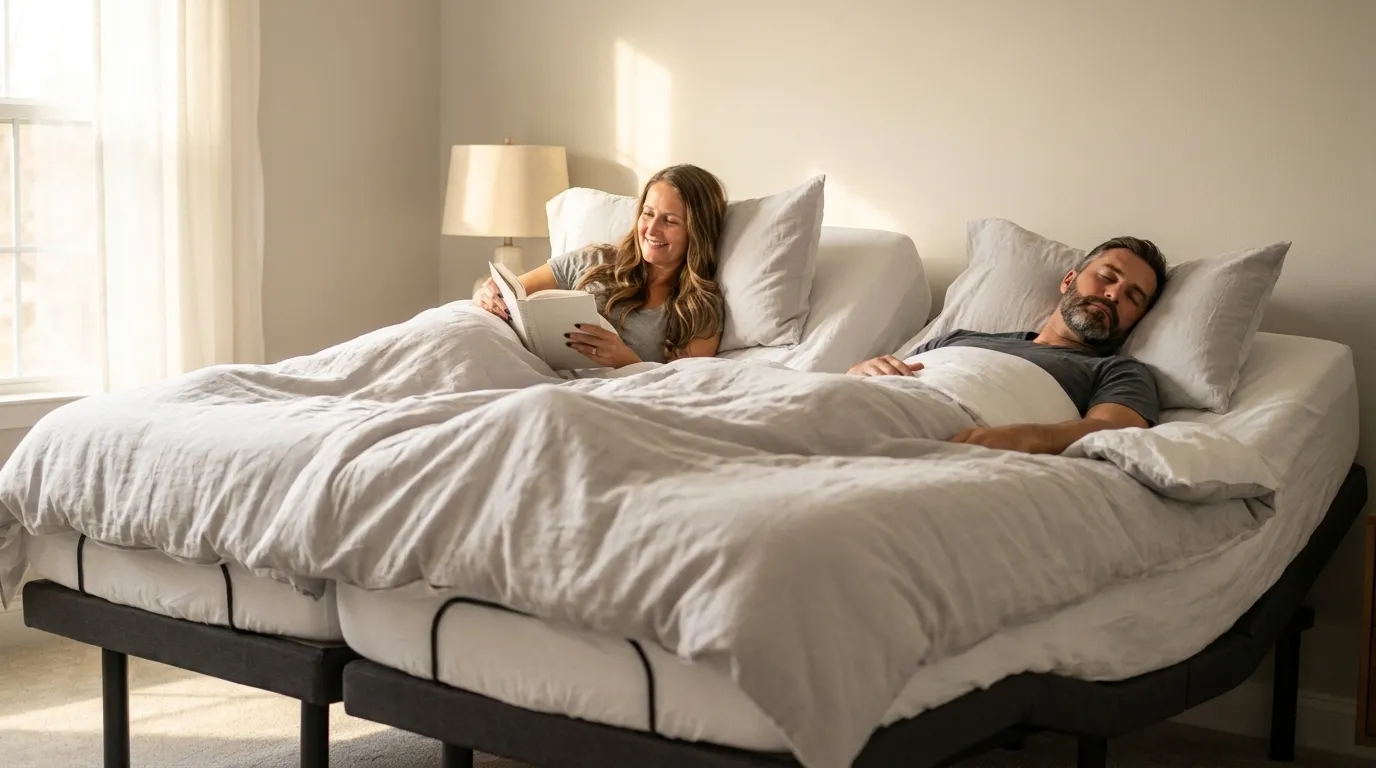
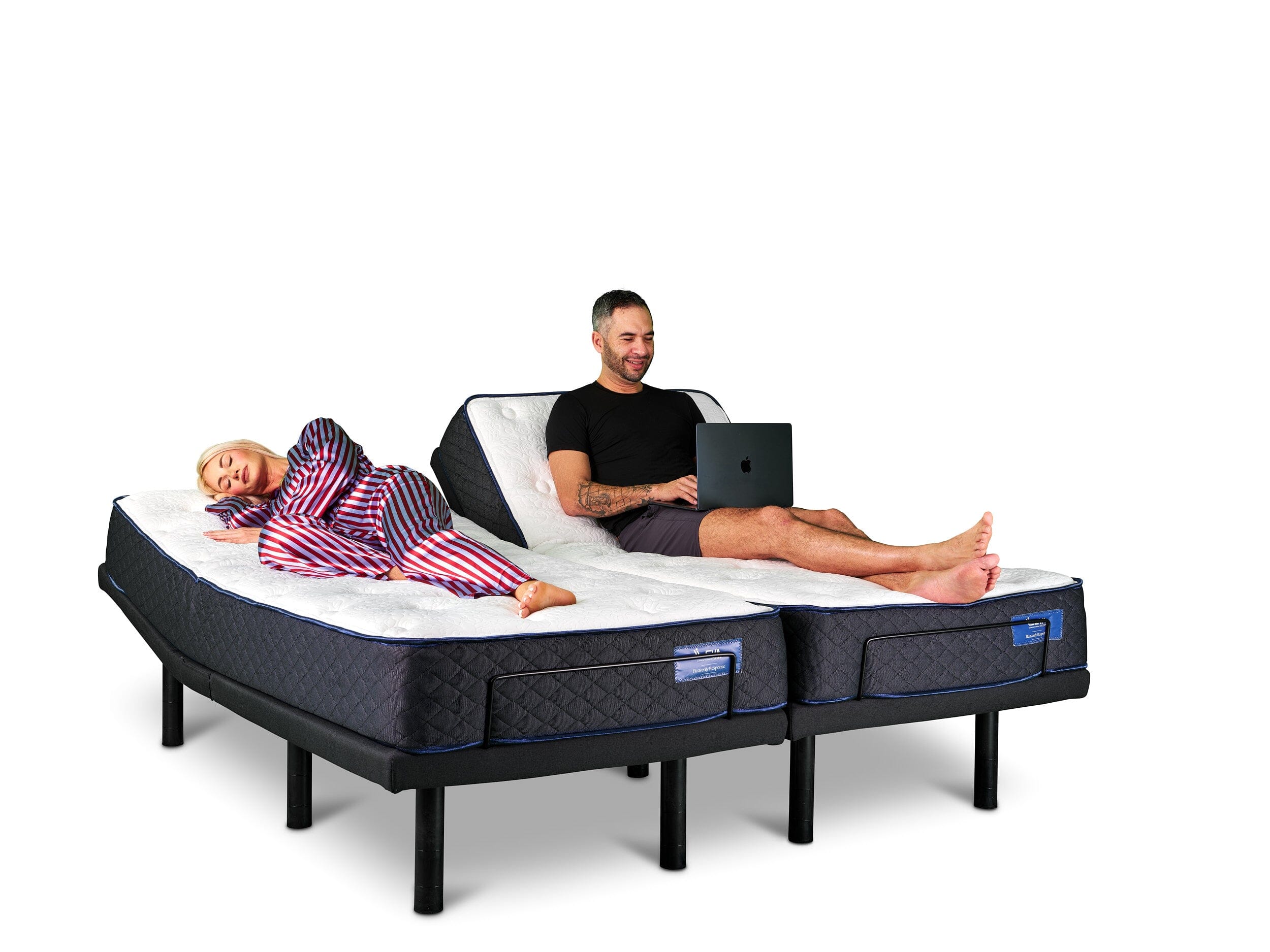
- A split queen adjustable bed uses two independent 30-inch by 80-inch bases within a standard 60-inch by 80-inch queen footprint. Each partner can set different head and foot elevations without needing a larger king-size room.
- Split queen halves are not the same as two standard twins. They require Twin XL-length sheets and still fit most existing queen bed frames and headboards in Canadian homes.
- Buyers should plan for centre-gap management, sheet slippage, and motor noise. Whisper-quiet German motors and specialized accessories help reduce these issues in daily use.
- The configuration supports post-hip-surgery recovery and sleep-apnea management by letting one partner elevate independently while the other sleeps flat.
- Leva Sleep offers split queen adjustable bed packages with purpose-built bedding and white-glove delivery. Explore Leva's split queen packages to find a solution tailored to Canadian couples.
How a Split Queen Differs from Two Twins
A split queen consists of two 30-inch by 80-inch halves that together form a standard 60-inch by 80-inch queen footprint, which matches the outer dimensions of a conventional queen mattress. A standard twin mattress measures 38 inches by 75 inches, so it is both wider and shorter than a split queen half. Two standard twins placed together create a 78-inch by 75-inch surface, which does not match either a queen or a king.
Standard Twin sheets measuring 75 inches long will not fit split queen adjustable beds, which require 80-inch Twin XL-length sheets to avoid snapping off during adjustments. Because the outer footprint matches a standard queen, a split queen configuration remains compatible with existing queen bed frames and headboards. This compatibility helps couples who prefer to keep their current bedroom furniture. However, that compatibility comes with trade-offs that affect daily use.
Common Drawbacks and Considerations in Canada
A split queen adjustable bed offers genuine benefits, but buyers should evaluate several real-world considerations before purchasing.
- Centre gap: The seam between the two 30-inch halves creates a noticeable gap that feels distinct during sleep, especially for sleepers who gravitate toward the middle of the bed. On adjustable bases, mattress movement is more pronounced because each side moves independently, which increases lateral forces and can widen the gap in head-elevation, foot-elevation, or zero-gravity positions.
- Sheet slippage: Independent sides on split adjustable beds usually require a separate fitted sheet for each mattress so one side can rise without pulling the other. A shared top sheet can tug when the two sides sit at different angles.
- Motor noise: Basic adjustable bases can produce disruptive motor sounds during position changes. Whisper-quiet motor engineering, such as the German motors used in Leva Sleep's bases, reduces this disturbance.
- Mattress compatibility: Traditional innerspring mattresses with connected coils are not recommended for adjustable bases, as repeated flexing can damage the coil structure and void warranties. Buyers should look for the phrases "adjustable base compatible" or "flex-friendly" in product descriptions.
- Limited retail availability: Split queen mattresses are less commonly stocked at Canadian chain retailers than standard queen mattresses because the product is niche and requires explanation.
Given these trade-offs, many couples start to compare split queen and split king setups to see which configuration better fits their room and bedding needs.
Split Queen vs Split King in Canada: Matching Your Room and Bedding
The table below compares the two configurations across four practical dimensions relevant to Canadian couples. Use this comparison to see how your bedroom size, bedding priorities, and need for independent control point toward either a split queen or a split king. All figures are drawn from cited sources.
| Factor | Split Queen | Split King | Source |
|---|---|---|---|
| Footprint | 60″ × 80″ | 76″ × 80″ (two 38″ × 80″ Twin XL halves) | Mattress Miracle |
| Independent control per side | Yes, head, foot, massage, elevation | Yes, head, foot, massage, elevation | Orthex |
| Recommended minimum room width | Fits rooms sized for a standard queen (approx. 10 ft × 12 ft) | Requires at least 12 ft × 14 ft, feels cramped in rooms narrower than 10 ft | Mattress Miracle |
| Bedding availability in Canada | Rare, often needs specialty or custom-order sheets; standard queen sheets can cover both halves but may slip at the seam | More available than split queen; uses two Twin XL fitted sheets plus one king flat sheet or comforter | Mattress Miracle |
A split king can feel cramped in Canadian bedrooms narrower than 10 feet, which makes the split queen a practical choice for many homes built with standard queen-sized rooms.
Medical Uses: Hip Surgery Recovery and Sleep Apnea Support
Head-of-bed elevation can reduce the apnea-hypopnea index in some patients with positional obstructive sleep apnea. Elevating the head with an adjustable base can lower apnea events for certain sleepers. An estimated 858,900 Canadian adults have been diagnosed with sleep apnea, and roughly 80% of moderate to severe cases remain undiagnosed.
Adjustable bases also support post-surgical recovery. Canada performs 51,200 hip replacements due to osteoarthritis annually, according to CIHI. An adjustable base paired with a compatible medium-firm hybrid mattress supports safe position changes without twisting the hip joint during the first 6 to 12 weeks of recovery. Adjustable beds support post-surgical recovery after hip and knee replacement by enabling leg elevation to reduce swelling and head elevation to make getting in and out of bed easier during restricted-movement periods.
On a split queen, the recovering partner can elevate their side independently while the other partner sleeps flat. This independence removes the compromise that often pushes couples into separate rooms during recovery. Buyers with a medical need should confirm eligibility with a licensed physician and check with the Canada Revenue Agency regarding the Medical Expense Tax Credit. View Leva's adjustable bases designed for post-surgical recovery.
Specialized Bedding and Accessories for Split Queens in Canada
The centre gap and sheet slippage issues documented above have practical solutions, and Leva Sleep's bedding accessories are designed specifically to address these failure points on adjustable bases.
- Extra-elastic fitted sheets: Deep-pocket fitted sheets with reinforced elastic stay anchored when the head or foot section rises. This design prevents the corner pop-off that standard sheets experience on articulating bases.
- Duvet clips: Clips maintain separation between partners' duvets when each side sits at a different angle. This setup removes the tug-of-war that occurs with a shared top sheet.
- Mattress connector straps: A mattress connector strap pulls the two 30-inch halves together from below, which reduces the centre gap and minimizes sheet slippage. Universal mattress connectors at Canadian bedding retailers typically cost between $35 and $71 CAD. Buyers should measure the gap before ordering to select the correct size.
- Remote pockets: Side pockets integrated into the base or bedding keep wireless remotes accessible and prevent them from falling between the mattresses or off the bed.
Who Benefits Most from a Split Queen Adjustable Bed
A split queen adjustable bed suits specific situations, so couples can review the list below and see whether their needs match this configuration.
- The bedroom accommodates a queen but not a king. A queen fits well in a 10-foot by 12-foot room, while a king requires at least 12 feet by 14 feet.
- One or both partners snore, which is common among adults.
- Partners have significantly different firmness preferences. A survey of 1,500 people found that 35% of couples argue about mattress firmness.
- One partner is recovering from hip or knee surgery and requires independent elevation without disturbing the other.
- One partner has been advised to sleep elevated for sleep apnea, acid reflux, or circulation issues.
Leva Sleep's split queen adjustable beds address each of these scenarios directly. Independent controls on each 30-inch base allow fully personalized head and foot elevation. Whisper-quiet German motors reduce the disruptive noise associated with basic adjustable bases. The 2026 anti-snore mode detects snoring and makes micro-adjustments to the head of the bed automatically. Leva's extra-elastic fitted sheets and duvet clips are designed for the articulating surface. In-house white-glove delivery, available in Ontario and Alberta, includes bedroom setup, leg-height adjustment, a product tutorial, and removal of the old bed, which removes the assembly burden entirely. With pricing 30–50% below comparable luxury competitors through a direct-to-consumer model, Leva Sleep delivers a premium split-queen system without the premium-brand price tag. Compare Leva's split queen packages and pricing.
Frequently Asked Questions
How long does it take to set up a split queen adjustable bed?
Setup time depends on whether white-glove delivery is chosen. With professional in-home setup, a split queen adjustable base is typically assembled, levelled, and ready to use in a single appointment. The process includes connecting the two 30-inch bases within the queen frame, attaching the mattresses, calibrating leg height, and pairing the wireless remotes or app. Self-assembly is possible but more complex than a standard bed frame because two independent motor units must be aligned correctly within the frame before the mattresses are placed.
Which mattress types are compatible with a split queen adjustable base?
All-foam, memory foam, latex, and hybrid mattresses with individually wrapped pocket coils work well with adjustable bases, provided the mattress is labelled "adjustable base compatible" or "flex-friendly." Mattresses over 14 inches thick can struggle to flex without comfort layers separating or bunching, so most adjustable-compatible mattresses fall between 10 and 13 inches thick. Traditional innerspring mattresses with interconnected Bonnell coils are not compatible. Repeated flexing damages the coil structure and typically voids the manufacturer's warranty. Buyers should confirm compatibility in writing before purchasing.
How do you prevent the centre gap from widening over time?
Three approaches reduce gap formation on a split queen adjustable bed. A mattress connector strap pulls the two halves together from below and offers the most effective long-term solution for couples who use different elevation settings frequently. A foam bridge wedge fills the gap to create a more continuous surface and works well for couples who spend time near the middle of the bed. A mattress topper placed over both halves minimizes the seam effect and creates a more unified surface feel, though it may limit independent articulation slightly. Gap fillers should be checked for compatibility with the specific adjustable base model, because some bridges can interfere with independent movement on certain frames.
Conclusion: Deciding Whether a Split Queen Fits Your Life
A split queen adjustable bed resolves a common problem for Canadian couples with differing sleep needs. It removes the forced choice between personal comfort and sharing a bed. By placing two independent 30-inch by 80-inch adjustable bases within a standard queen footprint, the configuration delivers personalized elevation, firmness, and anti-snore positioning for each partner. Couples gain this flexibility without needing a king-size room or separate bedrooms. The documented drawbacks of centre gaps and sheet slippage remain manageable with the right accessories.
For couples in queen-sized rooms across Ontario and Alberta, Leva Sleep's split queen system combines whisper-quiet German motors, purpose-built bedding, and white-glove delivery into a complete sleep solution at a direct-to-consumer price point. See Leva's complete split queen systems.