Written by: Matthew Timmins, Founder and Managing Director, Leva Sleep | Last updated: June 24, 2026
Key Takeaways
-
A split queen adjustable bed gives each partner independent head and foot control on a standard 60-inch queen footprint.
-
This setup helps with snoring, reflux, and pain while keeping couples in the same bed instead of separate rooms.
-
Compared with a split king, a split queen fits better in narrower Canadian bedrooms and usually costs less while keeping independent controls.
-
Quality systems work best with flexible mattresses, deep-pocket adjustable-rated sheets, and optional gap fillers for comfort.
-
Leva Sleep’s adjustable bed packages offer split queen options designed for Canadian couples with different sleep preferences.
Split Queen Pros and Cons for Real Bedrooms
Pros:
-
Each partner controls elevation, firmness, and features independently.
-
Fits in bedrooms too narrow for a split king, using the standard 60-inch queen width.
-
Helps address snoring, reflux, and pain while couples keep sharing a bed.
-
Usually carries a lower entry cost than a split king system.
Cons:
-
Narrower individual sleeping surface at 30 inches per side compared with a split king’s wider lanes.
-
Requires specialized deep-pocket sheets and split-compatible bedding.
-
A centre gap can appear between the two bases when each side is elevated differently.
-
Fewer Canadian retailers stock split queen setups, which limits in-person testing.
Why Canadian Couples Are Prioritizing Sleep Health
Post-pandemic household surveys show Canadians now rank sleep quality among their top health priorities. Physicians and sleep clinicians increasingly recommend positional therapy, which means elevating the head or torso, as a first-line step for obstructive sleep apnea, acid reflux, and post-surgical recovery. When one partner needs elevation and the other does not, a flat mattress forces a compromise that often leaves both partners sleeping poorly. The concept of “sleep divorce,” where one partner moves to a separate room to protect sleep, is growing, yet most couples still want a shared solution. Split queen adjustable beds offer that shared solution in a structural way.
Quick-Read Primer: How a Split Queen Adjustable Bed Is Built
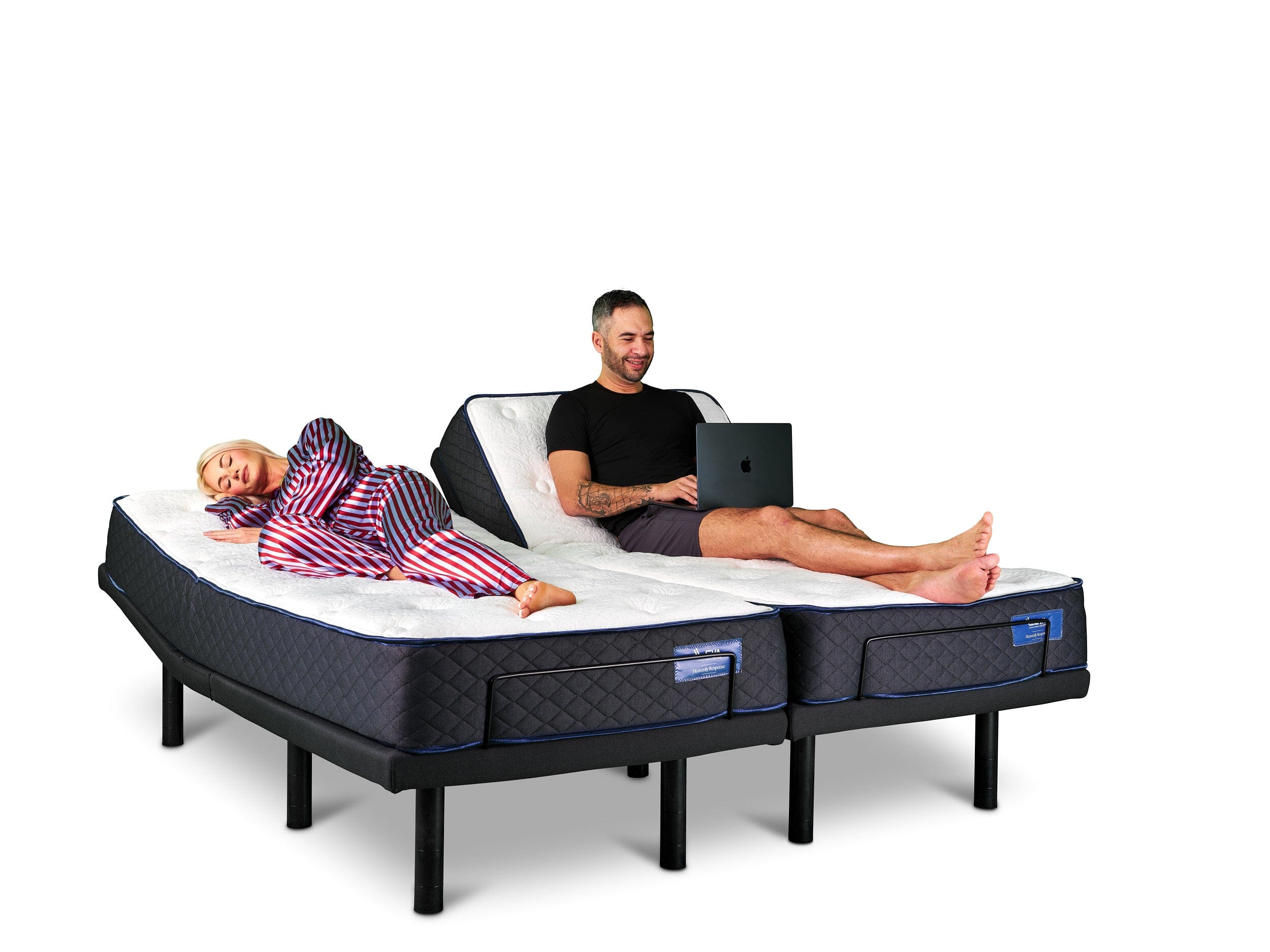
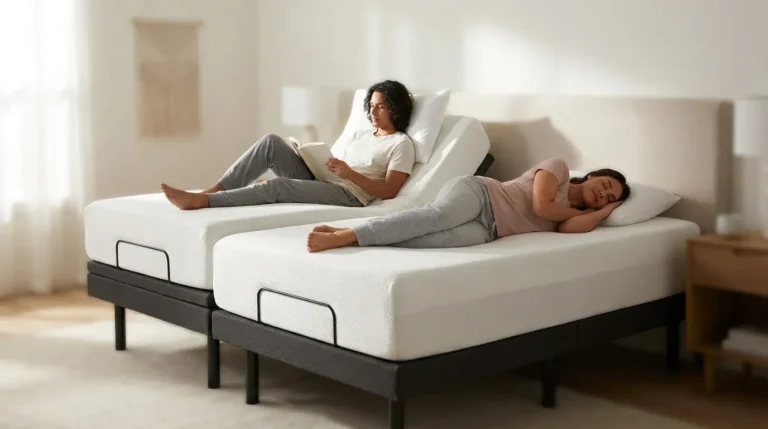
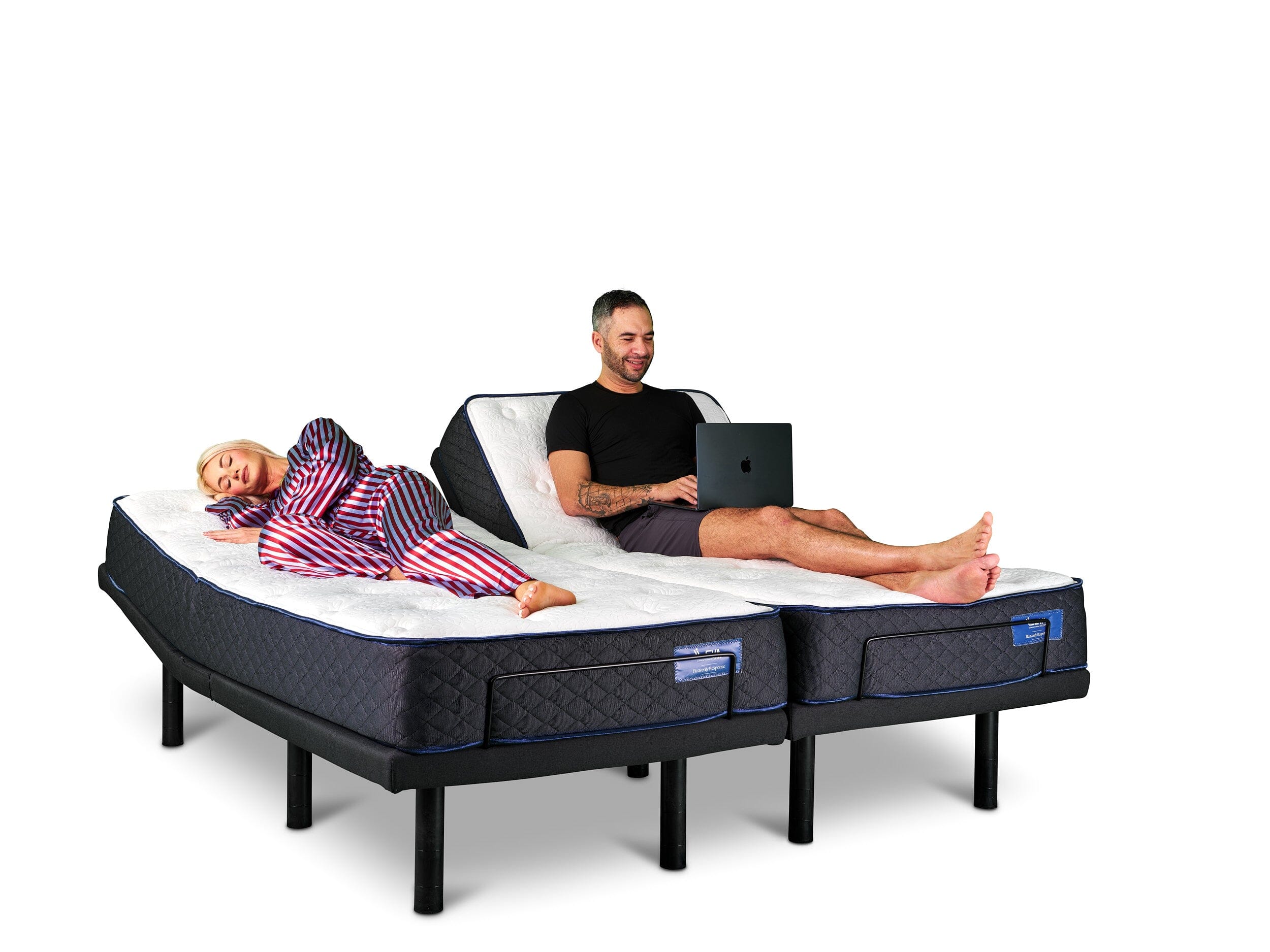
A split queen uses two 30-inch-wide adjustable bases placed side by side inside a shared queen frame. Each base moves on its own, with the head section rising from flat to roughly 60 to 70 degrees and the foot section lifting separately to ease pressure on the lower back and legs. Most systems use a wireless remote, a smartphone app, or both for control. The two mattresses sit on their own bases and move with them, so one partner can stay flat while the other reads at a comfortable incline.
Split Queen vs Split King for Canadian Homes
The split king is the format most often advertised in Canada and pairs two twin XL mattresses for a wider overall footprint. A split queen keeps the standard 60-inch queen width while still dividing the surface into two independent sides. For couples in Ontario or Alberta condos, older homes with tight doorways, or bedrooms where a king simply will not fit, the split queen delivers independent control in a more space-conscious size. The trade-off is a narrower personal lane, which can feel tight for partners who spread out or move a lot at night.
From a cost standpoint, split queen packages usually price below split king packages because the mattresses and bases are smaller. That difference matters in Canada, where luxury adjustable systems often carry steep premiums.
How a Split Queen Adjustable Bed Operates Night to Night
Each base uses one or more motors, and quality systems rely on whisper-quiet motors that run below conversational noise levels so adjustments do not wake a sleeping partner. Higher-end models add lumbar support zones, pillow tilt for fine neck positioning, and vibration massage. App-controlled systems let partners save custom positions, set vibrating wake alarms, and, in systems like Leva Sleep’s upcoming anti-snore mode, trigger automatic micro-adjustments when snoring starts.
Mattress compatibility plays a central role. Standard innerspring mattresses usually lack the flexibility to bend repeatedly without damage. Compatible designs use all-foam construction or individually wrapped pocket coils with flexible foam comfort layers. Mattress thickness between 10 and 14 inches tends to work well. Very thick or rigid mattresses resist bending and reduce how far the head and foot can elevate.
Real-World Use Cases for Different Sleep Needs
-
Snoring: Elevating the head by 7 to 15 degrees shifts the jaw and tongue forward, which reduces airway restriction. One partner can raise their side while the other stays flat.
-
Firmness differences: Each side uses its own mattress, so one partner can choose a firm foam while the other selects a softer hybrid.
-
Temperature regulation: Per-side heating and cooling pads help when one partner sleeps hot and the other sleeps cold.
-
Sleep apnea: Head elevation is a recognized positional strategy for mild to moderate obstructive sleep apnea. An adjustable base keeps that angle consistent without relying on stacked pillows.
-
Hip and knee pain: Raising the foot section reduces pressure on hip joints and lets the knees rest in a slightly bent position, which many orthopaedic patients find more comfortable.
-
Acid reflux: Sleeping with the upper body elevated reduces nocturnal reflux episodes by using gravity to keep stomach acid below the oesophageal sphincter.
Full Split vs Head-Only Split: Choosing Your Configuration
|
Feature |
Full Split (independent head + foot per side) |
Head-Only Split (independent head, shared foot) |
|---|---|---|
|
Independent head elevation |
Yes, each side fully independent |
Yes, each side independent |
|
Independent foot elevation |
Yes, each side fully independent |
No, foot moves together for both partners |
|
Centre gap when elevated |
Gap forms at both head and foot sections |
Gap forms only at head section |
|
Mattress requirement |
Two separate flexible mattresses required |
One mattress with a split head zone, or two mattresses |
Couples where only one partner needs head elevation for snoring or reflux often start with a head-only split, which keeps costs and complexity slightly lower. Couples with different needs at both head and foot, such as one partner elevating the foot for hip pain while the other keeps it flat, usually gain more long-term value from a full split.
Typical Split Queen Problems and Simple Fixes
Sheet fit: Standard fitted sheets are cut for flat mattresses and tend to pop off at the corners when the base moves. Deep-pocket sheets with reinforced elastic, designed for adjustable bases, keep a secure fit.
Centre gap: When both sides sit at different angles, a gap opens between the mattresses. Foam wedge gap fillers close this space for couples who move toward the centre during the night.
Delivery and setup complexity: Split queen systems include two bases, two mattresses, a shared frame, and several cables. White-glove delivery services handle assembly, cable management, height adjustment, and cleanup. Self-assembly is possible but time-consuming and usually requires two people.
Motor noise: Entry-level bases can produce noticeable motor noise during movement. Quality systems with German-engineered motors run quietly enough that overnight adjustments rarely disturb a sleeping partner.
How Well Split Beds Work for Couples
For couples with truly different sleep needs, a split adjustable bed offers a direct structural answer. It removes the need to negotiate a single position or firmness, which often causes ongoing compromise in shared beds. The main questions involve comfort with the 30-inch individual width of a split queen and whether the household budget supports the higher upfront cost compared with a flat mattress.
Couples who share similar sleep preferences and mainly want a larger, more comfortable surface usually do better with a non-split adjustable base or a traditional mattress upgrade. The split layout adds value specifically when preferences diverge.
Key Buying Checks Before You Order
-
Mattress engineering: Confirm that each mattress is rated for adjustable base use. All-foam and pocket-coil hybrids with flexible foam layers are the standard compatible designs.
-
Specialized bedding: Plan for deep-pocket fitted sheets, a split-compatible duvet with clips or separate duvets per side, and a mattress protector rated for adjustable use.
-
Remote and app access: Review whether the system offers app control, saved positions, and support for both iOS and Android so each partner can adjust easily.
-
Bedroom dimensions: Measure doorway widths and stairwell clearances before ordering. Split queen bases ship in sections but still need enough access space.
-
Warranty and support: Check motor warranty length, with five years as a reasonable minimum, and confirm whether the retailer provides in-home service or requires shipping components.
2026 CAD Pricing Snapshot for Split Queen Packages
In Canada, split queen adjustable bed packages that include the base, mattresses, and basic accessories span a wide price range. At the premium end, Tempur-Pedic queen adjustable mattress and base bundles are typically priced between $3,000 and $5,100 CAD. Mid-market adjustable bases at Sleep Country usually range from about $1,200 to $4,000 CAD, although adjustable-base expertise and model selection at those outlets remain limited. Ghostbed’s adjustable options appear mainly through wholesale channels such as Costco, with pricing that shifts by promotion and a single-model lineup with fewer configuration choices.
Leva Sleep’s direct-to-consumer model, which keeps design and assembly local and avoids retail markup, positions its split queen packages roughly 30 to 50 percent below comparable luxury competitors. That pricing advantage comes from controlling design, assembly, and delivery in-house and removing intermediary margins. Leva’s anti-snore mode, app control, quiet motors, and white-glove delivery sit within that more accessible price band as included features or add-ons.
When comparing offers, look at total system cost, including base, mattresses, bedding, and delivery, rather than base price alone. Many Canadian retailers treat white-glove delivery as a paid extra that typically adds $100 to $250 CAD for mattresses and adjustable beds. Leva Sleep provides white-glove delivery as an in-house service with old-bed removal included, which affects the real final price.
Setup and Ownership in Ontario and Alberta
Leva Sleep currently delivers to Ontario and Alberta, which are the provinces served by its in-house white-glove team. Delivery timelines vary by region and season, and customers in major centres such as Toronto, Ottawa, Calgary, and Edmonton usually receive faster scheduling than those in smaller communities. The white-glove service covers delivery to the bedroom, full assembly of both bases and the shared frame, cable management, leg height adjustment, a product walkthrough for app setup and position programming, and removal of the old bed for donation or recycling.
Customers outside Ontario and Alberta should confirm delivery options directly before purchasing, since white-glove availability and scope can differ by location.
Common Split Queen Buying Mistakes
-
Using standard bedding: The most frequent complaint after purchase involves fitted sheets that come loose. Buying adjustable-rated deep-pocket sheets at the same time as the bed prevents this problem.
-
Ignoring configuration choice: Choosing a head-only split when one partner also needs foot elevation for hip or knee pain limits what the system can do. Clarify both partners’ needs before deciding between full split and head-only split.
-
Overlooking accessory needs: A split queen without a gap filler, duvet clips, and remote pockets feels less seamless in daily use. These accessories cost little compared with the base system yet noticeably improve the experience.
-
Evaluating base price only: A lower base price that excludes compatible mattresses, delivery, and setup can end up costing more than a bundle that includes all components.
Frequently Asked Questions
Can a split queen adjustable bed use a single fitted sheet?
Standard fitted sheets are not designed for split adjustable bases and usually pull off at the corners when the base moves. Deep-pocket fitted sheets with reinforced elastic, engineered for adjustable bases, are required. Some couples prefer two separate sets of twin-equivalent sheets, one per side, for maximum flexibility.
Is a split queen the same width as a regular queen?
Yes. A split queen measures 60 inches wide in total, identical to a standard queen. The difference is that the 60 inches are divided into two 30-inch independent bases rather than one continuous surface. This layout fits any room or frame built for a queen-sized bed.
How loud are the motors on a quality split queen adjustable base?
Quality adjustable bases use motors designed to run below conversational noise levels, often described as whisper-quiet. Entry-level or older bases can sound noticeably louder. When you evaluate a system, ask about motor noise ratings or request a live demonstration.
Do both partners need to adjust their side at the same time?
No. Each side operates independently. One partner can change head elevation, turn on massage, or shift position at any time without affecting the other side. This independence is the core functional benefit of a split setup.
What happens to the gap between the two mattresses when both sides are elevated?
A gap appears between the mattresses as each side moves to its own angle. The size of that gap depends on how high each side sits. Foam wedge gap fillers, sold as accessories, fit between the mattresses and close the space for couples who move toward the centre of the bed.
Conclusion: When a Split Queen Makes Sense
A split queen adjustable bed offers a practical, space-efficient answer for Canadian couples whose sleep needs differ. Clear understanding of full-split versus head-only split layouts, bedding requirements, and true total system cost helps buyers choose confidently without overpaying or selecting the wrong configuration. For couples in Ontario and Alberta, Leva Sleep’s specialist focus, 15 to 20 model selection, in-house white-glove delivery, and 30 to 50 percent pricing advantage over many luxury competitors make it a logical first stop when comparing options.