
Written by: Matthew Timmins, Founder and Managing Director, Leva Sleep | Last updated: July 24, 2026
Key Takeaways for Split Queen Adjustable Beds
- A split queen adjustable system fits a standard 60 × 80-inch queen footprint and gives each partner independent head and foot elevation without needing a larger bedroom.
- Unlike split-top queens or dual-firmness mattresses, a true split queen base lets each sleeper adjust their side separately for snoring, acid reflux, or circulation support.
- Buyers should plan for specialty bedding such as split fitted sheets, connector straps, or deep-pocket sheets to prevent seam gaps and sheet slippage.
- Older Ontario and Alberta homes often lack space for a split king, so the narrower split queen becomes the practical choice for couples who want independent adjustability.
- Leva Sleep focuses on split queen adjustable systems with whisper-quiet motors, anti-snore technology, and white-glove delivery in Ontario and Alberta. Browse Leva Sleep’s split queen packages to match your room size, comfort needs, and budget.
How a Split Queen Mattress Works for Two Sleepers
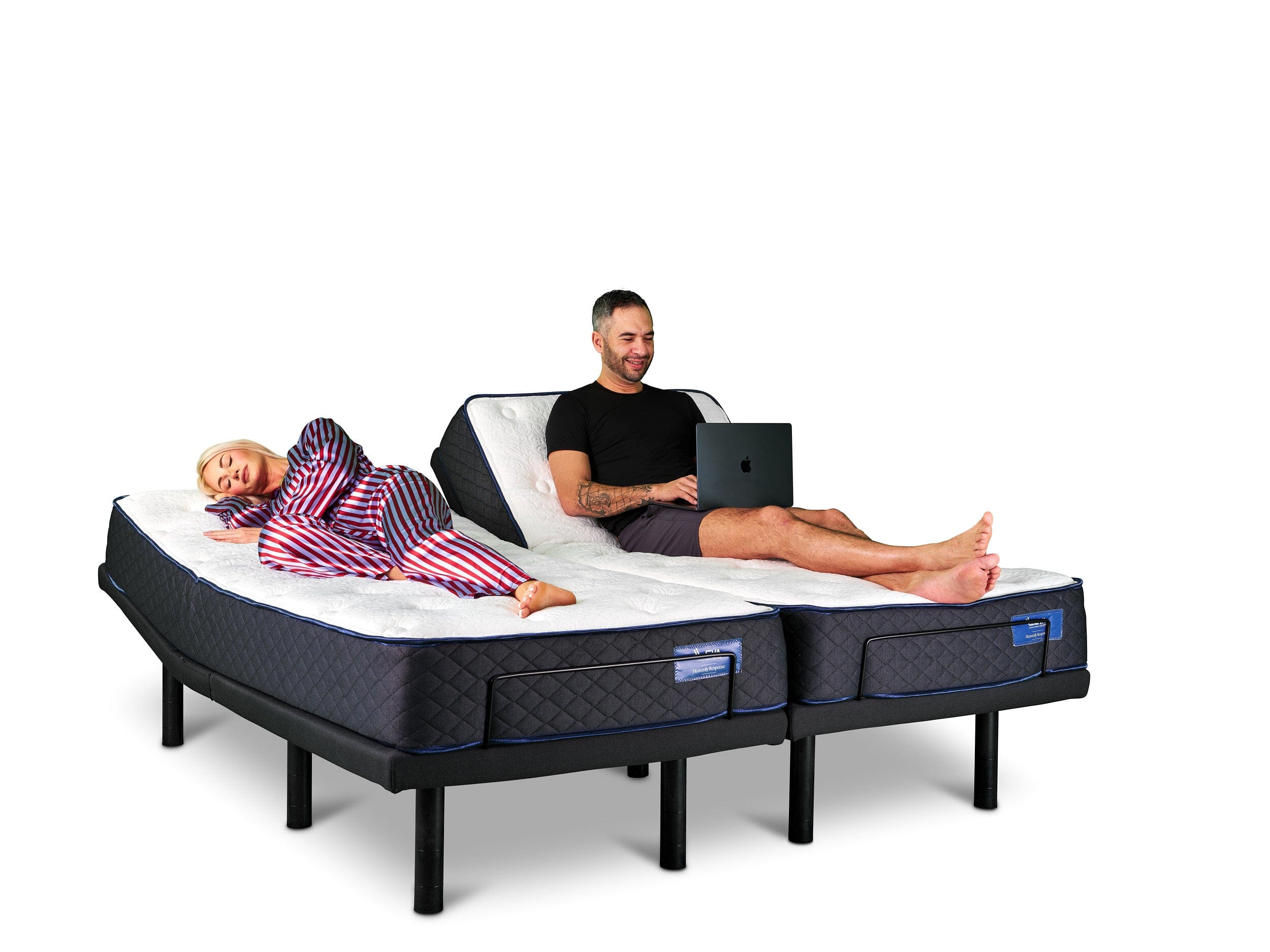
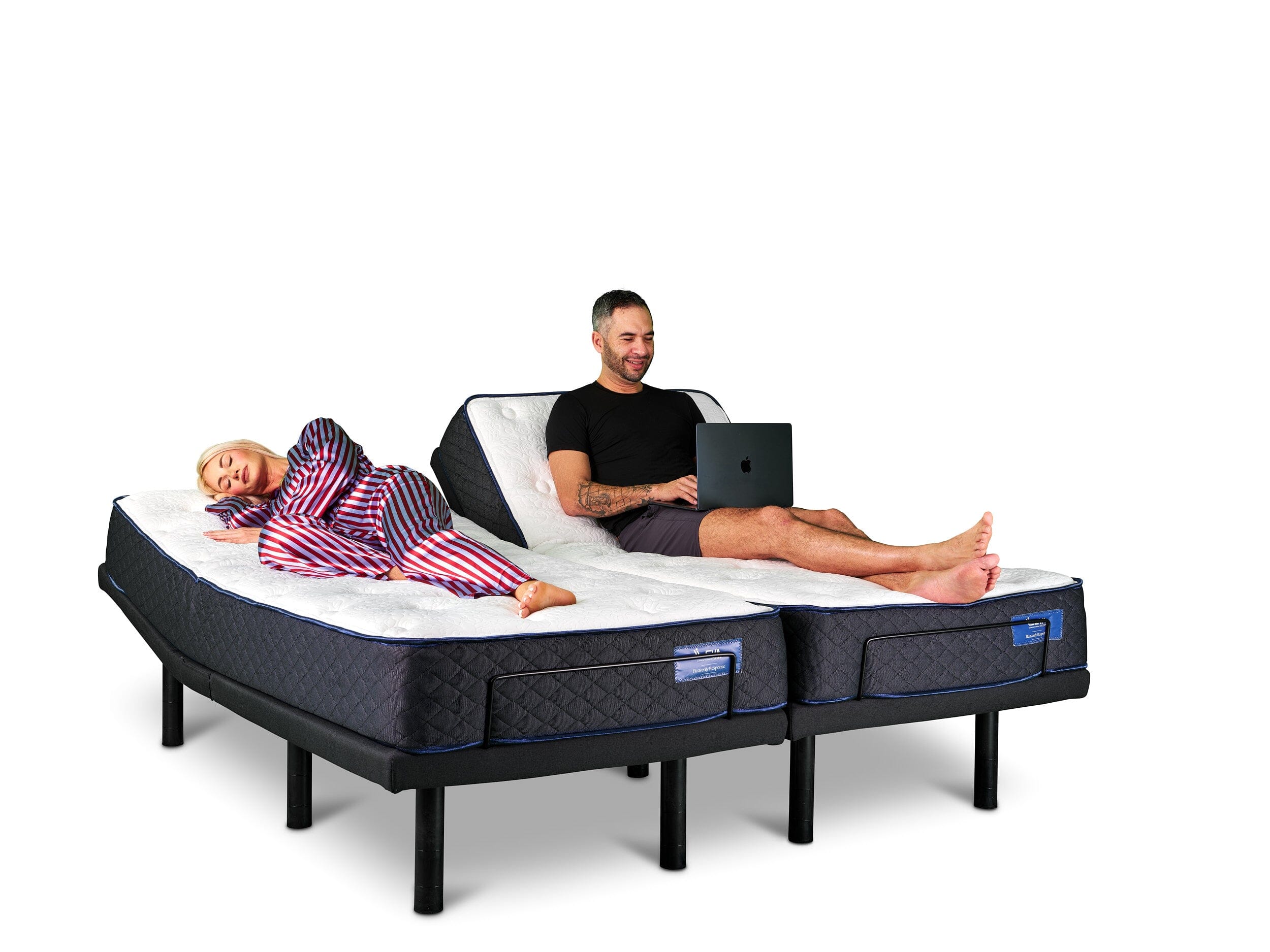
A split queen mattress consists of two independent 30-inch by 80-inch halves that together form a standard 60-inch by 80-inch queen footprint. Each partner can choose a different firmness level or operate an adjustable base independently without affecting the other side.
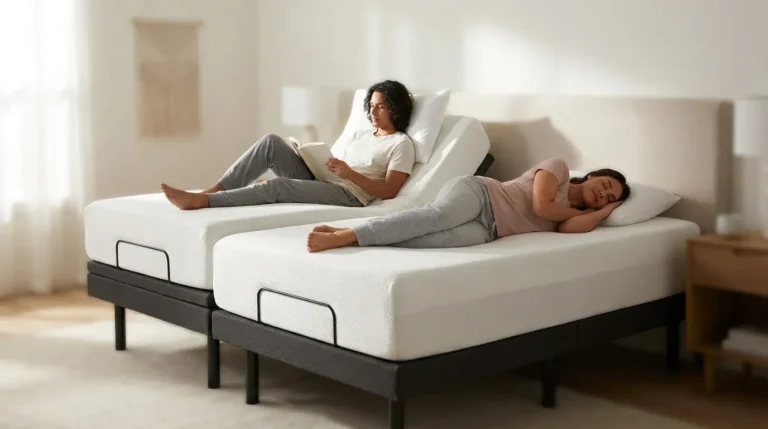
This configuration differs from a split-top queen, where only the upper portion of a single mattress is divided. It also differs from a unified queen with dual-firmness zones, which offers no independent elevation. On a true split adjustable base, each sleeper can elevate their side for reading, acid reflux relief, sleep apnea management, snoring reduction, or leg elevation to improve circulation.
Compatible mattresses are foam or hybrid pocket-coil models. Traditional innerspring mattresses with connected coils are generally incompatible because they resist bending at the hinge points of an adjustable base.
Split Queen, Split-Top Queen, and Split King Compared
| Configuration | Footprint | Independent Elevation | Fits Older Ontario Bedrooms | Standard Bedding Compatible |
|---|---|---|---|---|
| Split Queen | 60 × 80 in (two 30 × 80 in halves) | Full independent head and foot per side | Yes, matches standard queen clearance | Standard queen sheets do not reliably fit a true split queen mattress, so separate or split-design fitted sheets are required. Deep pockets are needed only if mattress height exceeds the sheet’s pocket depth. |
| Split-Top Queen | 60 × 80 in | Head section only, foot is unified | Yes | Standard queen sheets generally fit |
| Split King | 76 × 80 in (two 38 × 80 in Twin XL halves) | Full independent head and foot per side | Requires about 16 in more width, often impractical | Requires king-size sheets, with two Twin XL fitted sheets recommended |
Drawbacks to Weigh Before Choosing a Split Queen
A split queen system offers strong benefits, but buyers should understand the trade-offs before committing.
- Sheet slippage and seam gap: The seam between the two halves creates a noticeable gap that allows sheets to slip between the halves during sleep. Practical solutions include a mattress connector strap, two separate 30-by-80-inch fitted sheets with a shared flat sheet or duvet on top, or specialty split-queen fitted sheets.
- Seam awareness: Sleepers who gravitate toward the centre may notice the seam, though for most it is only faintly perceptible and rarely disruptive. Placing a mattress topper over both halves reduces how noticeable the seam feels.
- Higher cost per square inch: Split queen mattresses are generally more expensive than a standard queen because buyers are purchasing two complete separate mattresses rather than one.
- Limited retail availability in Canada: Split queen mattresses are less commonly stocked at Canadian chain retailers than standard sizes, so specialist retailers become the most reliable source.
- Frame support requirements: Standard metal rail frames with a centre support bar may allow the two halves to shift if the bar is not positioned to support both inner edges.
- Long-term seam durability: Lower-quality or very thin budget options may develop soft spots near the seam faster than one-piece queens.
Who Makes Split Queen Adjustable Beds?
True split queen adjustable bases exist and sit at the core of Leva Sleep’s product range. Each half of the base operates independently, with separate motors controlling head elevation, foot elevation, lumbar support, and pillow tilt per side.
Technology in this category has advanced quickly. Customatic’s SnoreSense™ technology automatically detects snoring and adjusts the bed in real time to reduce noise-related sleep disruption. Ergomotion’s 20th Anniversary model offers head and foot articulation, head tilt, powered lumbar support, zero-clearance design, and a Zero-G® preset position. Leva Sleep’s own anti-snore mode detects snoring and makes micro-adjustments to the head of the bed without waking either partner.
These advanced features depend on one critical component, the motor. Whisper-quiet German motors are a key differentiator in quality split queen bases. Noisy or jerky motors are a documented pain point with entry-level adjustable beds and can defeat the purpose of independent adjustment if the movement wakes the other partner.
Nisco’s RippleFlex five-zone adjustable base uses independently controlled zones to elevate the head and neck, upper back, lumbar region, thighs, and calves in a wave-like motion. This example shows how quickly zone-specific control is evolving across the category.
Decision Guide for Choosing a Split Queen System
Use the following criteria in sequence to narrow down the right configuration for your bedroom and sleep needs.
- Room dimensions first: Measure the bedroom. If a 76-inch-wide king footprint fits comfortably with adequate clearance on both sides, a split king is viable. If that width feels tight, a split queen is the practical choice.
- Elevation vs. firmness priority: If both partners need independent head and foot elevation for snoring, acid reflux, sleep apnea, or post-surgery recovery, a full split adjustable base is required, not a split-top or dual-firmness queen.
- Motion isolation needs: If one partner’s movements frequently wake the other, independent sleep surfaces with pocket coil systems can reduce motion transfer between the two halves.
- Temperature regulation: Temperature disagreement affects 75% of American couples. Consider whether the base system integrates a per-side heating and cooling pad.
- Anti-snore technology: Seventy-five percent of people with snoring partners report that it impacts their sleep quality. Confirm whether the base includes automatic snore detection and head adjustment or whether that feature appears only on higher-tier models.
- App and remote control: Check Bluetooth connectivity, programmable memory positions, and whether the app supports per-side control from a single device.
Canadian Factors: Room Size, Delivery, and Retail Gaps
Older Ontario homes, especially semi-detached and detached houses built before 1980, often have master bedrooms sized for a double or queen. These rooms leave limited clearance for a king footprint. A split queen system fits within the standard 60-inch queen width, so couples gain independent adjustability without removing furniture or reconfiguring the room.
Retail availability in Canada remains limited. Sleep Country Canada and general furniture retailers treat adjustable bases as add-on products, with narrow model selection and staff who are generalists rather than adjustable-bed specialists. Costco carries select adjustable base brands, but stock is inconsistent and configuration options are narrow. Cross-border purchasing from U.S. retailers adds duty, currency conversion, and warranty complications that erase most apparent price savings.
The two lighter, narrower halves of a split queen mattress make delivery and setup easier through narrow stairwells, tight apartment doorways, or RV entryways compared to a single one-piece queen mattress. The narrower halves simplify navigation of tight spaces during delivery and setup.
Leva Sleep’s in-house white-glove delivery service in Ontario and Alberta includes bedroom delivery, full assembly, leg height adjustment, a product tutorial, and old bed removal. This service removes the assembly burden that comes with most online mattress purchases and ensures the split base is correctly configured from the first night.
How to Judge Sheets, Duvet Clips, and Anti-Snore Features
Buyers can avoid frustration by checking bedding compatibility and snore-control features before ordering a split queen system.
- Fitted sheet depth: Mattress profiles of 12 inches or thicker require deep-pocket sheets to stay secure. Confirm pocket depth before purchasing standard queen sheets.
- Elastic coverage: Sheets designed for adjustable bases use extended elastic around the full perimeter rather than only at the corners. This design keeps the sheet in place when the head or foot section elevates.
- Connector straps: A mattress connector strap pulls the two halves together and reduces the centre gap. Check strap width and the tensioning mechanism for long-term durability.
- Duvet clips: When partners elevate to different angles, a shared duvet can bunch or slide. Duvet clips attach the cover to each mattress half independently and maintain coverage at different elevations.
- Anti-snore detection method: Check whether the system uses a microphone, vibration sensor, or biosignal monitoring to detect snoring. Confirm the adjustment response, since head elevation can open the airway during sleep. Adjustable beds can help manage snoring through gentle head elevation, which opens the airway during sleep.
- Per-side independence: Confirm that anti-snore adjustments apply only to the snoring partner’s side and do not alter the other partner’s position.
Frequently Asked Questions
Will standard queen sheets fit a split queen mattress?
A standard 60-by-80-inch queen fitted sheet covers the combined footprint of a split queen, but the centre seam creates a gap where the sheet can slip between the two halves during sleep. The most reliable setup uses two separate 30-by-80-inch fitted sheets, one on each half, with a shared flat sheet or duvet on top. Specialty split-queen fitted sheets and mattress connector straps are also available and reduce the gap. For mattresses thicker than 12 inches, buyers should choose deep-pocket sheets regardless of configuration.
Is a split queen adjustable bed available in Canada, and how does delivery work?
True split queen adjustable bases are not widely stocked at Canadian chain retailers such as Sleep Country or Costco, so specialist retailers remain the primary source. Leva Sleep offers split queen adjustable systems with delivery to Ontario and Alberta through an in-house white-glove service that includes bedroom setup, assembly, leg height adjustment, a product tutorial, and old bed removal. This support creates a clear advantage over online-only retailers that ship components to the door without setup help.
What is the difference between a split queen and a split king, and which is better for a smaller bedroom?
A split queen consists of two 30-by-80-inch halves forming a 60-by-80-inch footprint, which matches a standard queen. A split king consists of two Twin XL halves forming a 76-by-80-inch footprint, which matches a standard king. The 16-inch width difference matters in older Ontario and Alberta homes where master bedrooms were designed around double or queen beds. Both configurations offer full independent head and foot elevation per side. The split queen suits smaller rooms or narrow doorways where a king footprint feels impractical.
How long do split queen adjustable bases typically last, and what warranty should I expect?
Quality split queen adjustable bases with well-engineered motors and frames are built for long-term use. When evaluating a purchase, look for a minimum 10-year frame warranty and at least a 3-year motor warranty. Confirm whether the warranty is handled directly by the manufacturer or through a third-party service provider, because this affects claim response times. Leva Sleep backs its systems with manufacturer warranties and provides direct customer support rather than routing claims through a retail intermediary.
Can a split queen adjustable bed help with sleep apnea or snoring without a CPAP machine?
Head elevation on an adjustable base opens the airway by repositioning the soft tissue at the back of the throat. This change can reduce the frequency and intensity of snoring and mild obstructive sleep apnea episodes. An adjustable base does not replace medically prescribed CPAP therapy in moderate-to-severe cases, but it complements treatment and, for mild cases, may reduce reliance on a mask. As mentioned earlier, Leva Sleep’s anti-snore mode uses automatic detection to adjust head elevation in real time, which can support CPAP therapy or, in mild cases, lessen mask dependence. Sleep apnea clinics in Canada have referred patients to Leva Sleep as part of a broader sleep management approach.
Split Queen Adjustable Bed Checklist for Canadian Couples
Couples in Canada can use this checklist when comparing split queen adjustable systems before purchasing.
- Adjustability range: Confirm independent head and foot elevation per side, lumbar control, and pillow tilt availability on the model you are considering.
- Motor noise level: Whisper-quiet motors, measured at a volume similar to a library, are essential for adjustments that do not wake the other partner.
- Anti-snore technology: Verify automatic detection and per-side adjustment capability, not just a manual preset.
- Temperature regulation: Confirm whether a per-side heating and cooling pad is included or available as an add-on.
- Bedding ecosystem: Check whether the retailer offers fitted sheets with full-perimeter elastic, duvet clips, and mattress connector straps designed for adjustable bases.
- Delivery and setup: Confirm white-glove delivery to the bedroom, full assembly, and old bed removal, not curbside drop-off.
- Total Canadian price after tax: Compare landed cost including delivery, setup, and applicable taxes. Factor in the 30–50% value advantage that direct-to-consumer specialists often provide versus traditional retail.
- Model selection: A specialist retailer with a broad range of adjustable models offers meaningful choice across price points and feature sets, while a general retailer with only a few models offers limited flexibility.
- Trial period and warranty: Confirm the in-home trial length, return process, frame warranty duration, and motor warranty coverage before purchasing.
Partners lose at least one hour of sleep per night due to snoring, which equals 365 hours annually. This chronic sleep loss affects individual health and creates friction between partners, because many couples report that disruptive nighttime habits strain their relationship. A split queen adjustable system directly addresses these root causes, including snoring, differing firmness preferences, temperature conflict, and elevation needs, while keeping the footprint most Canadian couples already have.