Written by: Matthew Timmins, Founder and Managing Director, Leva Sleep
Key Takeaways
-
The ideal mattress for an adjustable base is 10–14 inches thick with no rigid perimeter border, which supports smooth hinging and motor performance.
-
Memory foam and pocket-coil hybrid mattresses both flex reliably on adjustable frames when they meet the thickness and border-free requirements.
-
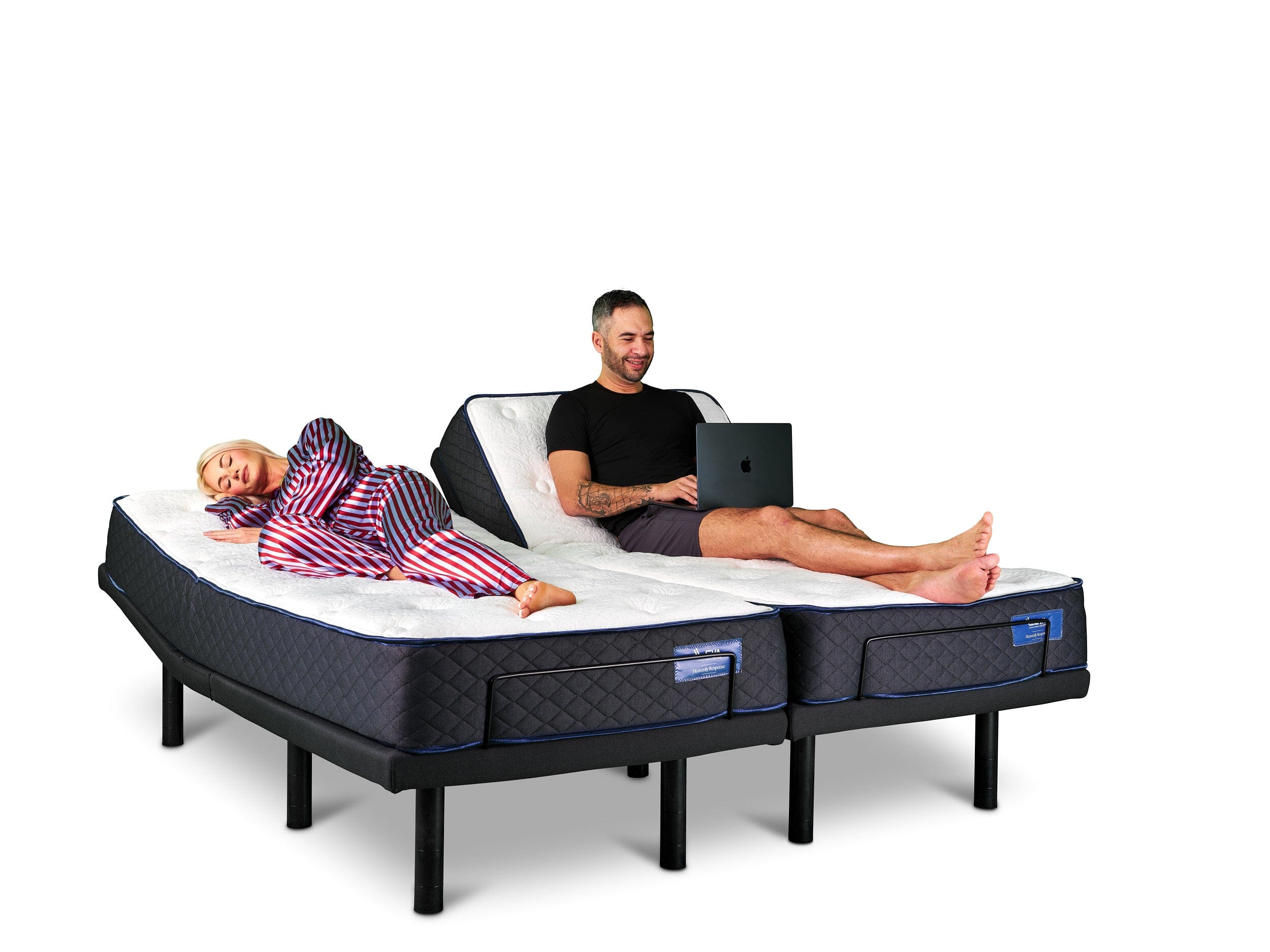
Split-king and split-queen systems let couples enjoy independent head and foot elevation while maintaining motion isolation and comfort.
-
Canadian-made options such as Leva Sleep provide comparable pressure relief and articulation at 30–50% lower cost than luxury brands like Tempur-Pedic.
-
Leva Sleep’s complete adjustable-bed packages help Canadian couples choose a split-king or split-queen system that fits their bedroom and sleep needs.
Why Canadian Couples Choose Adjustable Sleep Systems
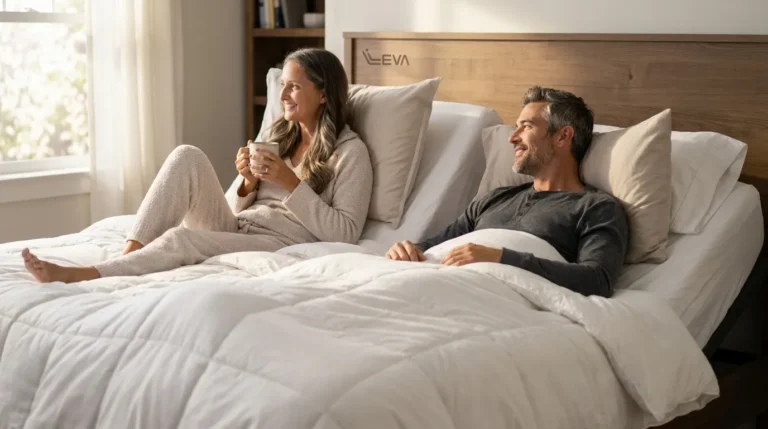
Snoring, hip and knee pain, acid reflux, and sleep-apnea diagnoses are driving more Canadian couples toward adjustable sleep systems. When one partner needs head elevation and the other prefers a flat surface, a traditional bed forces a compromise that often ends in separate rooms. Split-king and split-queen adjustable bases solve this by giving each side independent elevation and firmness control, so couples stay in the same bed without sacrificing comfort.
Demand for these systems grows as more people learn that positional therapy can reduce snoring and ease pressure on joints. The main challenge is pairing the right mattress with the base. Not every memory-foam-style mattress flexes reliably under repeated articulation, and the wrong combination can waste thousands of dollars. Understanding the key technical requirements helps you choose a mattress that will perform consistently on an adjustable frame.
Ideal Mattress Specs for Adjustable Bases
The optimal mattress for an adjustable base is 10–14 inches thick and has no rigid perimeter border. Mattresses in the 10–12 inch range offer excellent flexibility with minimal resistance at hinge points, while 12–14 inch profiles balance pressure-relief depth with smooth articulation. Hybrid options need individually pocketed coils, not Bonnell or interconnected coils, so the mattress can flex safely under repeated bending.
Tempur-Pedic-Style Mattresses on Adjustable Frames
Tempur-Pedic-style mattresses can work well on adjustable bases when they meet the right specifications. Memory foam mattresses without a rigid perimeter border are fully compatible with adjustable bases because the foam flexes easily at hinge points. High-density all-foam mattresses and pocket-coil hybrids both perform reliably, provided the hybrid contains 1,000 or more individually wrapped coils in a queen size, which creates a flexible grid instead of a rigid slab.
As of 2026, split-king and split-queen configurations are widely available. Each side of the bed uses a separate mattress on its own base, which eliminates motion transfer and allows independent articulation. Tempur-Pedic-style mattresses in these formats are sold by several Canadian retailers, although pricing and split-queen availability vary significantly.
Recommended Mattress Thickness for Adjustable Beds
Memory foam mattresses between 10 and 14 inches thick are recommended for adjustable frames, and 10–12 inch profiles offer excellent flexibility with minimal resistance at hinge points.
Mattresses thicker than 14 inches risk the motor-strain and bunching issues described earlier and should be tested on your specific base before purchase. Thicknesses over 14 inches can cause motor strain or hinder movement. A simple test helps confirm compatibility. Lay the mattress flat on the floor and bend it to a 45-degree angle. A suitable mattress bends smoothly and returns flat without a lasting crease.
Mattress Types That Work Best on Adjustable Bases
Memory foam mattresses achieve the highest compatibility with adjustable bases because millions of tiny cells respond to pressure and heat, allowing them to contour to the base and return to their original shape without rigid internal structures. They also provide strong pressure relief and lumbar support in zero-gravity or inclined positions by filling gaps in the lower back.
Hybrid mattresses combine memory foam comfort layers with individually pocketed coils that respond independently to pressure, improve edge support, promote airflow, and reduce motion transfer compared with many all-foam options. Hybrid mattresses with pocket coils have become a preferred choice over pure memory foam for adjustable bases in the Canadian market because they maintain hinge flexibility while offering more responsive support and better edge stability.
The choice depends on your priorities. All-foam suits sleepers who want maximum motion isolation and deep contouring. Hybrid suits sleepers who value edge support, airflow, and a more responsive feel.
Endy and Tempur-Pedic on Adjustable Bases
Endy:
-
Canadian-made, competitively priced all-foam construction that flexes well on adjustable bases, with a comfort layer designed for pressure-point relief.
-
Split-queen availability is limited through Endy’s direct channel. White-glove setup is not standard, and the brand does not specialize in adjustable-base pairing.
Tempur-Pedic:
-
Proprietary TEMPUR material is engineered for adjustable-base compatibility and is sold with Tempur-Pedic’s own adjustable bases. Pressure relief and motion isolation are well-documented strengths.
-
CAD pricing for a queen mattress plus adjustable base system usually runs significantly higher than Canadian-made alternatives. Split-queen configurations often require purchasing through specialty retailers with adjustable-base expertise.
GhostBed Luxe on Adjustable Bases
GhostBed Luxe:
-
The 13-inch profile sits within the recommended thickness range for adjustable bases, and the cooling gel and Ghost Ice fabric layers address heat retention, which is a common complaint with dense memory foam.
-
At 13 inches, the Luxe sits near the upper end of the optimal flex window. Profiles in this range provide a strong balance of pressure-relief depth and smooth articulation, although buyers should confirm hinge performance with their specific base model. GhostBed’s Canadian distribution through Costco focuses on volume rather than adjustable-base specialization.
Tempur-Pedic-Style Mattresses for Adjustable Frames: Comparison Table
|
Mattress |
CAD Price Range (Queen) |
Thickness |
Construction |
Split King/Queen Available |
Hinge-Flex Notes |
|---|---|---|---|---|---|
|
Tempur-ProAlign |
$2,499–$3,949 |
12 in |
All-foam (TEMPUR) |
Via specialty retailers |
Engineered for adjustable bases, no rigid border |
|
GhostBed Luxe |
approx. $2,500 |
13 in |
Hybrid (foam + coils) |
Limited in Canada |
Within optimal range, confirm coil type before purchase |
|
Endy Hybrid |
$1,095–$1,695 |
10 in |
Hybrid |
Not standard |
Good flex, not sold as adjustable-base specialist |
|
Restonic Revive Tiffany Rose |
from $2,979 |
13 in |
Hybrid (copper Talalay latex layers) |
Via adjustable-base retailers |
13-in profile flexes on adjustable bases, copper latex layers |
|
Silk & Snow Hybrid |
approx. $900 |
11.5–12 in |
Hybrid (pocket coils) |
Not standard |
Thinner profile offers strong flex, pocket coils confirmed |
Note: CAD prices are approximate retail ranges as of June 2026 and vary by retailer and promotions. Split-queen availability depends on the retailer’s adjustable-base expertise. Confirm current pricing directly with each brand.
Couples and Split-Base Choices
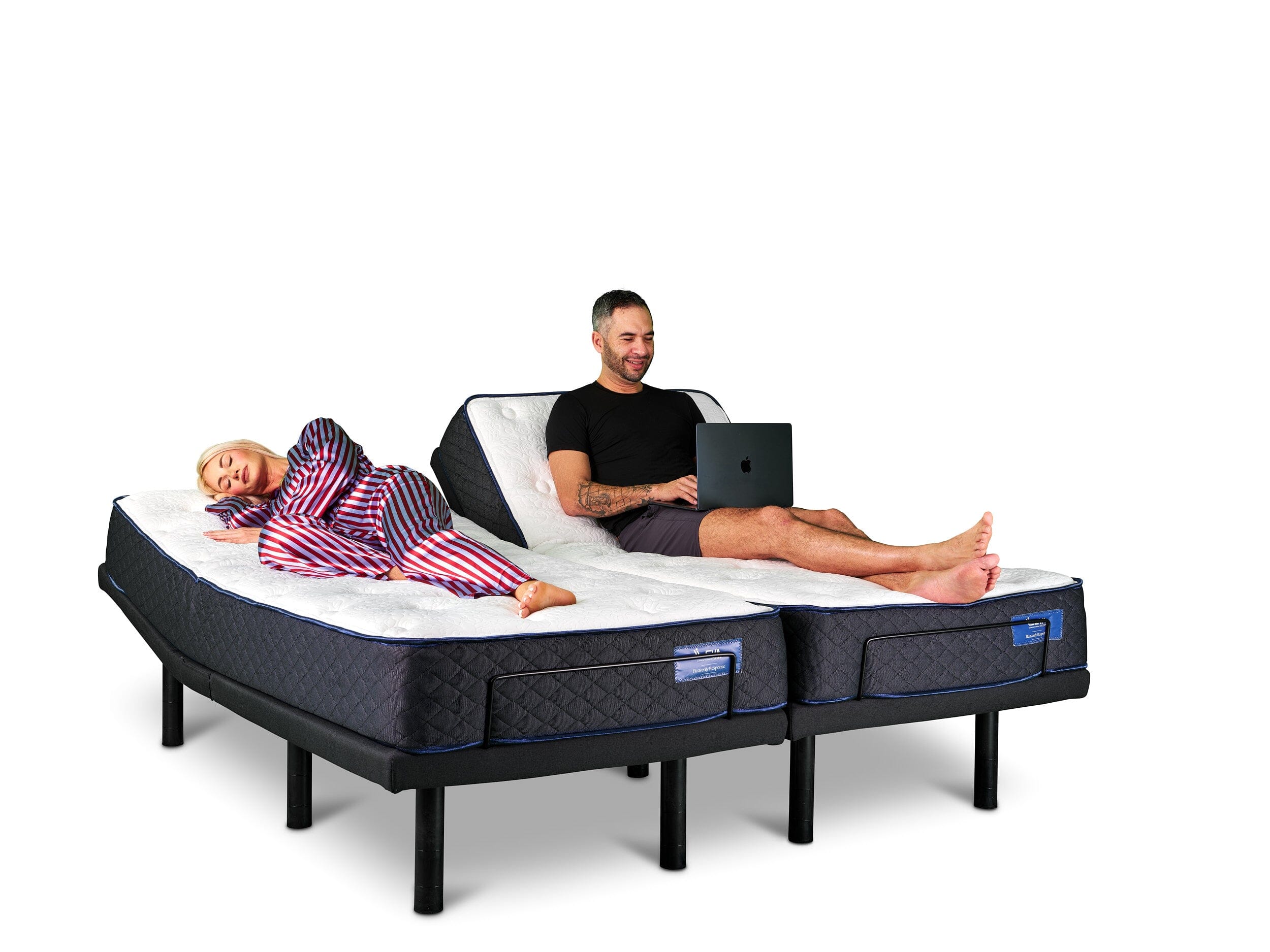
Split-king and split-queen systems place two separate mattresses on two independent bases, so each partner controls their own elevation, firmness, and massage settings. Split-king memory foam setups on dual adjustable bases maximize motion isolation and independent positioning for couples, allowing one partner to elevate for acid reflux or reading while the other remains flat without disturbance.
Split-queen is a less common configuration that delivers the same independent-control benefits in a smaller footprint, which helps in Ontario and Alberta bedrooms where a full split-king may not fit. Leva Sleep is one of the few Canadian specialists offering split-queen systems built to customer specifications, along with 15–20 adjustable base models compared with the 3–5 typically found at general mattress retailers.
Medical and Recovery Positions on Adjustable Bases
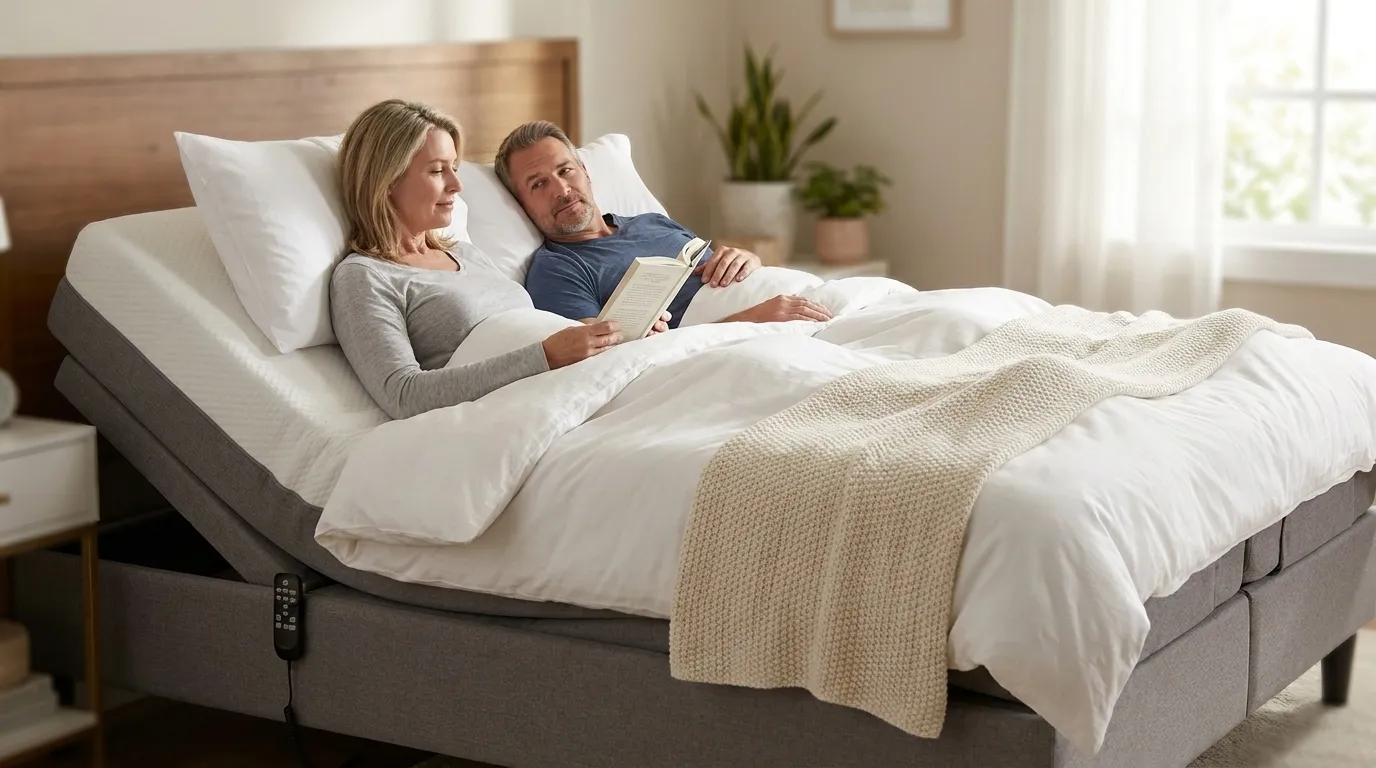
Head elevation between 30 and 45 degrees opens the airway and serves as a recognized positional intervention for mild obstructive sleep apnea and acid reflux. Post-surgical patients recovering from hip or knee procedures benefit from foot elevation, which reduces swelling and pressure on the joint. Adjustable bases allow these positions to be set precisely and changed during the night, which a flat bed or wedge pillow cannot match with the same consistency.
Sleep apnea clinics in Canada increasingly refer patients to adjustable-base specialists as a complement or alternative to CPAP therapy for mild cases. Independent elevation ensures the partner without a medical need can remain in a preferred flat or lower position.
Key Decision Framework for Mattress and Base Systems
A clear checklist helps you compare mattress-and-base systems without missing critical details.
-
Density: Start by confirming high-density foam in the comfort layers, because this supports shape retention and comfort under daily flexing.
-
Cover stretch: After checking density, look at the cover. The mattress cover needs to be knit or otherwise stretchable, since woven covers restrict articulation at hinge points and can wear out faster.
-
Edge support: With the core materials confirmed, consider edge performance. All-foam mattresses trade edge support for stronger motion isolation, while hybrids with pocket coils provide firmer edges that make entry and exit easier.
-
Warranty transferability: Review the warranty language and confirm that adjustable-base use is explicitly approved. Some warranties become void when the mattress is articulated.
-
Total system cost: Compare mattress, base, and delivery as a single CAD figure. A complete system that pairs a quality hybrid mattress with an adjustable base can start just above $2,000 CAD, while luxury brand systems can exceed $6,000 CAD. Leva Sleep’s vertically integrated model delivers the cost savings mentioned earlier while maintaining comparable pressure relief and independent positioning.
Mattress Care Checklist for Adjustable Frames
-
Sheets: Use fitted sheets with deep pockets of at least 18 inches and reinforced elastic, since standard sheets often pop off at the corners when the base moves. Leva Sleep designs its fitted sheets specifically for adjustable bases.
-
Mattress protector: A mattress protector guards against moisture damage and premature deterioration. Choose a stretchable, waterproof protector that moves with the mattress.
-
Rotation schedule: Rotate the mattress head-to-foot every 2–3 weeks during the first 90 days to precondition layers evenly, then at least once per month afterward. Do not flip one-sided mattresses.
-
Retainer bar check: Inspect the base’s retainer bar monthly to confirm the mattress has not shifted, since a shifted mattress strains the motor and creates uneven wear.
-
Duvet management: In split configurations, use separate duvets or duvet clips so the cover does not pull when one side elevates.
Conclusion: Matching Your Mattress to the Right Adjustable System
The right Tempur-Pedic style mattress for an adjustable base in Canada meets the core specs of 10–14 inches thick, no rigid border, and comes from a retailer with real adjustable-base expertise. Luxury brand names often carry a premium that reflects marketing spend more than a meaningful performance gap over well-specified Canadian-made alternatives.
For couples in Ontario and Alberta who manage snoring, joint pain, or different firmness needs, a split-queen or split-king system from a vertically integrated specialist delivers independent positioning, quiet motors, and white-glove setup at 30–50% less than comparable luxury brands.
Frequently Asked Questions
Can any memory foam mattress be used on an adjustable bed frame?
Not every memory foam mattress is suitable for an adjustable base. The key requirements are a thickness between 10 and 14 inches and the absence of a rigid perimeter border. Mattresses thicker than 14 inches may resist full articulation, strain the base motor, and develop temporary ridges at the hinge point. Before purchasing, perform a manual bend test by laying the mattress flat and folding it to a 45-degree angle. A compatible mattress bends smoothly and returns flat without a lasting crease. Always confirm with the manufacturer that the warranty covers adjustable-base use.
What is the difference between a split-king and a split-queen adjustable bed?
A split-king uses two twin XL mattresses placed side by side on two independent adjustable bases, which together match the width of a standard king. Each side has its own controls for elevation, massage, and firmness. A split-queen uses two narrower mattresses on two independent bases to match the width of a standard queen, which fits smaller bedrooms while still providing full independent control for each partner. Split-queen systems are less common in Canada, and Leva Sleep is one of the few specialists offering them built to customer specifications.
How does an adjustable bed help with snoring and sleep apnea?
Head elevation between 30 and 45 degrees changes the position of the airway and reduces the collapse of soft tissue at the back of the throat that causes snoring and contributes to obstructive sleep apnea. This positional approach is recognized as a non-invasive option for mild to moderate cases. Adjustable bases allow precise, repeatable elevation that a wedge pillow cannot match. Leva Sleep’s systems include an anti-snore mode that detects snoring and makes subtle micro-adjustments to the head position automatically. Sleep apnea clinics in Canada refer patients to adjustable-base specialists as a complement to, and in some mild cases an alternative to, CPAP therapy.
Why is Leva Sleep less expensive than Tempur-Pedic for a comparable adjustable system?
Leva Sleep designs, assembles, and delivers its systems in-house without passing retail markups through a chain of distributors and showroom partners. This vertically integrated, direct-to-consumer model removes intermediary costs that inflate the price of many luxury brand systems. The result is a 30–50% lower price point for a system that uses comparable foam densities, pocket-coil hybrids, and whisper-quiet motors. Leva also focuses exclusively on adjustable beds, offering 15–20 models versus the 3–5 found at general mattress retailers, so the product line is tuned for adjustable-base performance rather than adapted from a flat-bed catalogue.
What bedding accessories do I need for an adjustable bed?
Standard bedding is not designed for the movement of an adjustable base and often shifts, bunches, or pops off at the corners when the head or foot section elevates. You need fitted sheets with deep pockets of at least 18 inches and reinforced elastic around the full perimeter. A stretchable, waterproof mattress protector prevents moisture damage and moves with the mattress during articulation. In split configurations, separate duvets or duvets with clips prevent one partner’s cover from pulling when the other side elevates. Leva Sleep designs its full bedding range, including sheets, protectors, and duvets, specifically for adjustable bases, with features such as side remote pockets and extra elastic to maintain a secure fit through the night.