Visit One Of Our 6 Showrooms Located Across Canada!
No Payments, No Interest Until 2027
Free Delivery & In-Home Set Up
How to Choose Under Bed Lighting for Your Adjustable Bed
Content
Written by: Matthew Timmins, Founder and Managing Director, Leva Sleep | Last updated: July 18, 2026
Key Takeaways for Split Adjustable Bed Lighting
Split adjustable beds reduce sleep conflicts for couples but can create new light issues when one partner gets up at night.
Motion-sensor under-bed lighting activates only when needed and keeps overall nighttime light exposure low.
Warm white LEDs (2700–3000 K) or red/amber options suppress melatonin far less than cool white LEDs, so they work better for nighttime navigation.
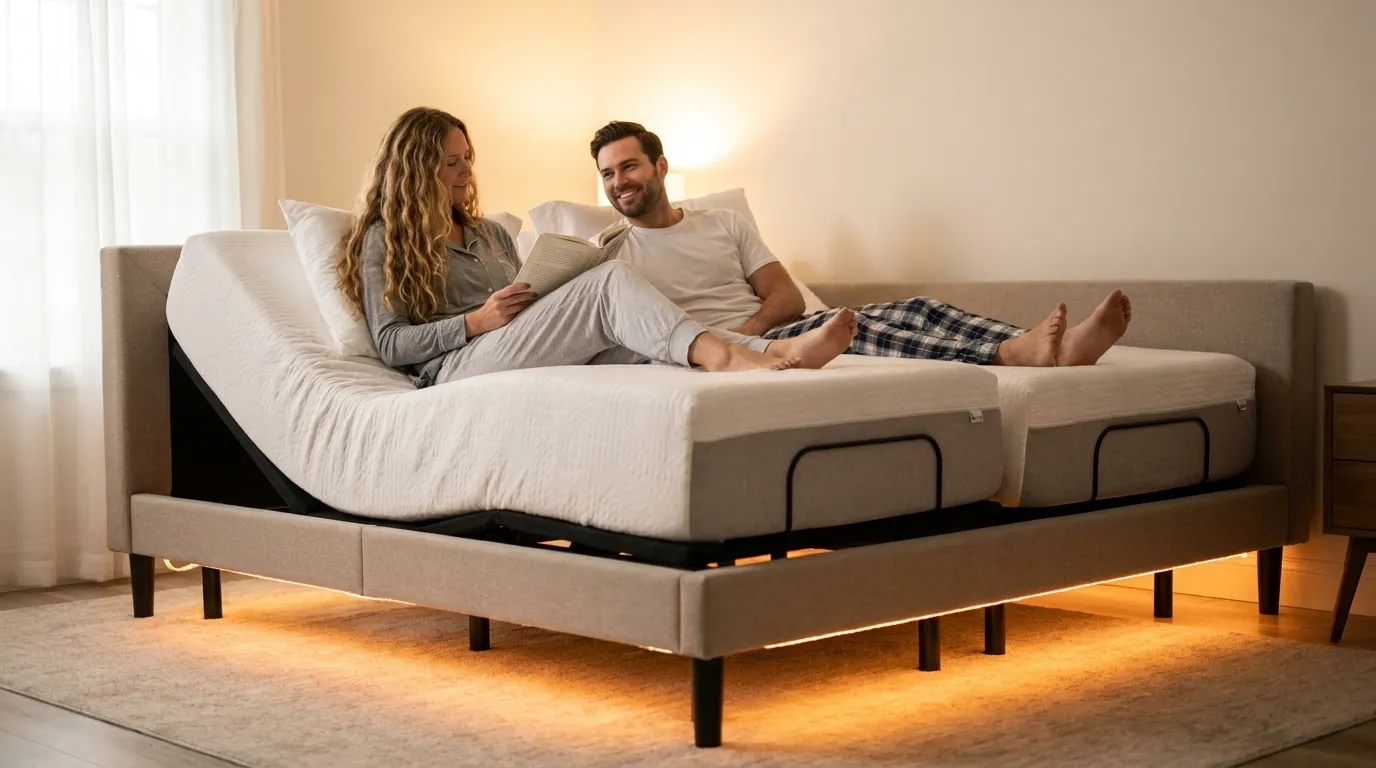
Mounting strips on the outer or bottom rail of each base half, with tidy cable routing, keeps lighting hidden even at full elevation.
Leva Sleep offers complete adjustable bed packages with integrated lighting and white-glove delivery, so you can shop Leva Sleep’s adjustable beds and build a complete sleep system.
Phase 1: Choose Motion-Sensor Lighting Instead of Always-On Strips
Motion-sensor under-bed lights turn on when they detect movement, usually when feet touch the floor, then shut off after 15 to 90 seconds of inactivity. Always-on strips stay lit all night. For couples sharing a split adjustable base, that difference strongly affects sleep quality.
Common mistake: Many people choose always-on LED strips that run the full length of the bed frame. When a split adjustable base elevates the head or foot section, strips mounted along the inner rail can become visible to the sleeping partner and stay in their line of sight all night. Motion-sensor strips that deactivate after use prevent this problem.
When you compare motion-sensor options, look for passive infrared (PIR) sensors with at least a 10-foot detection range and a 120-degree angle. Choose an auto-off timer of 30 seconds or less for bedroom use, and a sensitivity setting that detects a person standing but ignores minor mattress movement.
Phase 2: Pick a Sleep-Friendly LED Colour Temperature
Once you decide how the light will turn on, the next choice is colour temperature. Colour temperature, measured in Kelvin (K), determines how much short-wavelength blue light an LED emits. Warm white LEDs at 2700–3000 K generally emit less short-wavelength blue light than cool white LEDs, which reduces stimulation of melanopsin-containing ipRGCs and lowers melatonin suppression. When you compare LED options, look at colour temperature, light direction, and whether the strip can switch to a warm or red mode.
RGBWW LED strips with a dedicated warm white chip can reach colour temperatures below 2500 K, which makes them more sleep-compatible than RGBCW strips that cannot create true warm amber tones. If you already have an RGB strip installed, set it to warm white or red mode before bed and avoid cool white or blue settings at night.
Phase 3: Match Mounting Style and Power Source to Your Base
Power options include USB-powered strips, battery-powered strips, and hard-wired strips. USB-powered strips connect to a USB port on the base or a nearby adapter. Battery-powered strips need periodic recharging. Hard-wired options need an electrician but provide the most stable power. The right choice depends on your base’s available ports and your tolerance for maintenance. Battery-powered strips add recharging tasks, hard-wired setups remove that step but add installation work, and USB-powered strips balance convenience with reliability. For most Canadian couples, USB-powered strips that plug into the base’s built-in USB port create the cleanest installation with no visible cables.
Expert tip: Route any excess cable along the inner frame rail with adhesive cable clips, working from the power source toward the far end of the strip. Tuck the final connection point behind the leg bracket so it stays hidden when the base reaches full elevation.
Phase 4: Confirm Split Adjustable Base Compatibility
When you add aftermarket strips, confirm these points before you buy:
The strip length matches the usable rail length on each individual base half, not the combined bed width.
The strip mounts on the outer or bottom rail, not the inner rail that faces your partner.
The strip stays below the frame’s lowest visible edge when the head or foot section reaches full elevation.
Compatibility check: Raise the head section of your base to its maximum angle and note which frame surfaces become visible from your partner’s side. Any strip on those surfaces will sit in their direct line of sight during elevation. Mount strips on the underside of the lowest fixed rail only.
Phase 5: Weigh Canadian Pricing, Service, and Total Cost
Buying under-bed lighting separately from a base adds compatibility questions and extra shipping costs. For Canadian couples in Ontario and Alberta, purchasing the base and lighting as a single system removes that friction. Leva Sleep’s white-glove delivery service includes in-room setup, cable management, and a product tutorial, so the lighting is installed, tested, and adjusted to the correct height before the delivery team leaves.
When you compare pricing, look at the full cost of ownership. Include the strip, a compatible motion sensor module if it is not integrated, adhesive mounting hardware, and any cable management accessories. A strip that looks cheaper upfront but needs a separate sensor, separate power adapter, and professional cable routing can end up costing more than an integrated solution.
Leva Sleep’s direct-to-consumer model, with local assembly in the regions it serves, removes the retail markup that often inflates pricing at general furniture retailers.
Phase 6: Follow a Simple Installation and Cable Plan
Installation on a split adjustable base follows a consistent sequence across most strip brands. Review each step before you start:
Clean the mounting rail with isopropyl alcohol and let it dry completely. Adhesive bonds fail on oily or dusty surfaces, especially on powder-coated steel frames.
Measure the usable rail length on each base half and cut the strip to length at a designated cut point. Avoid cutting mid-segment.
Peel and press the strip firmly along the underside of the outer fixed rail, starting from the power-source end.
Route the power cable along the frame with adhesive cable clips spaced every 15–20 cm, keeping slack behind the leg bracket.
Connect the motion sensor module at the foot-of-bed end, with the sensor facing downward toward the floor where feet will land.
If the base supports app pairing, connect the strip controller to the same network as the Leva Sleep app so a head-elevation command can also trigger a gentle illumination sequence.
What a Successful Under-Bed Lighting Setup Delivers
A correctly configured under-bed lighting system delivers three clear outcomes. First, the person getting up can walk to the bathroom and back without touching a wall switch or phone screen. Second, the sleeping partner avoids light exposure above the melanopic threshold. Consensus guidelines for adults recommend limiting nighttime melanopic EDI to avoid circadian disruption, which you can reach with a dim warm-white or red strip aimed at the floor. Third, when the base returns to flat and the person settles back in, the strip has already deactivated. This behaviour reflects the brief-activation principle described in Phase 1 and returns the room to full darkness within about 30 seconds of the last movement.
Advanced Options for Smart Homes and Paired Accessories
Couples who already use smart-home devices can connect the under-bed strip controller to a smart plug with a dedicated sleep-mode schedule. This setup keeps the motion sensor active only between set hours, such as 10 p.m. and 6 a.m., which prevents daytime false triggers. Setting LED strips to warm mode on a timer removes the need to adjust colour temperature manually each night, and consistent behaviour matters more than perfect settings.
Under-bed heating pads often pair well with adjustable bases for couples who manage different temperature needs. When you use both accessories, route the heating pad cable and the LED strip cable on opposite sides of the frame. This approach prevents interference and keeps cable management clean. Confirm that the combined power draw of both accessories stays within the capacity of the base’s USB output or the wall outlet you use.
Frequently Asked Questions
Are motion-sensor under-bed lights compatible with split King bases?
Yes, motion-sensor under-bed lights work with split King bases when you treat each half as an independent unit. As explained in Phase 4, a split King uses two Twin XL bases side by side, each with its own motor, rail system, and elevation range. This layout means you need two separate LED strips, one per side, each with its own motion sensor at the foot of that side. Mount strips on the outer or bottom fixed rail of each half so they stay hidden when the head or foot section elevates. Verify the strip length against the rail on each base half, and check your base model number against the strip’s compatibility listing before you buy.
How long does delivery take to Ontario and Alberta?
Leva Sleep delivers to Ontario and Alberta with in-house white-glove service. Delivery timelines vary by location and current scheduling, so the most accurate estimate comes from Leva Sleep’s team at the time of purchase. White-glove delivery includes transportation to the bedroom, full assembly, leg height adjustment, removal of old bedding or frames, and a product tutorial. The bed and any integrated lighting are ready to use before the team leaves. Contacting Leva Sleep directly gives you the most current lead times for your postal code.
What should I check before buying an LED strip for an adjustable base?
Review several criteria before you purchase any under-bed LED strip for an adjustable base. Confirm the strip’s colour temperature is 2700 K or lower for nighttime use, or that it includes a tunable setting that reaches 2700 K or below. Verify that the adhesive type is rated for metal or powder-coated surfaces, because adhesive strength changes on textured frame finishes. Check that the strip length matches the usable rail on your specific base half, not the full bed width. Confirm the motion sensor activation method, such as foot-touch or PIR, and the auto-off timer duration. Finally, verify compatibility with your base model number and production year, since accessory fit is not universal across brands or generations.
Will under-bed lighting suppress melatonin?
Melatonin suppression depends on colour temperature, intensity, and exposure duration. Warm white LEDs at 2700–3000 K cause significantly less melatonin suppression than cool white options, which can reach over 12 percent suppression at 5000 K. Red or amber light in the 620–700 nm range causes the least suppression of any visible colour and works best for nighttime navigation. A motion-sensor strip that turns on for about 30 seconds per bathroom trip creates far less cumulative light exposure than an always-on fixture or an overhead light switched on briefly. Mounting the strip on the underside of the frame rail so light falls on the floor, not toward your partner’s face, further reduces retinal exposure. For the partner who stays in bed, a correctly mounted strip that directs light downward should not create meaningful melatonin suppression.
Conclusion: Build a Split Adjustable Bed Setup That Protects Sleep
Choosing under-bed lighting for a split adjustable base follows a six-phase process. You select motion-sensor activation instead of always-on strips, pick warm white or red colour temperatures, use adhesive mounting with clean cable management, confirm compatibility for each base half, factor in Canadian pricing and total cost, and follow a clear installation sequence that keeps the strip hidden at full elevation. Each phase removes a specific failure risk, such as false triggers, melatonin disruption, visible cables, adhesive failure, or partner disturbance.
Leva Sleep’s adjustable bases support this kind of integrated sleep environment with whisper-quiet motors, independent side control, app connectivity, and in-house white-glove delivery that covers setup from base assembly to accessory installation. With over 25,000 Canadian customers and eight years of adjustable bed experience, Leva Sleep offers both the foundation and the accessories that help it perform at its best.