Written by: Matthew Timmins, Founder and Managing Director, Leva Sleep | Last updated: June 20, 2026
Key Takeaways for Sleep Apnea and Shared Beds
- Wedge pillows use a fixed 30–45° incline to help reduce mild sleep apnea symptoms by keeping airways open through gravity, but they do not replace professional medical treatment.
- Common drawbacks include sliding during the night, discomfort, mask interference for CPAP users, and no independent adjustment for each partner in a shared bed.
- Wedge pillows work best for back sleepers, while many side sleepers and people with positional OSA find them less effective or uncomfortable.
- Adjustable beds provide customizable, independent elevation for each partner, better CPAP compatibility, and added features such as lumbar support and quiet motors.
- For couples managing mild sleep apnea together, explore Leva Sleep’s split adjustable bases designed for independent elevation tailored to each sleeper’s needs.
How Wedge Pillows Support Mild Sleep Apnea
Mid-level inclines of 6 to 12 inches, roughly 30 to 45 degrees, are the typical range used by sleepers with sleep apnea, and wedge pillows come in various sizes to maintain consistent elevation across the upper body. A higher incline is generally preferred for OSA because it more effectively prevents airway tissue collapse. A wedge pillow can be a helpful addition for snoring and sleep apnea by elevating the head and opening the airway, but it does not replace a CPAP machine. Individuals with both sleep apnea and acid reflux may find a 10-inch wedge useful, while a 12-inch incline offers greater elevation and often feels better for more significant upper-body support.
Limitations and Drawbacks of Wedge Pillows
Wedge pillows carry the documented drawback of causing sliding during the night, which can interrupt sleep and reduce tolerance for the incline. Many users describe this as one of the most frustrating parts of trying to maintain nightly elevation.
Elevated sleeping with wedge pillows can cause middle-of-the-night repositioning and discomfort that leads patients to abandon the approach before they experience therapeutic benefits. Standard pillow materials make this worse, because standard pillows lose structural support through compression collapse, which reduces consistency and comfort over the course of the night. Beyond general comfort concerns, CPAP users face an additional layer of complexity with wedge pillows.
For CPAP users, the problem becomes more specific. Standard pillow designs create mask interference and discomfort through pressure on the mask and tubing, while specialized elevated systems are designed to accommodate masks without these pressure points. A wedge that lacks mask cut-outs forces CPAP users to choose between elevation and mask comfort, which undermines adherence to both therapies.
Users require some time to get used to wedge or contoured sleep apnea pillows, which often feel firmer than standard pillows because they prioritize airway alignment over plushness. For couples, there is an added structural limitation, because a wedge pillow occupies one side of the bed and cannot be independently adjusted for a partner with different elevation needs.
Who Is a Poor Fit for a Wedge Pillow?
Wedge pillows are recommended specifically for back sleepers who cannot change position, while side sleepers are advised to use contoured pillows, which signals limited suitability and potential adherence challenges for non-back sleepers. This limitation matters, because many OSA patients receive advice to avoid back sleeping altogether.
A standalone upper body wedge pillow does not include contoured side pillows, so it fails to prevent unconscious rolling onto the back for patients with positional sleep apnea whose symptoms worsen in the supine position. Side sleepers who roll during the night receive no positional correction from a standard wedge.
CPAP users face compounding challenges. Many sleep apnea patients require both elevation and positioning stability, and using only a wedge can result in continued rolling, shoulder discomfort, or mask leaks during sleep. Couples in which one partner uses CPAP and the other does not, or where both partners have different elevation requirements, cannot solve those needs with a single static wedge.
At-Home Ways to Ease Sleep Apnea Symptoms Without CPAP
Elevation is the most evidence-supported non-CPAP home strategy for mild OSA. Head-of-bed elevation can reduce apnea events in positional OSA, and elevation at 15–30 degrees can also lower required CPAP pressure settings, improving comfort, mask seal, and reducing side effects like aerophagia-related reflux. This means elevation benefits extend to people who use CPAP as well as those exploring alternatives.
Static wedge pillows provide one fixed angle with no ability to micro-adjust throughout the night. Starting with a wedge pillow to test inclined sleeping is reasonable, but upgrading to an adjustable bed for long-term use is recommended if nightly elevation is needed, because adjustable bases offer greater customization, independent leg elevation, and consistent mattress support.
Positional therapy, weight management, and avoiding alcohol before bed are additional non-CPAP strategies. None of these approaches replace a clinical diagnosis or professional treatment plan. Anyone experiencing moderate-to-severe OSA symptoms should consult a sleep physician before relying on elevation alone.
Why Split Adjustable Beds Work Better for Couples
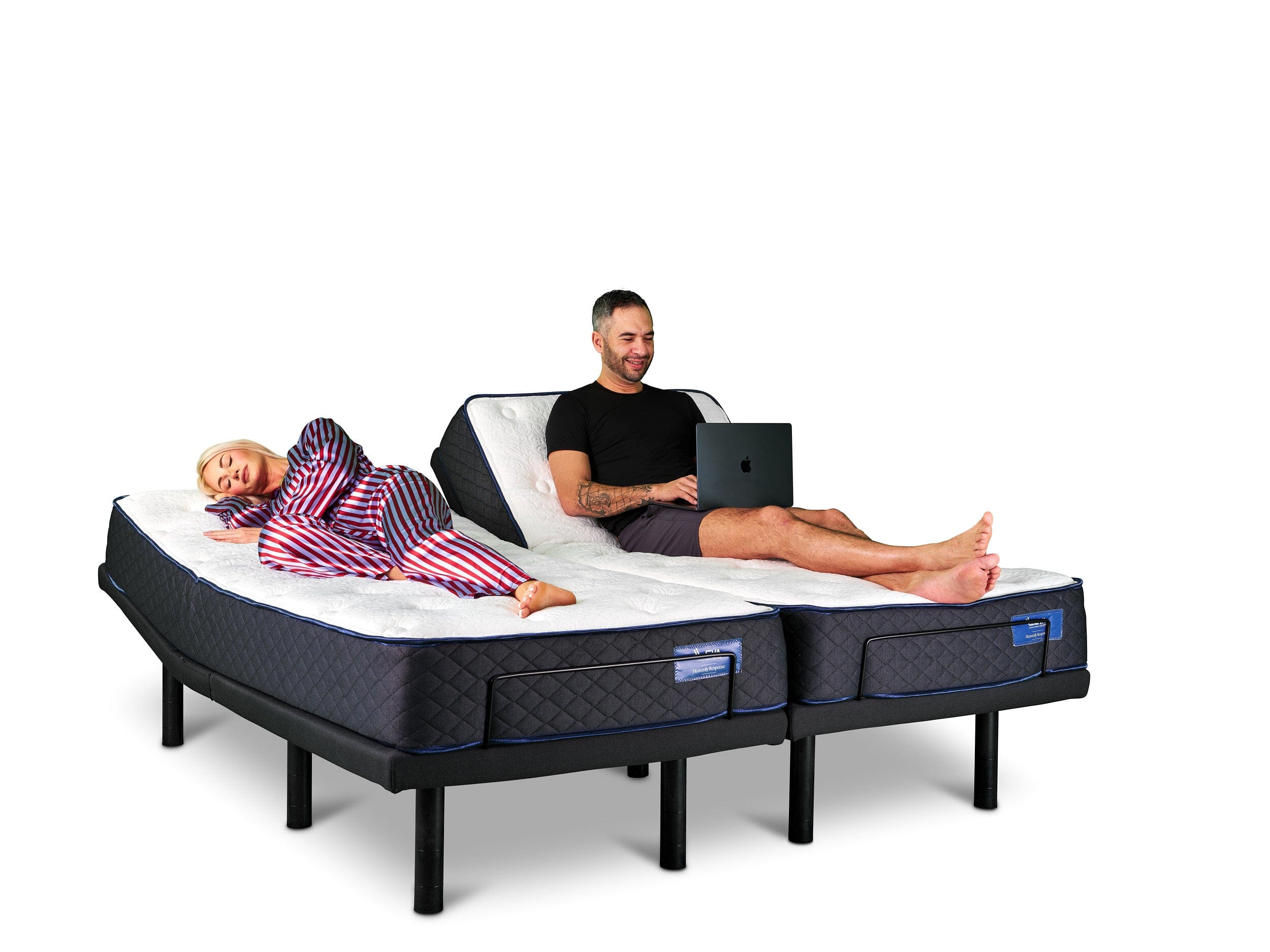
For couples managing mild sleep apnea in a shared bed, Leva Sleep’s split adjustable bases solve the structural limitations of static wedge pillows. Each side of the bed operates independently, so one partner can elevate the head to 30 degrees while the other sleeps flat, without any mechanical impact on the other side.
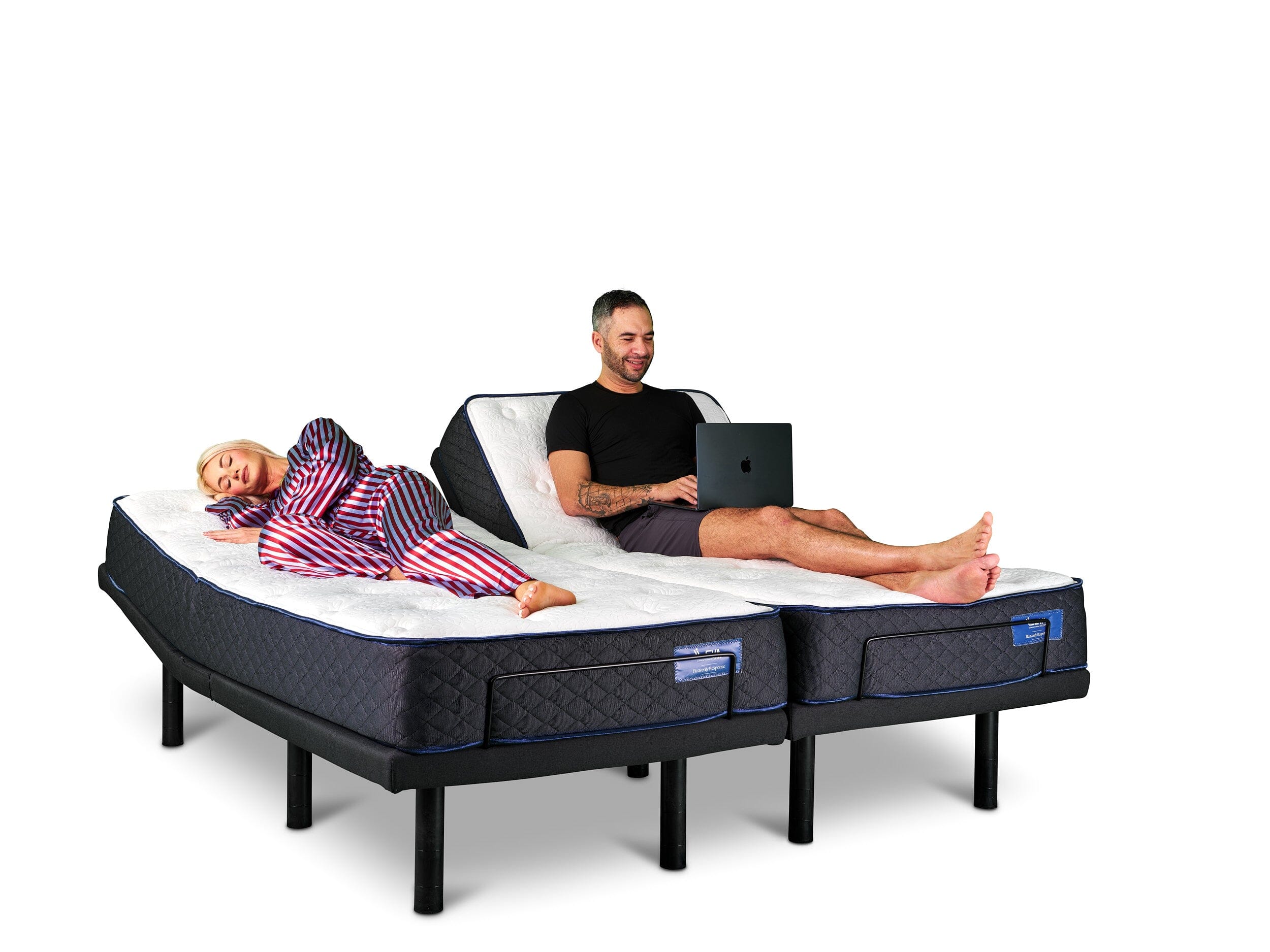
Leva Sleep’s adjustable bases include independent head and foot elevation, adjustable lumbar support for lower back positioning, and pillow-tilt motors that fine-tune head angle without full upper-body repositioning. All adjustments run through the Leva Sleep app via Bluetooth, which allows micro-adjustments without waking a partner. Head elevation of 15–30 degrees via an adjustable base promotes nasal drainage and reduces congestion, making nasal CPAP or nasal pillow masks more tolerable. This advantage becomes especially meaningful during Canadian winters, when indoor humidity drops and nasal congestion is common.
Leva Sleep’s anti-snore mode, arriving spring 2026, will detect snoring and make automatic micro-adjustments to the head of the bed to reduce or eliminate snoring events. No static wedge product offers an equivalent feature. Whisper-quiet German motors keep these adjustments discreet so they do not disturb the non-snoring partner. White-glove delivery is available in Ontario and Alberta and includes bedroom setup, leg height adjustment, a product tutorial, and removal of the existing bed.
Wedge Pillow vs. Split Adjustable Base: Side-by-Side Comparison
| Feature | Wedge Pillow | Split Adjustable Base (Leva Sleep) | Clinical Relevance |
|---|---|---|---|
| Elevation range | Fixed 30–45° incline | Adjustable 15–30°+ via motorized base | Adjustable elevation can lower required CPAP pressure and reduce apnea events |
| Side-sleep compatibility | Back sleepers only | Compatible; shoulder-contouring mattresses maintain side-sleep position | Side sleeping reduces positional OSA risk; wedge does not prevent back-rolling |
| CPAP mask compatibility | Standard designs cause mask pressure and tubing interference | Reduces CPAP pressure needs; compatible mattresses maintain mask seal | Head elevation improves nasal drainage and mask tolerance |
| Couple use | Affects one side only, no independent control | Each partner controls their own angle independently | Removes elevation compromise in shared beds |
Benefits of Independent Elevation for Couples
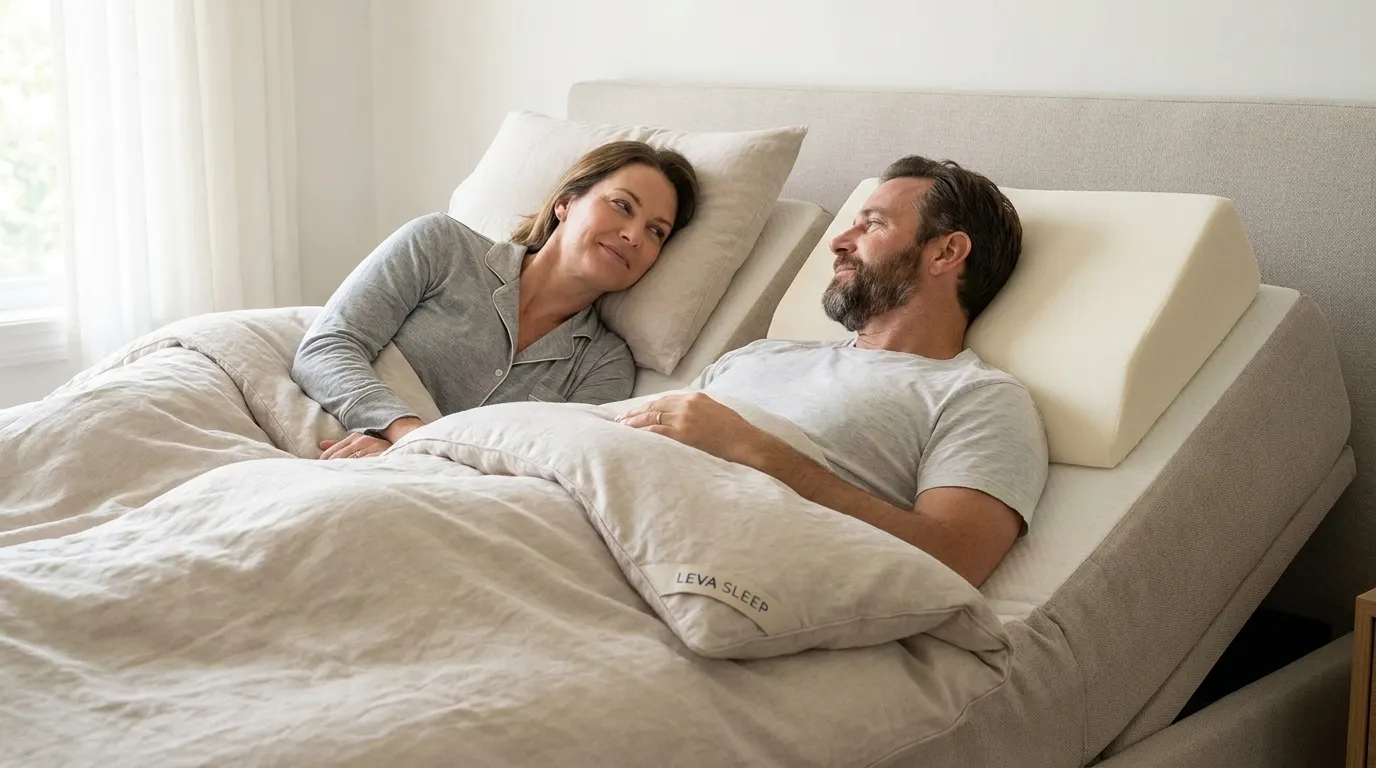
Split adjustable bases from Leva Sleep allow both partners to maintain their preferred elevation without negotiation or separate sleeping arrangements. This means one partner can elevate the head for mild OSA management while the other uses zero-gravity positioning for back pain, on the same bed frame, with neither compromising their therapeutic needs.
Lumbar support adjustment addresses a common complaint among wedge pillow users, which is lower back strain from sustained incline without lower-body support. Pillow-tilt motors allow fine-grained head positioning that a fixed foam wedge cannot match. For CPAP users, a mattress with good shoulder contouring allows the face to rest more naturally against the pillow during side sleeping, which reduces CPAP mask displacement and improves seal maintenance. Leva Sleep’s hybrid pocket-coil and all-foam mattresses are designed specifically for this compatibility.
Leva Sleep’s split queen and split king configurations are available at 30–50% less than comparable luxury competitors, with CAD pricing that reflects the direct-to-consumer model. White-glove delivery in Ontario and Alberta includes full setup and a product walkthrough, which removes the assembly burden entirely.
Frequently Asked Questions
Can a wedge pillow replace CPAP therapy for sleep apnea?
No. Wedge pillows are a supplementary tool that may reduce mild OSA symptoms through gravity-assisted elevation, but they do not treat the underlying condition. CPAP therapy remains the primary clinical treatment for obstructive sleep apnea. Anyone diagnosed with OSA should follow their physician’s treatment plan and discuss whether positional elevation works as an appropriate complement to, not a substitute for, prescribed therapy.
Is an adjustable bed compatible with a CPAP machine?
Yes, and in several ways it improves CPAP use. As discussed earlier, head elevation between 15 and 30 degrees can reduce the CPAP pressure setting required to maintain airway patency, which improves mask seal and reduces side effects like aerophagia. Leva Sleep’s mattresses use shoulder-contouring layers that allow side sleepers to maintain mask position without displacement. The adjustable base itself does not interfere with CPAP equipment, and the app-controlled elevation can be set to a consistent nightly position.
Can both partners use different elevation settings on a Leva Sleep split adjustable base?
Yes. Leva Sleep’s split queen and split king bases give each partner fully independent control over head elevation, foot elevation, lumbar support, and pillow tilt. One partner can sleep flat while the other maintains a therapeutic incline. Adjustments run through the Leva Sleep app via Bluetooth and rely on whisper-quiet German motors that do not disturb the other side of the bed.
When should someone with sleep apnea see a doctor instead of trying home elevation strategies?
Anyone experiencing symptoms of moderate-to-severe OSA, including gasping during sleep, witnessed breathing pauses, excessive daytime sleepiness, or morning headaches, should consult a sleep physician before relying on elevation alone. Home elevation strategies, including adjustable beds, work best as complements to professional treatment for mild positional OSA. A formal sleep study is the only way to accurately assess OSA severity and determine the appropriate treatment pathway.
What makes Leva Sleep’s adjustable beds different from a basic adjustable base sold at a general mattress retailer?
Leva Sleep focuses exclusively on adjustable sleep systems and carries 15–20 models compared to the 3–5 typically found at general retailers. Key differentiators include whisper-quiet German motors, independent split configurations in both queen and king sizes, lumbar support and pillow-tilt motors, app-controlled micro-adjustments, and an upcoming anti-snore mode arriving spring 2026. Mattresses and all bedding accessories, including fitted sheets with deep elastic and duvet clips, are designed specifically for adjustable bases. In-house white-glove delivery is available in Ontario and Alberta, and pricing runs 30–50% below comparable luxury competitors through a direct-to-consumer model.
Conclusion: Choosing Elevation That Works for Both Partners
Wedge pillows provide a low-cost entry point for gravity-assisted elevation in mild sleep apnea, but their fixed angle, sliding risk, back-sleeping requirement, and inability to serve two partners independently make them a limited long-term solution for couples. For Canadian adults seeking sustained, adjustable elevation that accommodates both partners, supports CPAP use, and runs quietly overnight, Leva Sleep’s split adjustable bases address each of these limitations directly with independent app-controlled elevation, lumbar support, pillow-tilt motors, and white-glove delivery across Ontario and Alberta.