Written by: Matthew Timmins, Founder and Managing Director, Leva Sleep | Last updated: July 20, 2026
Key Takeaways for Snoring and Zero-Gravity Beds
- Zero-gravity elevation at 12 degrees yields only a modest 7% reduction in snoring duration for most back sleepers.
- Meaningful snoring relief from head elevation appears mainly in positional obstructive sleep apnea; non-positional snorers see minimal benefit.
- Side sleeping consistently outperforms zero-gravity positioning for reducing snoring and does not require steep angles.
- Sliding, pressure points, and partner disturbance limit how long most couples can comfortably stay elevated.
- Leva Sleep’s split adjustable bases with independent controls and anti-snore mode give Canadian couples a practical, partner-friendly way to manage positional snoring. Explore Leva Sleep’s split adjustable bed packages today.
The Problem: Why Zero-Gravity Elevation Falls Short for Most Couples
Most couples run into two recurring issues with elevated sleep: sliding toward the foot of the bed and struggling to stay comfortable while side sleeping at steeper angles. These comfort problems shorten the time people actually remain in the elevated position, which limits any potential snoring benefit.
When comfort limits real-world use, even strong clinical results lose impact. The clinical picture itself is also constrained, and the table below summarises what current evidence shows across different snorer profiles.
| Snorer Profile | Elevation Angle Tested | Reported Reduction | Key Caveat |
|---|---|---|---|
| Simple / positional snoring (back sleepers) | 12° | 7% reduction in snoring duration | Modest effect, comfort limits sustained use |
| Mild-to-moderate positional OSA | 7.5°–30° | Can help reduce AHI at 7.5°–30° | Applies only to positional OSA patients |
| Non-positional snorers (all positions) | Any | Minimal benefit | Likely anatomical cause (enlarged tonsils, deviated septum) |
| Severe OSA (AHI >30) | Any | Insufficient as standalone treatment | CPAP is the clinical standard of care |
Explore split adjustable bases with separate controls for each partner, designed specifically for Canadian couples.
Finding an Effective Angle for Snoring Reduction
Research points to head-of-bed elevation in roughly the 20–30 degree range as helpful for some people with positional OSA. Several studies also examine lower angles, such as 7.5 degrees, and report changes in respiratory events, although the effects are smaller.
Two practical boundaries shape which angles work in real bedrooms. Below about 15 degrees, gravity on the airway is not counteracted enough to reduce snoring in a meaningful way. Above 35–40 degrees, most people find the position uncomfortable for sustained sleep and often slide toward the foot of the bed.
This combination leaves a relatively narrow effective window. The zero-gravity preset on many adjustable bases sits in the 7–20 degree range, which sits at the lower end of that window. That placement explains why it produces measurable but modest results for positional snorers and remains insufficient for non-positional cases.
Side Sleeping in Zero Gravity for Snoring Relief
Side sleeping reduces snoring for many people by preventing the tongue and soft palate from falling backward into the airway. For habitual snorers who mainly snore on their back, shifting to consistent side sleeping can reduce snoring without devices or medication.
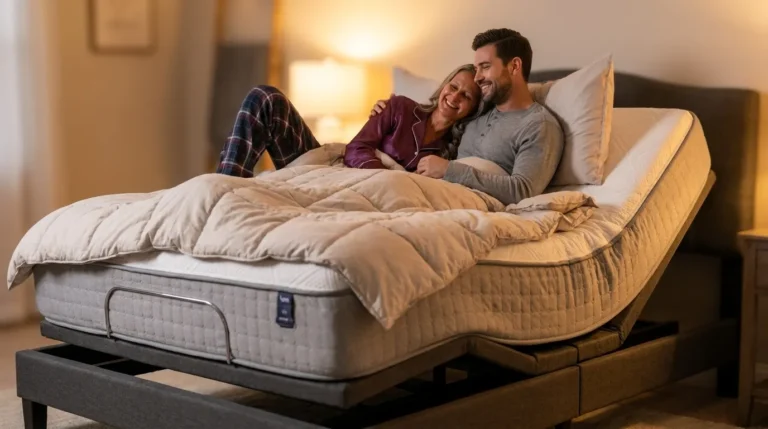
Couples can combine side sleeping with elevation on an adjustable base. The zero-gravity position often feels more comfortable for side sleepers than a flat mattress because it can improve spine alignment and pressure relief. Elevation alone, however, does not match the airway benefit of true lateral positioning. Recent in-home studies demonstrated the modest 7% reduction noted earlier, which remains smaller than the effect typically seen with sustained side sleeping.
All-Night Comfort Concerns with Zero-Gravity Positioning
Comfort challenges with zero-gravity positioning often prevent couples from maintaining helpful angles throughout the night.
- Sliding: When the knees do not rise with the head, the body tends to slide toward the foot of the bed at angles above about 20 degrees. This movement disrupts sleep and reduces the time spent at a therapeutic elevation.
- Pressure points: Prolonged elevation without strong lumbar support can shift pressure to the sacrum and heels. This discomfort prompts frequent position changes that break up sleep.
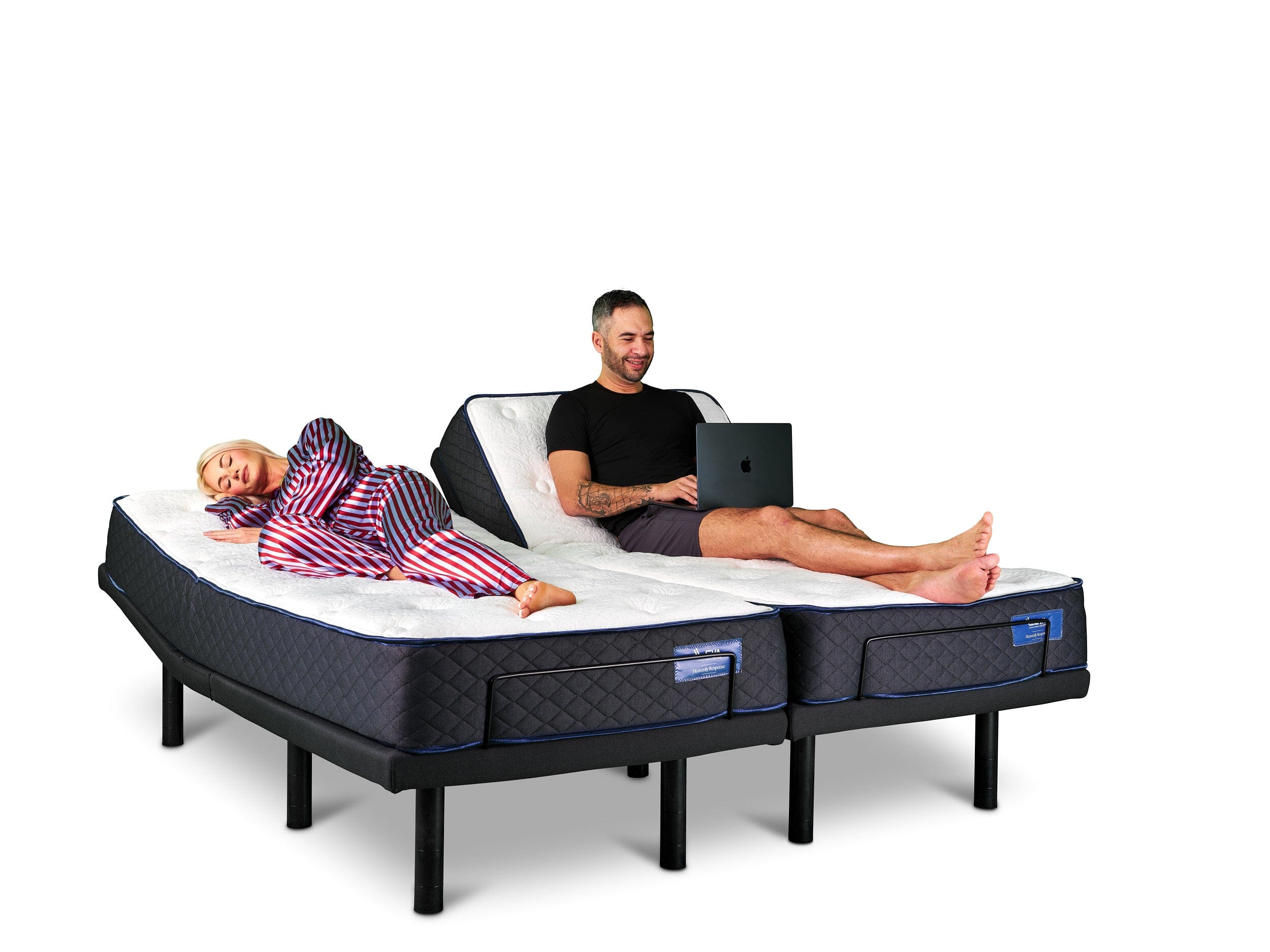
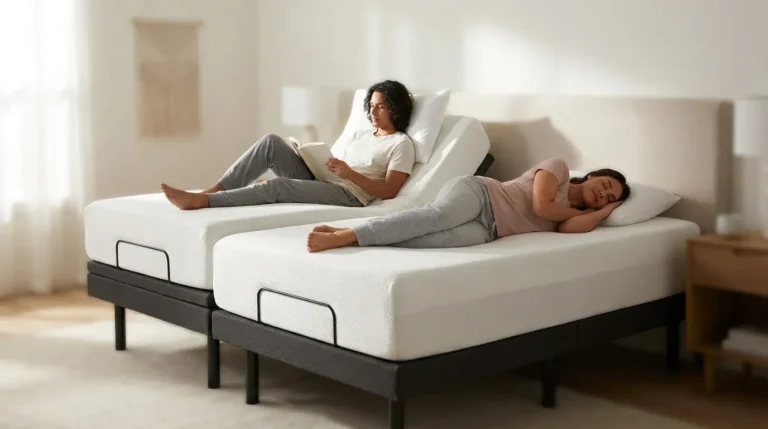
- Partner disturbance: On a standard shared base, one partner’s adjustment raises or lowers the entire mattress surface. The movement often wakes the other partner and discourages regular use of elevation. A split adjustable base solves this mechanical problem by isolating each side.
- Bedding displacement: Standard fitted sheets rarely stay in place at higher angles and often pull free. This adds another source of nighttime disruption and frustration.
OSA Red Flags: When to Prioritize Medical Evaluation
Head elevation can ease positional snoring but does not treat the underlying physiology of obstructive sleep apnea. Use the screening steps below to decide whether to seek medical evaluation before relying on an adjustable base.
Start with these questions that anyone can review at home:
- Does the snoring partner stop breathing? Witnessed apneas, which are pauses in breathing followed by gasping or choking, require a sleep study before any positional intervention. Snoring combined with witnessed apneas, excessive daytime sleepiness, or morning headaches calls for medical evaluation for obstructive sleep apnea. If this applies, stop here and arrange a sleep study.
- Does snoring occur in all positions? Non-positional snorers likely have anatomical issues, and head elevation usually provides less benefit. If snoring persists in every position, discuss this pattern with a healthcare provider.
- Has a sleep study been completed? The 2021 European Respiratory Society guideline gives a conditional recommendation for positional therapy only in position-dependent OSA, defined by a supine AHI at least twice the non-supine AHI. If either of the first two answers is yes and no study has been done, complete a sleep study before relying on positional therapy alone.
If a sleep study has already been completed, next steps depend on the diagnosis:
- Mild-to-moderate positional OSA: Head elevation may be sufficient for some people, but a sleep specialist should confirm this based on the study results. An adjustable base can also complement CPAP when prescribed.
- Severe OSA (AHI >30): An adjustable bed or head elevation alone does not provide adequate treatment. CPAP remains the clinical standard, and any positional changes should support, not replace, that therapy.
The Solution: How Leva Sleep Split Adjustable Systems Help Couples
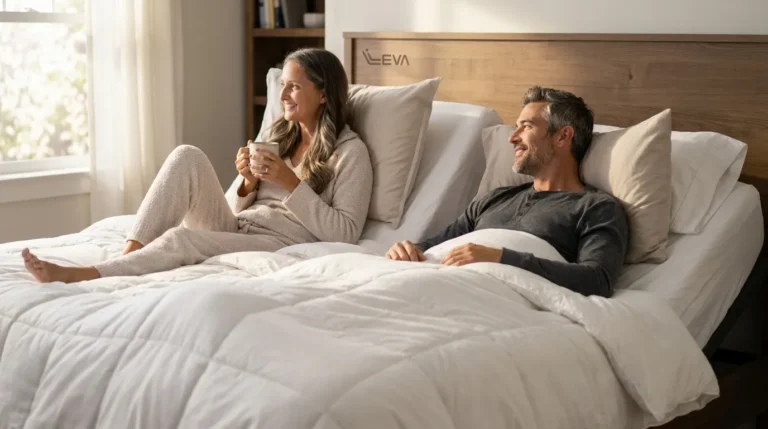
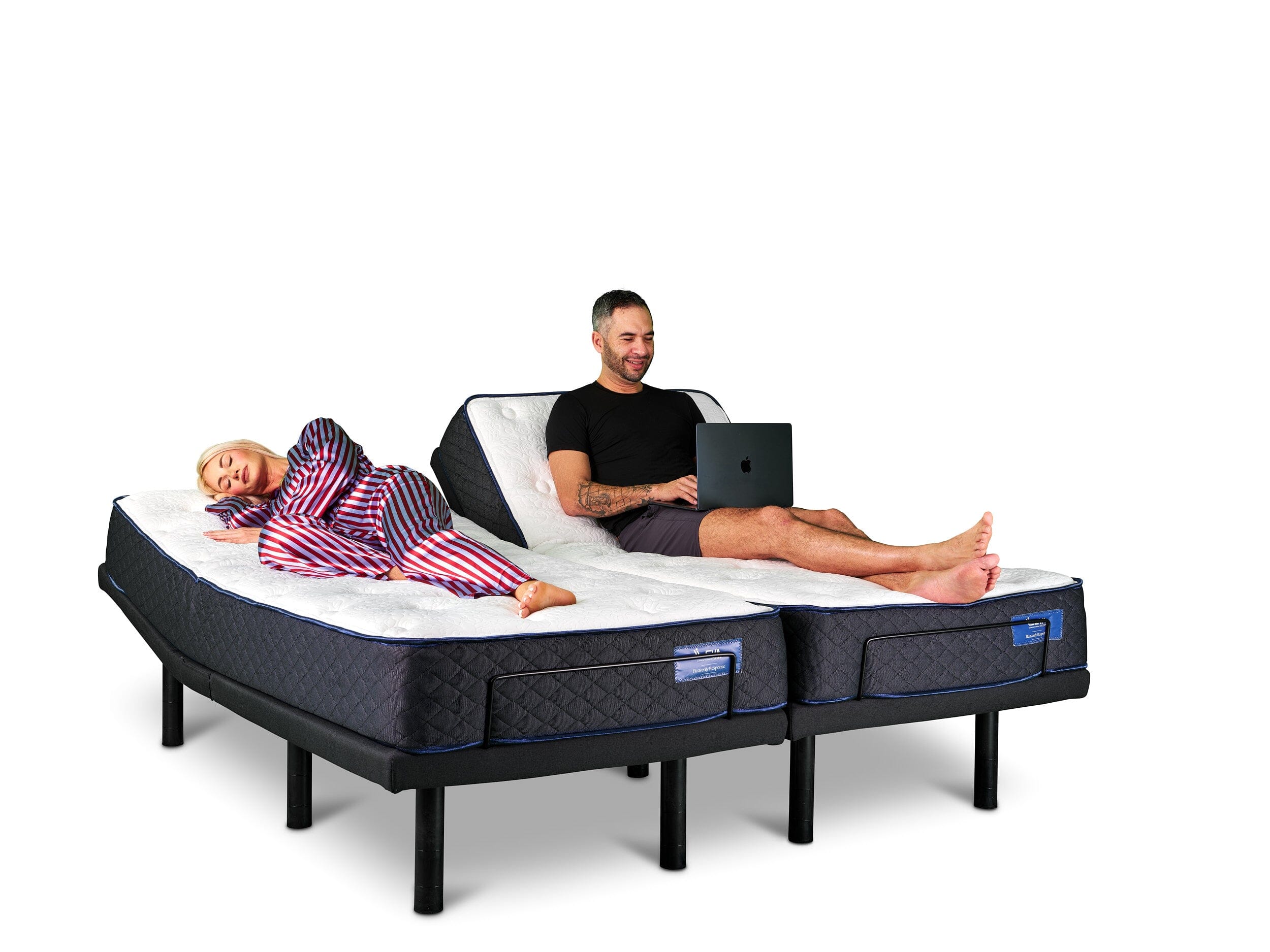
Couples with positional snoring, or couples where only one partner needs elevation, benefit from a base that treats each side separately. Leva Sleep’s split adjustable systems address the core mechanical limits of a single shared base and let both partners stay in the same bed comfortably.
Leva Sleep offers Split Queen and Split King configurations with independent controls on each side, powered by whisper-quiet motors. Each partner can adjust head elevation, foot position, and massage settings through the Leva Sleep app, so one partner can sleep at a 20-degree anti-snore elevation while the other remains flat without disturbing the other side.
Leva manages design, assembly, and delivery in-house across Ontario and Alberta, which removes the retail markup that inflates many competitor prices. The result is a luxury-grade adjustable system priced 30–50% below comparable competitors such as Tempur-Pedic’s Ergo Smart Base, which adds automated snore-response technology as a paid upgrade on an already premium base.
Leva’s anti-snore mode automates adjustments further by detecting snoring and making micro-changes to the head of the snoring partner’s side. These changes occur without waking the non-snoring partner. This mirrors the partner-specific automation of Sleep Number’s FlexFit 3 Partner Snore feature at a significantly higher price and brings similar functionality to Canadian couples at Leva’s direct-to-consumer pricing.
White-glove delivery is available for a fee across Ontario and Alberta, with trained professionals handling bedroom delivery, full assembly, and removal of the old bed through donation or recycling where possible.
View Split Queen and Split King adjustable systems with anti-snore features and see how they fit your bedroom setup.
Frequently Asked Questions
What mattress works best with Leva’s adjustable bases?
Leva Sleep designs its own all-foam and hybrid pocket-coil mattresses to flex with adjustable bases without damaging comfort layers or coil structures. Both options are engineered to maintain support at elevated angles. Leva also carries mattresses from Tempur-Pedic, Simmons, Beautyrest, Serta, and Kingsdown, paired with Leva’s bases.
When checking mattress compatibility, look for models explicitly rated for adjustable base use and a flex rating that matches your preferred elevation angle. Choose foam or individually wrapped coil construction rather than interconnected Bonnell springs, which resist bending and can void warranties.
Can the anti-snore mode replace CPAP?
No. Leva Sleep’s anti-snore mode, arriving spring 2026, detects snoring and makes automated micro-adjustments to head elevation to reduce positional airway collapse. This feature suits positional snorers and people with mild positional OSA whose sleep specialist has confirmed that positional therapy is appropriate.
The system is not a medical device and is not indicated for moderate-to-severe obstructive sleep apnea, where CPAP remains the clinical standard of care. Anyone with witnessed breathing pauses, gasping, excessive daytime sleepiness, or morning headaches should complete a sleep study before relying on positional adjustment alone.
How does white-glove delivery work in Ontario and Alberta?
Leva Sleep’s white-glove delivery service is available for a fee to customers in Ontario and Alberta. A scheduled appointment brings Leva’s trained delivery team directly to the bedroom, not just the front door. The team handles full assembly of the adjustable base and mattress, adjusts leg heights to the customer’s preferred bed height, connects and configures the app, and provides a hands-on product tutorial.
The team also removes the old bed through donation or recycling where available. This end-to-end service removes the assembly burden common with bed-in-a-box brands and helps ensure the system is correctly configured from the first night.
Is zero-gravity comfortable for side sleepers?
Zero-gravity positioning can work for side sleepers, and many people find it more comfortable than a flat mattress because knee elevation reduces lumbar pressure. Steeper head angles above roughly 20 degrees, however, make it harder to maintain a true lateral position without rolling toward the mattress edge or feeling extra shoulder pressure.
Side sleepers using elevation mainly to reduce snoring often do best with a moderate 10–20 degree head elevation and a mattress that provides strong shoulder and hip pressure relief. Leva’s hybrid pocket-coil and all-foam options are both designed to support this combination.
Conclusion: Choosing a Practical Path to Quieter Nights
Zero-gravity elevation can serve as a reasonable first step for positional snorers, yet the evidence shows modest effects. The 7% reduction in snoring duration at a 12-degree incline for typical back sleepers illustrates this limit, with larger reductions mainly seen in confirmed positional OSA at steeper angles. Side sleeping remains the more effective positional change for most people, and any signs of apnea or daytime symptoms should trigger a sleep study and medical review before relying on bed adjustments.
Canadian couples who have already tried basic changes and want to keep sharing a bed often benefit from a split adjustable base. A split system removes the core mechanical conflict, because one partner’s elevation no longer affects the other. Leva Sleep’s spring-2026 anti-snore mode adds automated detection and micro-adjustment on top of that foundation, at the same direct-to-consumer pricing advantage described above, with in-house white-glove delivery across Ontario and Alberta.
Review configurations, delivery options, and current pricing for Leva Sleep adjustable systems available to Canadian customers.