Visit One Of Our 6 Showrooms Located Across Canada!
No Payments, No Interest Until 2027
Free Delivery & In-Home Set Up
Zero Gravity Sleep Position: Benefits & How It Works
Content
Written by: Matthew Timmins, Founder and Managing Director, Leva Sleep | Last updated: July 24, 2026
Key Takeaways
The zero gravity sleep position elevates the head and knees into a gentle V-shape that reduces spinal pressure, eases snoring, and can relieve acid reflux.
Most people do well starting around 30° at the head and 25° at the knees, then adjusting gradually over several nights for comfort.
Side sleepers usually need medium-to-high loft pillows (5–7 inches) with adjustable fill to keep the spine neutral when the base is elevated.
Split adjustable bases with independent controls let each partner fine-tune their own angle without disturbing the other.
Explore Leva Sleep’s adjustable bed packages to experience zero gravity comfort with quiet motors and app-controlled presets designed for Canadian couples.
How the Zero Gravity Position Works and Why Angles Matter
The zero gravity position comes from NASA’s neutral body posture research, where the body naturally settles into a slightly reclined, knees-up posture in weightlessness. On Earth, studies suggest this posture can reduce intradiscal pressure compared to standing, which makes it mechanically favourable for some types of disc-related back pain.
Each angle in the position serves a specific purpose.
Head and torso elevation: Elevating the head of the bed can ease nighttime heartburn. The Sleep Foundation also lists head elevation as a practical way to reduce snoring by helping keep the upper airway open.
Knee elevation: Raising the knees can reduce hip flexor tension and lumbar lordosis, a common source of morning back stiffness. The Cleveland Clinic recommends elevating legs above heart level to help drain built-up fluid and ease mild swelling.
A 2022 in-home study in JMIR Formative Research, which analysed more than 1,000 nights of data, found that sleeping on an incline was associated with a 7% drop in snoring duration. A 2021 systematic review in BMC Family Practice supports torso elevation for reducing nighttime acid reflux symptoms.
Now that you understand how the position works and what benefits it may offer, the next step is confirming that it suits your health situation.
Step 1: Confirm Medical Suitability and Talk With Your Physician
The zero gravity position provides supportive care, not a stand-alone medical treatment. Before you adopt it full-time, walk through a few key checks.
Confirm whether a physician has reviewed the cause of your back, hip, or knee pain.
Review whether you have any of the contraindicated conditions described below.
Consider whether you are recovering from surgery that limits how much you can change positions.
Discuss whether your partner has different medical needs that may require independent elevation settings.
Step 2: Set Comfortable, Precise Angles on Your Adjustable Base
On a Leva Sleep adjustable base, the Leva app lets you fine-tune the head and foot sections independently so each partner can dial in a personal angle without disturbing the other side. A practical starting point is a head elevation of about 30° and a knee elevation of about 25°, followed by gradual changes over several nights.
Elevating the head 20–30° reduces lumbar pressure by taking some weight off the lower spine. Adding slight leg elevation further eases pressure at the lumbar-hip junction. Sleep consultant and occupational therapist Annie Schlecht suggests starting with the knees first and raising them until the lower back feels relieved. You can then lift the head slowly while keeping the neck supported so the spine feels long and neutral.
When you fine-tune your angles, first make sure you do not exceed about 45° at the head. Higher angles can strain the neck and disrupt breathing instead of improving it. Once you find a comfortable range, save that position as a preset in the Leva app so you can return to it with one touch each night. Because your body needs time to adapt to the new alignment, give each setting three to five nights before you decide whether the angle works for you.
Step 3: Choose Pillows and Bedding That Support Side Sleepers
Side sleepers face a specific challenge in the zero gravity position because the shoulder gap widens as the torso elevates. This change requires a pillow with enough loft to keep the cervical spine neutral. Medium-to-high loft pillows measuring 5–7 inches are commonly recommended for side sleepers to maintain neutral spinal alignment.
When you evaluate pillows for elevated sleeping, focus on a few features.
Adjustable fill: Shredded memory foam or latex fill that you can add or remove lets each partner customise loft independently.
Cervical or contoured shape: This shape supports the neck curve while filling the shoulder gap, which helps combination sleepers who move between back and side positions.
Bedding migration often becomes a frustration at elevation. Leva Sleep designs its fitted sheets with deep pockets and extra elastic for adjustable bases, and its duvets include clips to keep each side in place when partners choose different angles. A body pillow between the knees also supports whole-body alignment and limits spinal twisting for side sleepers.
Pillow migration tip: If your pillow slides toward the foot of the bed as the head section rises, switch to a pillow with a non-slip base or tuck a folded towel beneath it to anchor it against the headboard.
Step 4: Use Split-Base Controls So Each Partner Sleeps Well
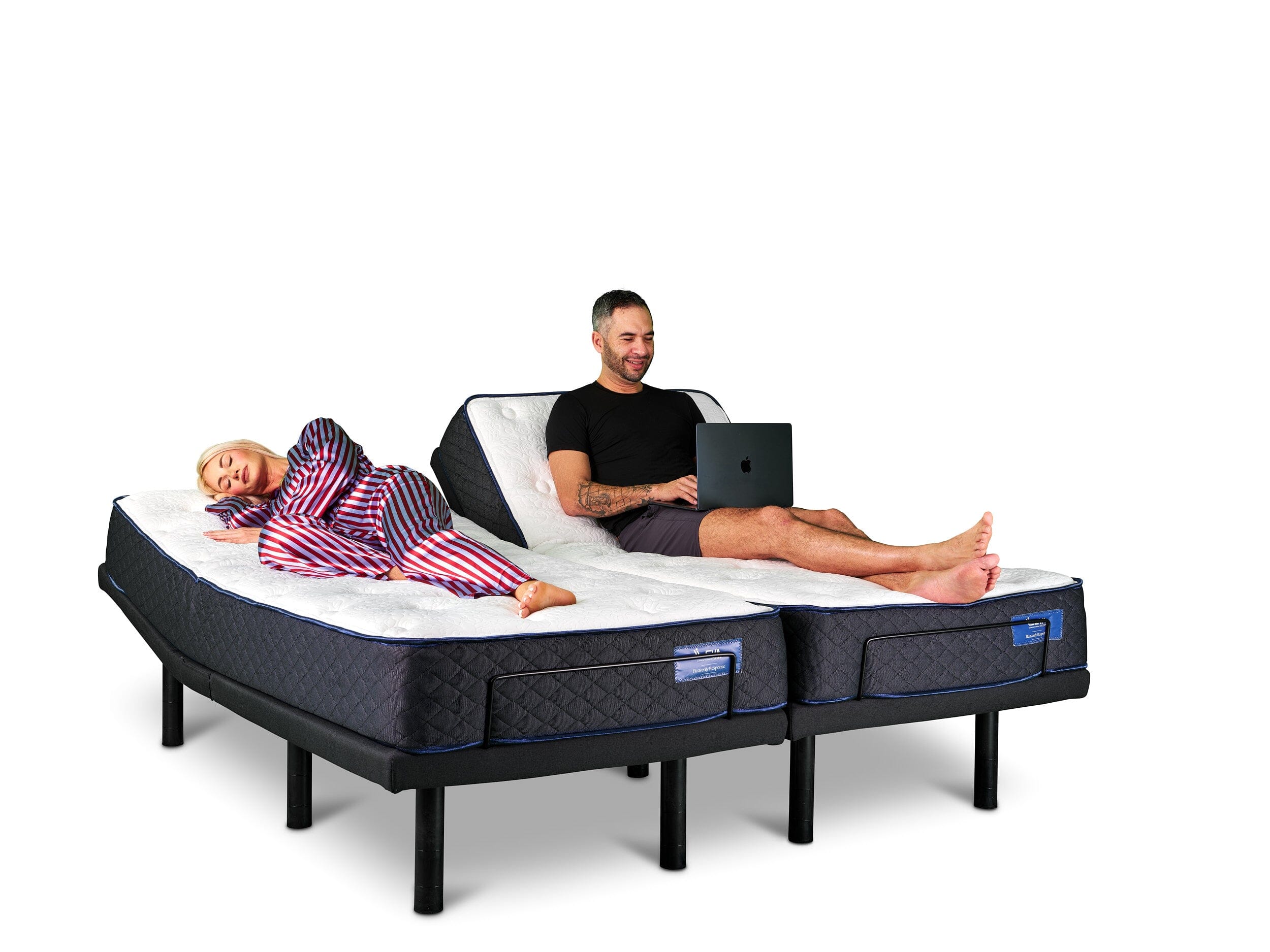
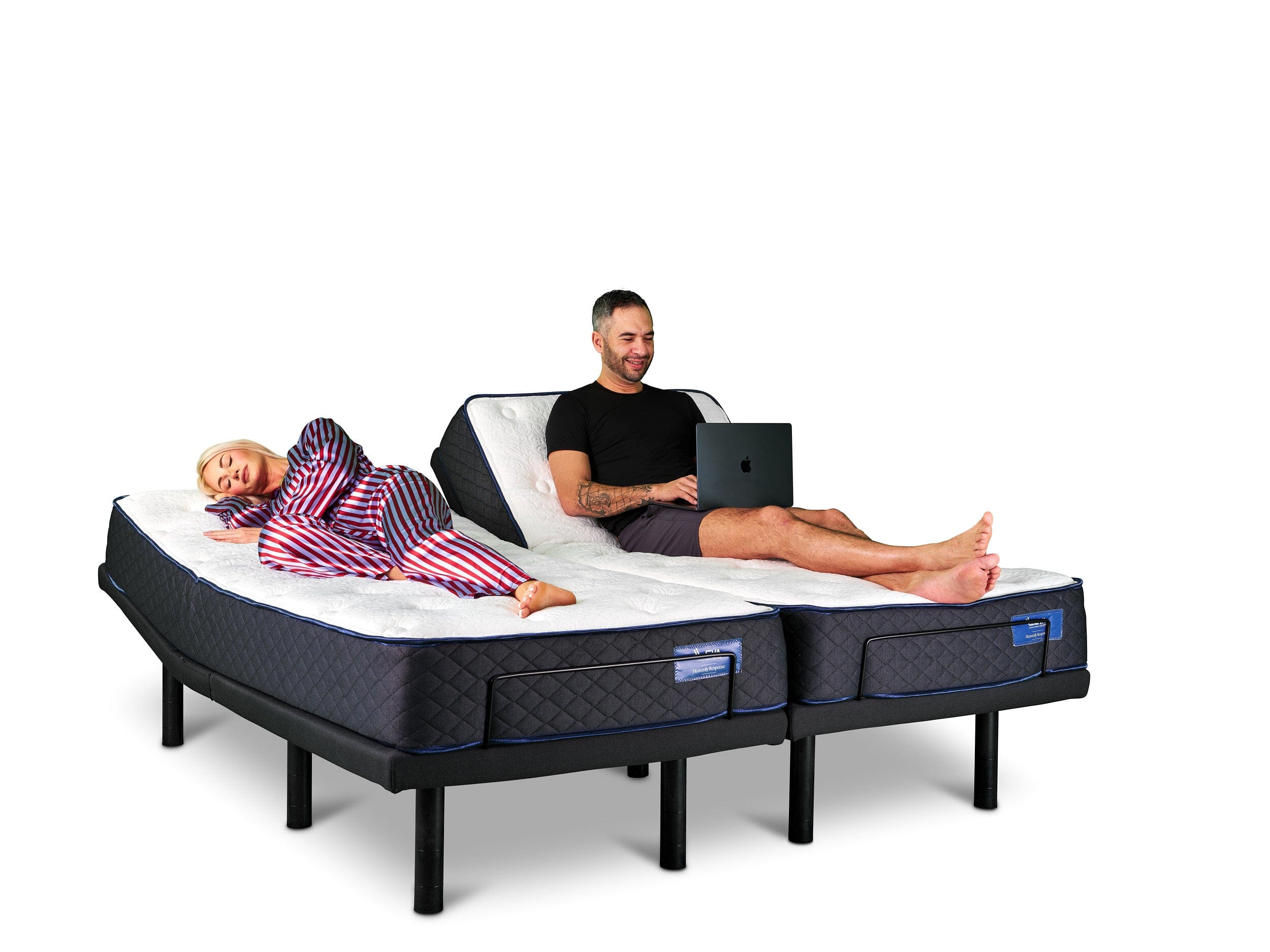
Many couples give up on the zero gravity position because one partner’s ideal angle disrupts the other’s sleep. A split adjustable base removes that conflict by giving each person independent control.
Leva Sleep Split Queen Bed
When you compare split bases, keep a few decision factors in mind.
Size availability: Leva Sleep offers Split Queen configurations, a rare option in Canada that provides independent control in a more space-conscious footprint than a Split King.
Independent controls: Each side should control elevation, massage intensity, and temperature separately through an app or remote.
Motor noise: Quiet motors allow one partner to adjust position during the night without waking the other.
Price difference: Leva’s direct-to-consumer, vertically integrated model keeps split-base pricing below many comparable luxury competitors.
For couples where one partner has acid reflux and the other does not, or where one snores and the other sleeps quietly, independent control becomes a requirement that keeps both people in the same bed.
Step 5: Fix Common Zero Gravity Sleep Problems
Three problems show up most often when people start using the zero gravity position.
Sheet slippage: Standard fitted sheets often pop off at the corners when the base elevates. Use sheets with deep pockets of at least 18 inches and reinforced elastic, or Leva’s purpose-designed adjustable-base sheets.
Sliding down the mattress: People with acid reflux should avoid sliding down during the night because this reduces the benefit of head elevation. A mattress with enough surface friction, or a non-slip mattress pad, helps keep the body in place.
Morning joint stiffness: Sleeping with bent knees for long periods can aggravate joint stiffness. If this happens, lower the knee elevation by about 5° and reassess after a week.
Step 6: Try Simple DIY Approximations Before You Invest
On a standard flat bed, you can approximate zero gravity by stacking pillows or using a foam wedge to elevate the upper body to about 30–45°. Combine this with a firm pillow or wedge under the knees to raise the legs slightly above heart level.
This setup works well as a short trial to see whether the position suits your body before you commit to a base. It also has clear limits.
A makeshift pillow arrangement is hard to maintain through the night, especially for side sleepers.
Pillow stacks shift with movement, so the precise angle rarely lasts beyond the first sleep cycle.
There is no independent control for a partner, so one person’s wedge setup affects the entire sleeping surface.
Couples cannot recreate split-base functionality with pillows alone.
Wedge pillows and knee bolsters work as a short-term test or travel solution. For nightly, medically relevant use, an adjustable base remains the only method that maintains consistent, measurable angles throughout the night.
What Successful Zero Gravity Sleep Usually Looks Like
After two to four weeks of consistent use at appropriate angles, many people notice clear, trackable changes.
Morning lower-back stiffness often decreases, and positional wake-ups become less frequent.
Partners may report less audible snoring, or the snoring partner may notice fewer dry-mouth symptoms.
People with GERD often experience fewer nighttime heartburn episodes.
Those with mild circulation issues may see less ankle and leg swelling by morning.
Both partners can usually stay in the same bed with their own preferred settings, which can end a “sleep divorce” pattern.
Is it safe to sleep in the zero gravity position all night?
For most healthy adults, sleeping in the zero gravity position all night is considered safe when the angles stay moderate and the body has time to adapt. Starting at lower elevations around 20–25° at the head and 15–20° at the knees, then increasing over several nights, reduces the risk of waking with neck stiffness or joint discomfort. People with the contraindicated conditions discussed in Step 1, including severe glaucoma, advanced arthritis, and cardiac issues, should consult their physician before using the position nightly. Aim for a position your body can hold comfortably through multiple sleep cycles rather than the steepest angle the base can reach.
How long does it take to adjust to the zero gravity position?
Most people notice a comfort change within the first few nights, while full adaptation usually takes one to three weeks. The body needs time to adjust to the new spinal alignment, especially if you have slept on a flat surface for years. Small angle changes every two to three nights tend to work better than jumping straight to a high elevation. If discomfort continues beyond three weeks, reduce the head or knee angle by about 5° and reassess before you give up on the position.
Which pillow works best for side sleepers in the zero gravity position?
Side sleepers in the zero gravity position usually do best with an adjustable-fill pillow that has a loft of 5–7 inches. This design lets you add or remove shredded memory foam or latex to match your shoulder width and the elevation angle of the base. As the head section rises, the gap between the shoulder and the mattress changes, so a fixed-loft pillow that worked on a flat bed may feel too low or too high once the base is elevated. A gusseted pillow with structured side walls holds its shape better through the night than a standard pillow, which can compress and shift. Couples with different shoulder widths should each use their own adjustable pillow rather than sharing a single pillow type.
What are the delivery and setup considerations for adjustable bases in Canada?
Leva Sleep delivers to Ontario and Alberta with an in-house white-glove service available for a fee. This service includes delivery to the bedroom, full assembly, leg-height adjustment, removal of the old bed with donation or recycling where possible, and a product tutorial that covers app setup, angle presets, and accessory use. Because adjustable bases are heavier and more complex than standard frames, professional setup helps ensure the base is level, the split configuration is aligned, and both partners finish the appointment confident using their independent controls. Leva’s direct-to-consumer model keeps delivery with the in-house team, so the people assembling the base are trained specifically on Leva’s products.
Recap: A Simple Framework for Deciding on Zero Gravity Sleep
The zero gravity sleep position can improve back pain, snoring, acid reflux, and circulation when the head is elevated to about 30–45° and the knees to about 25–35°, with those angles maintained consistently through the night. Pillow stacks and wedges can mimic the position for a short test but cannot match the precision, stability, or independent couple control of a split adjustable base.
When you weigh your options, think through a few core questions.
Do your medical needs require a specific, repeatable angle each night?
Does your partner have different elevation needs that a shared flat surface cannot handle?
Do motor noise, sheet compatibility, and long-term durability matter to your household?
Does the pricing of a specialist, vertically integrated retailer change the value compared with a luxury brand?
Do in-home setup and a Canadian-based support team matter to your purchase decision?
Leva Sleep’s split adjustable bases, available in Split Queen and Split King configurations and controlled through the Leva app, are designed for Canadian couples who want to stay in the same bed without compromising individual comfort or budget.