Written by: Matthew Timmins, Founder and Managing Director, Leva Sleep | Last updated: July 29, 2026
Premium vs Basic Adjustable Bases: What Couples Actually Get
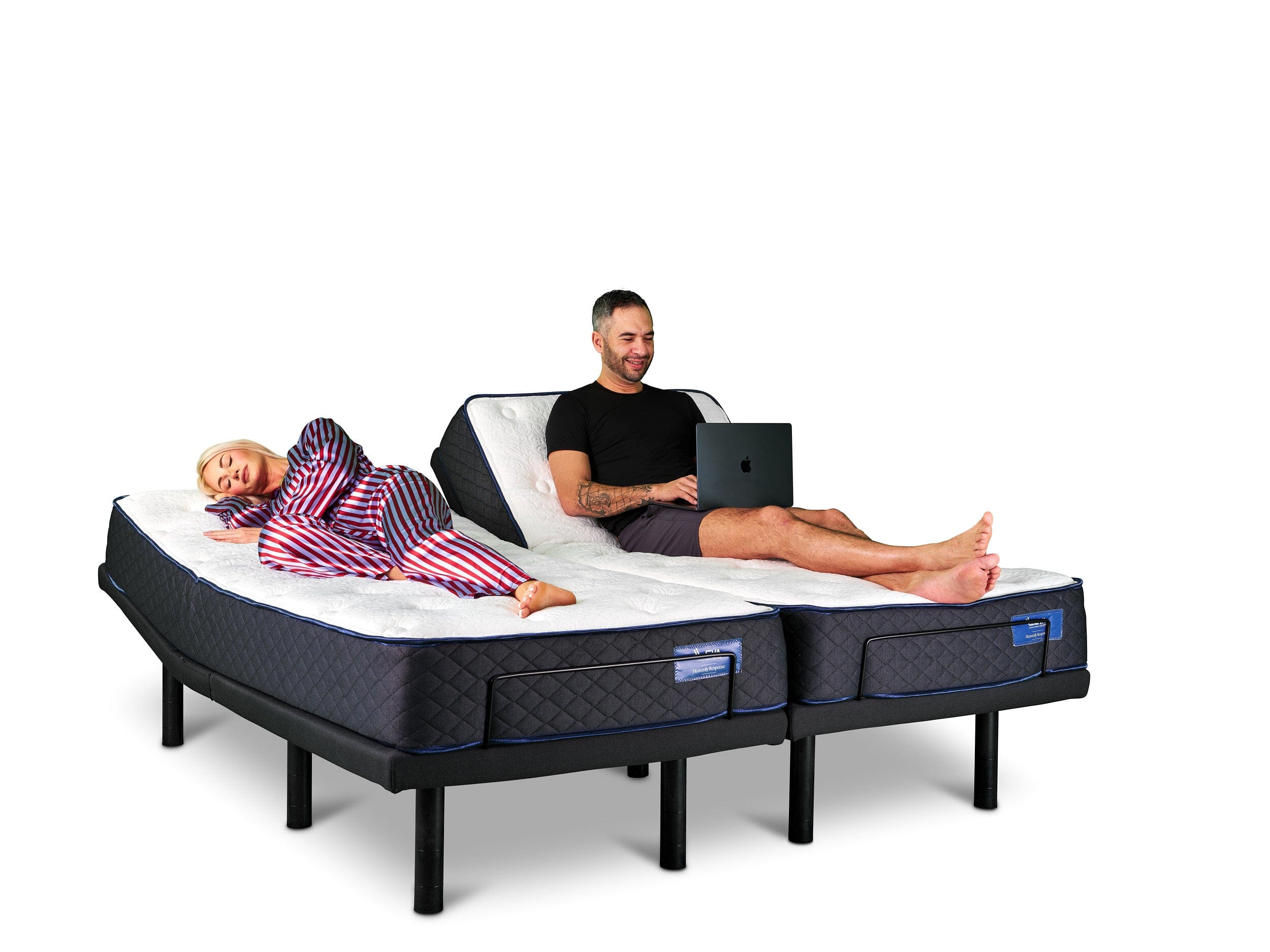
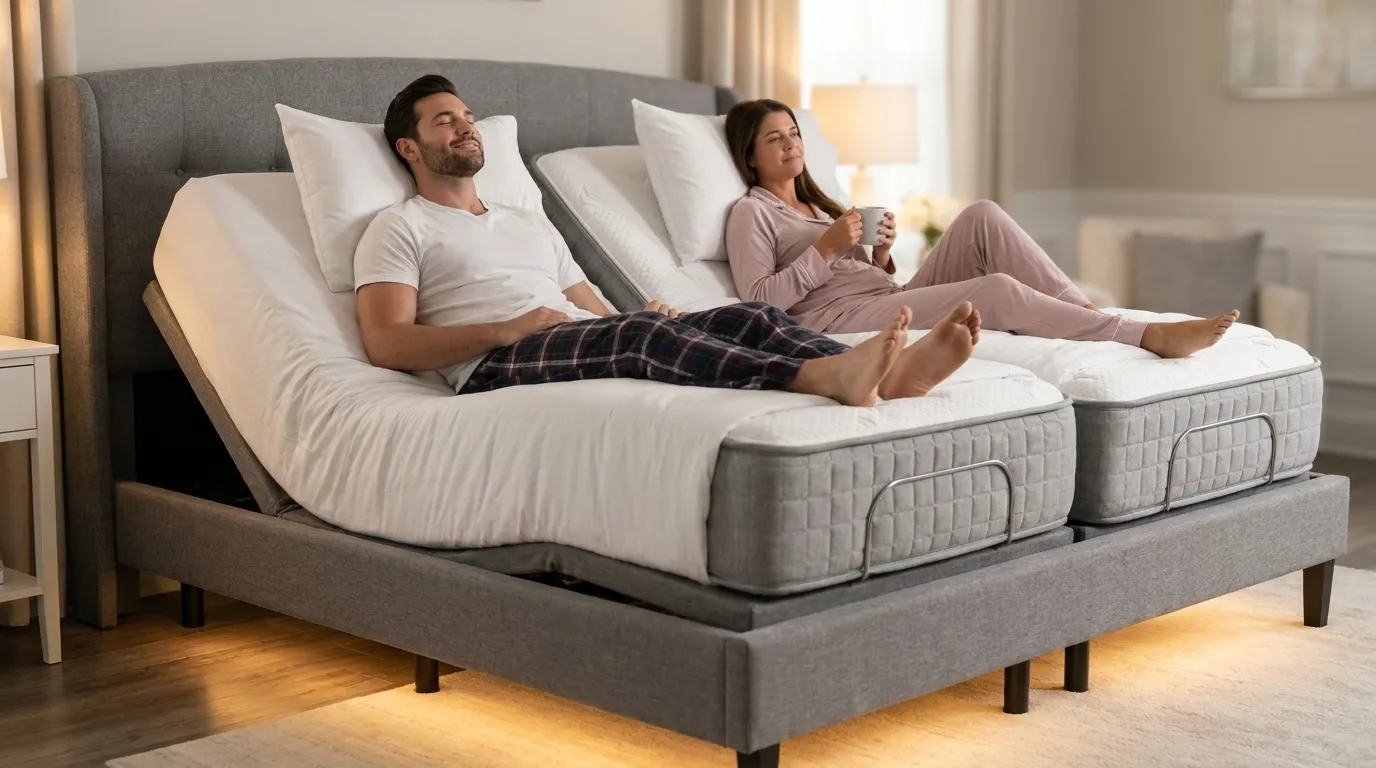
Basic adjustable bases raise and lower the head and foot sections using a single motor, often with a wired remote and limited presets. Premium adjustable bases add independent dual motors, whisper-quiet engineering, app control, lumbar support, pillow tilt, multi-zone massage, wall-hugging retraction, zero-gravity presets, under-bed lighting, and AI-driven anti-snore detection, features that address specific pain points rather than simply changing the angle of the mattress.
Canadian couples often deal with three recurring sleep problems. Snoring pushes one partner to the couch. Different comfort needs force both partners into a compromise that suits neither. Chronic pain in the back, hips, or neck makes nights restless and mornings stiff. The premium features below speak directly to these problems instead of acting as generic luxury extras.
Key Takeaways for Canadian Couples
- Premium adjustable bases add independent dual motors, app control, lumbar support, pillow tilt, multi-zone massage, wall-hugging retraction, zero-gravity presets, under-bed lighting, and AI anti-snore detection that address specific pain points rather than simply changing mattress angle.
- Canadian couples face concrete sleep challenges including snoring, differing firmness preferences, and chronic pain that can force one partner to the couch or compromise sleep quality for both.
- Targeted features like lumbar support, pillow tilt, and multi-zone massage deliver measurable benefits for couples with specific back, neck, or hip conditions without disturbing the other partner.
- Zero-gravity presets, whisper-quiet motors, and AI anti-snore mode provide the clearest measurable benefits for most couples, with wall-hugging design and under-bed lighting improving daily usability at mid-range price points.
- Leva Sleep offers 15–20 adjustable base models with independent app control, whisper-quiet German motors, Split Queen configurations, and in-house white-glove delivery across Ontario and Alberta at 30–50% lower prices than comparable luxury brands. Shop Leva Sleep’s adjustable beds to find the configuration that fits your sleep needs.
Targeted Lumbar Support for Lower Back Relief
Lumbar support on a premium adjustable base uses a dedicated motor or air bladder at the lower back that inflates or extends independently of the head and foot sections. This creates precise support for the lumbar area while the rest of the mattress stays in the preferred position.
For a couple where one partner has chronic lower back pain, this allows that partner to dial in extra support without disturbing the other side of the bed. Surface electromyography on 30 volunteers showed that zero-gravity positioning cut lumbar paraspinal muscle firing by 38% within five minutes compared with flat supine positioning. Lumbar support extends this benefit by maintaining that decompressed position throughout the night, even as the sleeper shifts.
For a 55-year-old in Calgary with a herniated disc, the difference between a flat base and one with active lumbar control can determine whether they wake functional or in pain.
Verdict: Worth paying for couples where one or both partners experience lower back pain or stiffness on waking.
Independent Pillow Tilt for Neck and Reading Comfort
While lumbar support focuses on the lower back, pillow tilt solves a different precision problem for the neck and head. Pillow tilt uses a secondary motor at the very top of the head section that adjusts the pillow zone angle independently from the main head elevation.
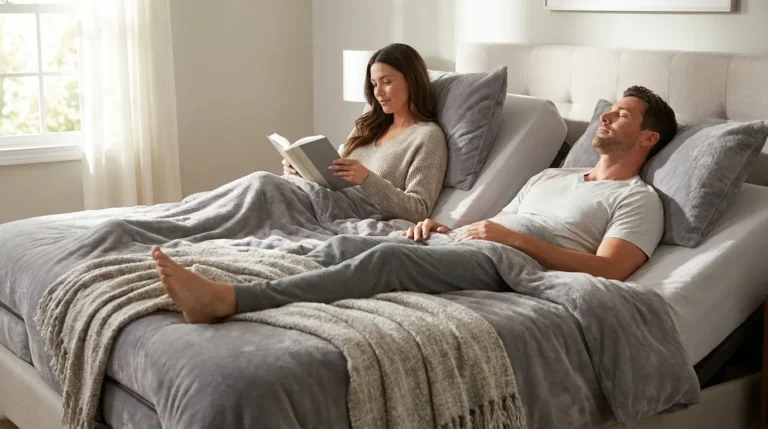
This design allows fine-tuning of neck alignment without raising the entire upper body, which helps for reading, watching television, or managing cervical discomfort. For couples, the value sits in that precision. One partner may need 15° of head elevation for acid reflux while the other needs only a slight pillow tilt for neck support.
On a split base, both adjustments happen independently. Raising the entire upper body from the waist up on an adjustable base maintains a natural spine position for GERD relief, unlike stacking pillows which elevate only the head and neck and create an unnatural bend. Pillow tilt refines this position further.
Verdict: Worth paying for couples who use the bed for reading or who have distinct neck and head support needs.
Multi-Zone Massage for Targeted Pain Management
Multi-zone massage uses vibration motors embedded in the base at the head, lumbar, and foot zones that can be activated independently at variable intensities. Single-zone massage on basic bases vibrates the entire surface uniformly, which can disturb a sleeping partner.
Low-frequency vibration at 30–50 Hz activates mechanoreceptors faster than pain fibers, closing the spinal gate to nociceptive signals; clinical trials show 20-minute sessions can dull soreness for up to four hours, though benefits plateau after six weeks. For a couple in Toronto where one partner has restless legs or chronic hip pain, targeted foot or lumbar massage before sleep addresses the specific zone without running a full-body vibration that wakes the other partner.
Verdict: Worth paying for couples where one partner uses massage regularly for pain management; less essential for those who rarely use the feature.
Wall-Hugging Design for Small Canadian Bedrooms
A wall-hugging base uses a horizontal retraction mechanism so that when the head section rises, the entire sleeping surface slides forward and keeps the pillow position close to the headboard. Without this feature, elevating the head section pulls the sleeper away from their nightstand and makes it harder to reach a phone, glass of water, or lamp.
Wall hugger retraction technology keeps the head position close to the headboard when elevated, making it practically significant in bedrooms where space is limited. In a standard Ontario bedroom where the bed sits close to the wall, a non-wall-hugging base can create a gap large enough to trap pillows or make the headboard functionally useless.
Verdict: Worth paying for couples in standard-sized bedrooms; less critical in large master suites with ample clearance behind the bed.
Zero-Gravity Presets for Everyday Pressure Relief
Zero-gravity is a one-touch preset that raises the head to about 30° and elevates the knees slightly, distributing body weight across the sleeping surface to reduce pressure on the lumbar spine and joints. The position approximates the posture astronauts use during launch to minimize gravitational stress on the body.
A 2022 randomized crossover study published in Spine assigned 154 chronic low-back-pain sufferers to four-week blocks on flat vs. zero-gravity sleep and found a 2.3-point greater reduction on the Oswestry Disability Index with zero-gravity positioning plus a 17-minute average increase in deep (N3) sleep. Benefits persisted two weeks after the intervention, suggesting structural rather than placebo effects.
Verdict: Worth paying for almost all couples, because zero-gravity is consistently the highest-use preset and delivers measurable pain and sleep quality benefits.
Whisper-Quiet Motors for Undisturbed Partners
Motor noise often becomes one of the most cited long-term complaints about basic adjustable bases. A grinding or whirring motor at 2 a.m. wakes the partner who was not adjusting the bed and cancels out the benefit of independent control.
Premium bases use brushless DC motors or German-engineered drive systems that operate at near-silent decibel levels. Motor quality and noise level matter more than other specifications for long-term usability, as noisy motors can disrupt a partner with a different sleep schedule, and user reviews mentioning motor noise are more reliable than manufacturer claims. Leva Sleep’s bases use whisper-quiet German motors specifically selected for couple compatibility, so a partner adjusting their side at midnight should not register as a disturbance on the other side.
Verdict: Worth paying for all couples. Noise is a non-negotiable factor for shared sleep environments.
2026 AI Anti-Snore Mode for Position-Based Snoring
AI anti-snore technology uses embedded microphones or contact sensors to detect snoring patterns in real time and then elevates the head section by about 12° to reopen the airway without waking the snoring partner or their partner.
A peer-reviewed in-home study published in PMC compared 4 weeks of flat sleep to 4 weeks at a 12° incline and found a 7% relative reduction in objective snoring duration, 4% fewer awakenings, and a 5% increase in time spent in deep sleep when participants slept inclined. Elevating the head 12° opens the oropharyngeal angle and cuts apnea-hypopnea indices by 30%. Tempur-Pedic’s TEMPUR-Ergo Smart Base uses Sleeptracker-AI to sense snoring and automatically raise the head once by approximately 12 degrees, with the response designed not to wake the partner.
Leva Sleep offers an anti-snore mode that detects snoring and makes micro-adjustments to the head of the bed. This positions Leva as a direct alternative to luxury AI bases at 30–50% lower cost, without requiring a subscription to unlock core features.
Verdict: Worth paying for couples where snoring is a primary sleep disruptor. This feature alone can prevent sleep divorce.
Under-Bed Lighting for Safe Nighttime Movement
Under-bed LED lighting activates at low intensity when motion is detected and illuminates the floor for safe nighttime navigation without turning on a lamp that wakes the other partner. It functions as a convenience feature rather than a therapeutic one, but its practical value in a shared bedroom stays consistent.
Mid-range adjustable bases priced $800–$1,500 deliver the highest value for most buyers with zero gravity positioning, massage, under-bed lighting, USB charging ports, and quieter motors. Under-bed lighting is now standard at the mid-range tier, so couples do not need to pay premium prices to access it.
Verdict: Worth paying for couples where one partner wakes frequently at night; available at mid-range price points and does not require a premium upgrade.
Basic vs Premium Features Comparison Table
The table below shows how premium features cluster at higher tiers and how Leva Sleep brings many of them into mid-range pricing for Canadian couples.
| Feature | Basic Base | Premium Base | Leva Sleep |
|---|---|---|---|
| Head & Foot Elevation | Single motor, wired remote | Dual independent motors, app control | Whisper-quiet German motors, app-controlled per side |
| Zero-Gravity Preset | Rarely included | Available in mid-range and above | Included across model range |
| Anti-Snore Mode | Not available | AI-driven, raises head ~12° | AI anti-snore mode arriving spring 2026 |
| Lumbar Support | Not available | Available at $1,500+ tier | Available on select models |
| Split Configuration | Not available | Split King (two Twin XL bases) | Split King and Split Queen available |
| Motor Noise | Audible, can disrupt partner | Brushless DC or low-noise motors | Whisper-quiet German motors |
| Pricing vs Luxury Brands | Lower cost, fewer features | Full price at luxury retail | 30–50% lower than comparable competitors |
The features above deliver measurable benefits, but they only help if the base configuration fits your bedroom and allows true independent control. For couples in standard Canadian bedrooms, size and split configuration determine whether premium features are actually usable.
Why Split Queen Configurations Solve Space and Sleep Issues for Canadian Couples
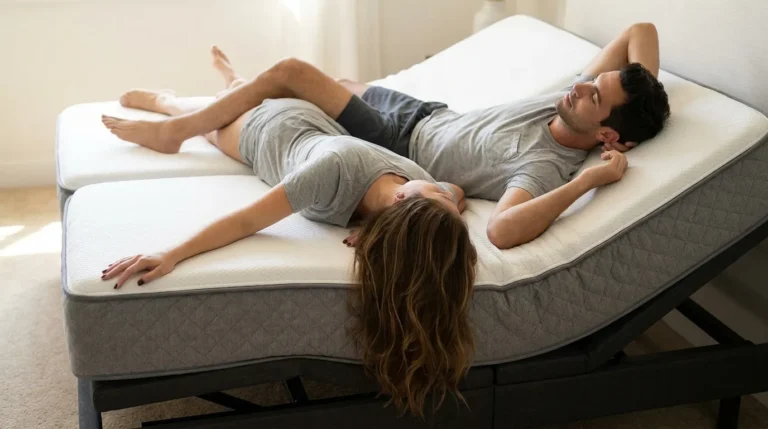
A split king bed uses two Twin XL mattresses placed side by side on two separate adjustable bases, giving each partner independent control over firmness, head elevation, and foot elevation while creating a combined 76″ × 80″ sleeping surface identical to a standard king. For couples in smaller Ontario or Alberta bedrooms, a Split Queen offers the same independent control in a more space-conscious footprint, a configuration that most retailers do not carry.
Leva Sleep is one of the few Canadian specialists offering Split Queen adjustable beds built to customer specifications. This matters because independent control only works when both the hardware and software support it. Leva’s 15–20 models provide separate bases and per-side app control, with each side controllable independently via the Leva Sleep app for custom sleep positions, vibrating alarms, and anti-snore micro-adjustments.
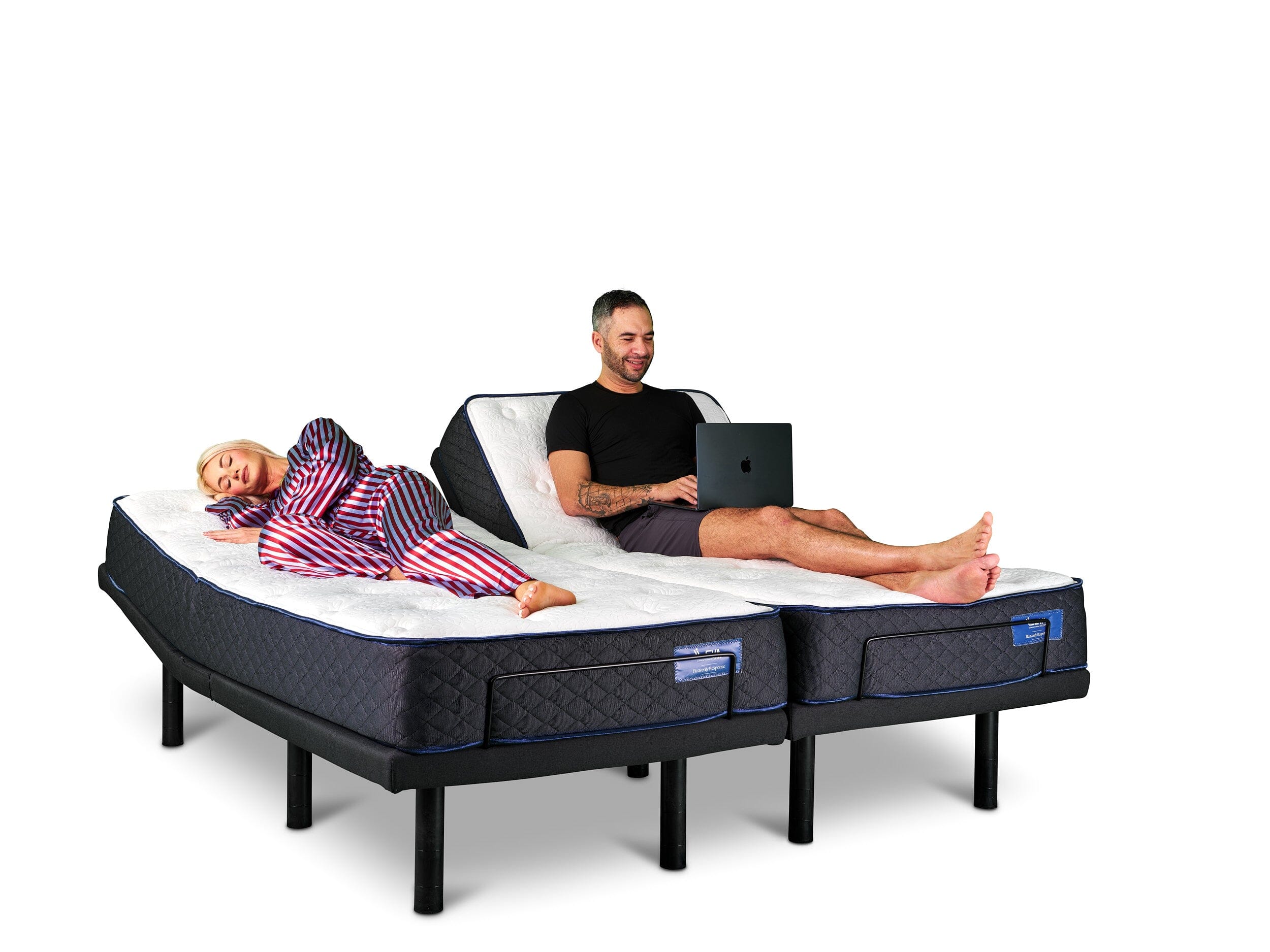
Two separate mattresses on separate adjustable bases provide zero motion transfer, so one partner’s tossing, turning, or getting up at night does not disturb the other. Leva’s specialized bedding, including fitted sheets with deep pockets and extra elastic, duvet clips to maintain separation when positions differ, and remote pockets, is designed specifically for split configurations to prevent slippage and maintain comfort at any elevation angle.
Shop Leva Sleep’s adjustable beds to explore Split Queen and Split King configurations with independent app control.
Frequently Asked Questions
How long does it take to set up a premium adjustable base, and what does white-glove delivery include?
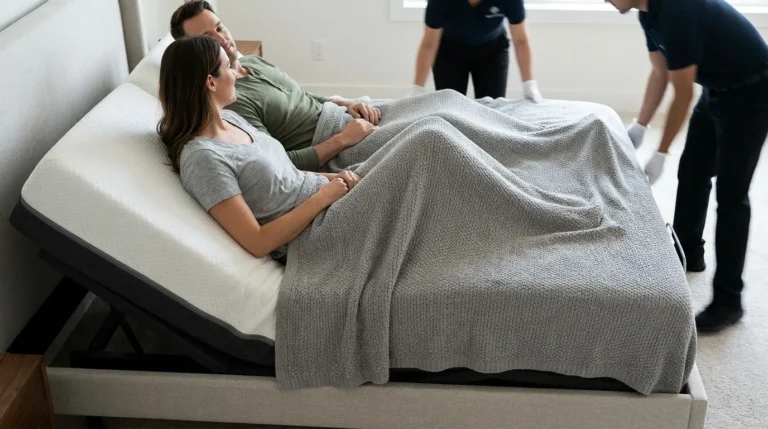
Setup time for a premium adjustable base varies by model complexity, but most installations take between one and two hours when handled by trained professionals. Leva Sleep’s in-house white-glove delivery service, available for a fee in Ontario and Alberta, covers delivery to the bedroom, full assembly, leg height adjustment for comfort, a product tutorial covering app setup and preset programming, and removal of the old bed through donation or recycling.
This service removes the assembly burden that typically accompanies large furniture purchases and helps ensure the base is calibrated correctly from the first night.
How noisy are premium adjustable bases during nighttime adjustments?
As discussed in the motor section above, noise is one of the most important long-term usability factors for couples. When evaluating any adjustable base, look for user reviews that specifically mention motor noise during nighttime use rather than relying on manufacturer decibel claims.
Leva Sleep’s whisper-quiet German motors are specifically selected for shared sleep environments so one partner can adjust their side at any hour with minimal disturbance.
Are all mattresses compatible with premium adjustable bases?
Not all mattresses flex adequately for adjustable base use. Innerspring mattresses with rigid coil systems and thick pillow tops often crack or deform under repeated elevation. Mattresses designed for adjustable bases are typically all-foam or hybrid pocket coil constructions that flex without structural damage.
Leva Sleep designs its mattresses, both all-foam and hybrid pocket coil options, specifically to work with its adjustable bases. The company also carries compatible mattresses from brands including Tempur-Pedic, Simmons, Beautyrest, Serta, and Kingsdown. If you are pairing an existing mattress with a new adjustable base, check the mattress manufacturer’s compatibility guidelines before purchasing.
Can an adjustable base help with medically diagnosed sleep apnea?
Adjustable bases address position-dependent snoring and mild obstructive sleep apnea by elevating the head section to reopen the airway. Positional therapy including head elevation has been associated with an average 32% reduction in apnea episodes in published research, the same mechanism behind the 12° elevation discussed in the AI anti-snore section above.
However, adjustable bases are not a medical device and are not a substitute for a CPAP machine in cases of moderate-to-severe obstructive sleep apnea. Leva Sleep’s anti-snore mode, arriving spring 2026, detects snoring and makes micro-adjustments to the head of the bed, which offers a meaningful benefit for position-dependent snorers. Individuals with a diagnosed sleep apnea condition should consult their physician before replacing or supplementing CPAP therapy with positional approaches.
What is the difference between an anti-snore preset and AI anti-snore mode?
An anti-snore preset is a fixed position, typically 7–12° of head elevation, that the user manually activates before sleep. AI anti-snore mode uses embedded sensors or microphones to detect snoring in real time and automatically adjusts the head section without requiring the user to wake up or press a button.
The automatic response occurs quickly enough to reopen the airway before the partner is disturbed. Leva Sleep offers an AI anti-snore mode, which makes it more effective for couples where snoring is unpredictable or occurs after the partner has already fallen asleep.
Decision Support Takeaway for Canadian Couples
For Canadian couples aged 35–70 navigating snoring, back pain, or differing sleep preferences, three features deliver the clearest measurable benefit across the widest range of sleepers: zero-gravity presets, whisper-quiet motors, and AI anti-snore mode. If one or both partners have diagnosed spinal or cervical conditions, lumbar support and pillow tilt become essential rather than optional.
Wall-hugging design and under-bed lighting address daily usability rather than therapeutic needs, which makes them valuable additions that do not require a top-tier budget. The decision framework stays straightforward. Identify which sleep problem is most disruptive, match it to the feature that addresses it directly, and then decide whether the price difference between tiers is justified by how frequently that feature will be used.
Shoppers rarely regret buying the tier that matches their routine; they often regret paying for a tier that looked impressive but did not fit how they actually use the bed. Leva Sleep’s 15–20 model range, Split Queen availability, whisper-quiet German motors, app-controlled independent settings, specialized bedding, and in-house white-glove delivery in Ontario and Alberta address the full spectrum of couple sleep problems at 30–50% lower cost than comparable luxury brands.
Shop Leva Sleep’s adjustable beds and find the configuration that matches your sleep needs, bedroom size, and budget.