Written by: Matthew Timmins, Founder and Managing Director, Leva Sleep | Last updated: July 5, 2026
Key Takeaways
- Adjustable beds improve circulation by raising the legs above heart level, using gravity to assist venous return and reduce lower-leg swelling.
- Zero-gravity positioning distributes gravitational stress more evenly, eases cardiac workload, and provides more effective leg elevation than simple foot raises.
- Regular leg elevation during sleep can reduce morning ankle swelling, ease varicose vein discomfort, and calm restless legs linked to venous insufficiency.
- Conditions such as peripheral artery disease or acute DVT require physician guidance before using leg elevation, which supports care but does not cure disease.
- Explore Leva Sleep’s adjustable bed packages with independent zero-gravity positioning for couples who want better circulation support.
How Leg Elevation Assists Venous Return
The veins in the legs carry deoxygenated blood, lactic acid, and cellular waste back to the heart against gravity after blood passes through the capillary bed. In the standing position without muscle activity, hydrostatic venous pressure in the legs approximates 100 mm Hg. Three mechanisms counteract this: one-way venous valves, the calf muscle pump, and respiratory pressure gradients.
A single calf muscle contraction triggered by foot flexion ejects venous blood and reduces venous pressure. During sleep, however, the calf muscle pump shuts down completely, leaving venous return dependent on gravity and body position for 6–8 hours. Simply lying flat removes the downward pull of gravity but often cannot reverse a full day of fluid accumulation in the lower limbs. Elevating the legs above heart level uses gravity to pull excess fluid back toward the heart, lowering venous pressure and easing edema.
Raising the legs above heart level for regular periods or overnight with an adjustable bed helps many people reach these therapeutic benefits more consistently.
Zero-Gravity Positioning Compared With Simple Foot Elevation
Zero-gravity recline positions the thighs at approximately 128° to the torso while elevating the legs above the heart, a configuration originally developed by NASA to distribute gravitational stress evenly on astronauts during launch. This setup differs from simple foot elevation, which raises only the lower legs without adjusting the torso or hip angle. The comparison below shows how common bed types handle independent control and zero-gravity support for couples.
| Feature | Flat Bed | Basic Single-Motor Adjustable Base | Leva Split Adjustable System |
|---|---|---|---|
| Independent leg elevation per partner | None, and flat position provides no gravity-assisted venous return | None, because a single motor raises both sides together | Available, since each side adjusts independently via whisper-quiet German motors |
| Zero-gravity positioning | Not available | Available on some models with a single shared angle | Available per side with thighs at about 128° to the torso and legs above heart level |
| Motor noise during adjustment | Not applicable | Audible motor noise common in basic models | Whisper-quiet German motors designed to limit sleep disruption |
| Couple compatibility | Shared flat surface with no individual adjustment | Shared angle that often forces compromise or separate rooms | Split Queen and Split King configurations with fully independent controls per partner |
Zero-gravity positioning reduces compressive lumbar loading, supports venous return, and eases cardiovascular workload by lowering cardiac preload. Elevating both the head and legs reduces pressure points, improves circulation, and often helps people fall asleep faster by relaxing lumbar muscles and easing heart strain.
Explore Leva Sleep’s Split Queen and Split King systems, which offer independent zero-gravity positioning for each partner and are assembled locally in Ontario and Alberta.
Evidence for Swelling and Edema Reduction
Leg elevation improves venous blood flow and can reduce pain intensity and swelling in people with chronic venous insufficiency.
Patients with vein-related symptoms often report dramatically reduced morning swelling after one week of consistent leg elevation during sleep. Chronic oedema that persists longer than three months and does not fully resolve with overnight rest or elevation suggests early lymphatic failure and commonly relates to chronic venous insufficiency. This pattern signals the need for medical assessment rather than relying on positional therapy alone.
Varicose Veins and Restless Legs Syndrome Relief
Consistent leg elevation reduces strain on vein valves and may slow the progression of vein-related conditions such as chronic venous insufficiency and varicose veins. Vascular specialists often consider leg elevation during sleep essential for patients with varicose veins, chronic venous insufficiency, or leg swelling.
Emerging evidence links restless legs syndrome symptoms to underlying venous insufficiency, and improved sleep position through leg elevation and left-side sleeping may ease symptoms by improving venous drainage. Clinical findings have reported 93% sustained symptomatic relief at one year after sclerotherapy treatment of lateral subdermic venous plexus insufficiency associated with restless legs symptoms. Lifting the legs slightly helps veins return blood to the heart, which can reduce the heaviness and throbbing often associated with Restless Leg Syndrome.
Medical Conditions That Require Extra Caution
Leg elevation acts as a supportive measure, not a stand-alone treatment. The following conditions require medical consultation before using an adjustable bed for leg elevation. This table outlines key contraindications, the physiological risks, and the clinical action needed before trying positional therapy.
| Condition | Risk of Leg Elevation | Recommended Action |
|---|---|---|
| Peripheral artery disease (PAD) | Potential worsening of symptoms by reducing arterial perfusion pressure | Consult a vascular specialist before elevating legs |
| Severe decompensated heart failure | Rapid fluid mobilization from elevated legs could precipitate pulmonary edema | Obtain medical clearance |
| Acute deep-vein thrombosis (DVT) | Relative contraindication in the first 24–48 hours, with early mobilization now often favoured | Follow the treating physician’s guidance |
| Mixed CVI and PAD (ABI <0.8) | Elevation can worsen tissue ischemia, so a neutral or slightly dependent position is preferred | Arrange a vascular assessment before using elevation |
Adjustable beds do not treat peripheral artery disease, deep-vein thrombosis, or heart failure. Zero-gravity positioning provides supportive care and should always be paired with medical treatment for conditions such as poor circulation or swollen legs.
Recommended Elevation Angles and Adjustment Tips
Leg elevation of 15–20° under the calves, about 10–15 cm or 4–6 inches, maximizes overnight venous and lymphatic drainage by using gravity to reduce venous pressure in the legs. This elevation range marks the point where gravity begins to meaningfully assist venous return, which helps limit nighttime leg swelling and cramping.
Effective leg elevation uses a gentle incline that supports the entire leg rather than bending at the knee, which can restrict blood flow. Stacking soft pillows for leg elevation often fails because they shift during sleep and do not provide stable support. An adjustable base with a motorized foot section maintains a consistent, stable angle throughout the night.
People who are new to elevated sleeping can start with a modest 4-inch raise and increase gradually over one to two weeks so the body adapts without discomfort.
Split-Base Solutions for Couples
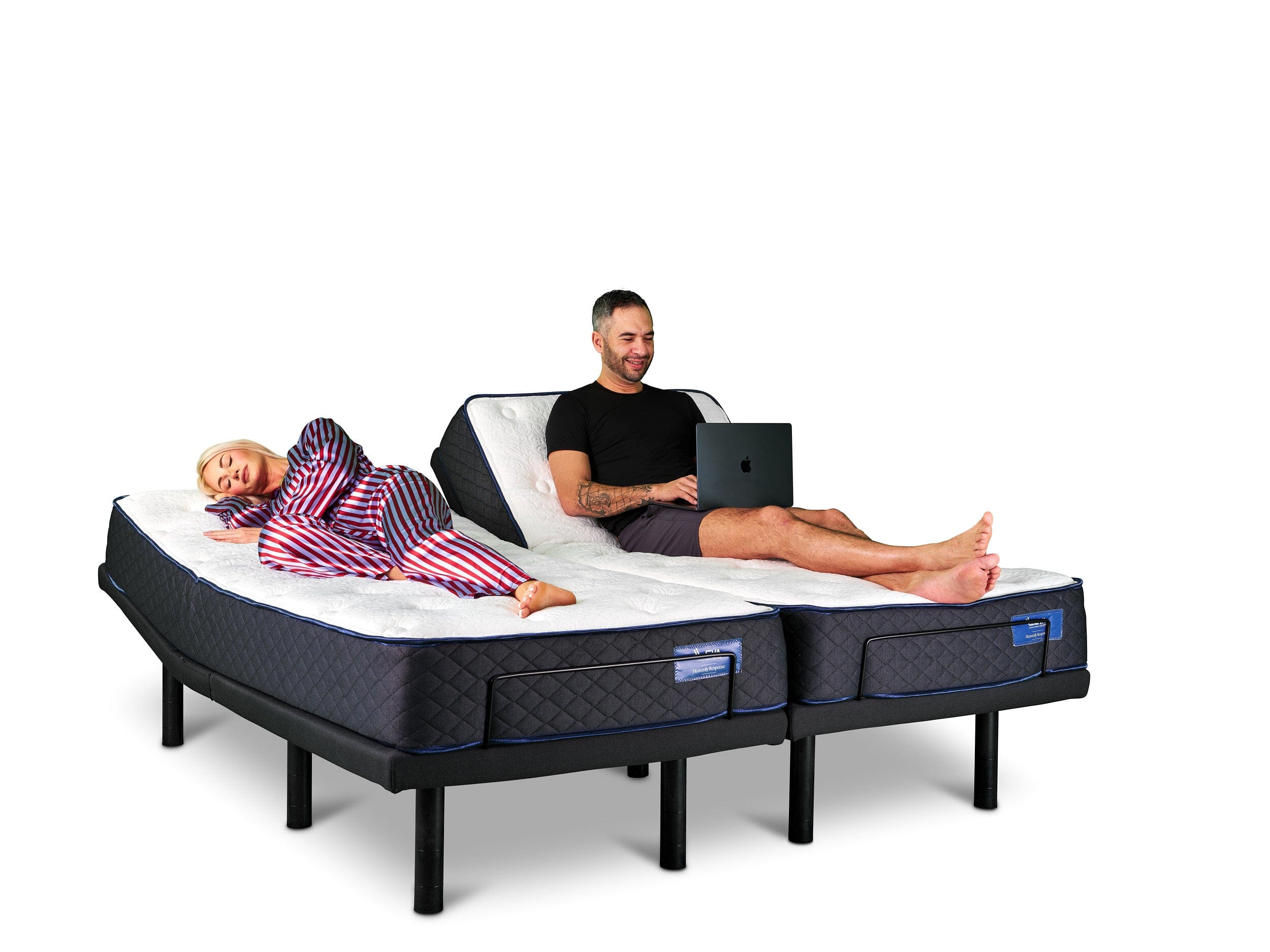
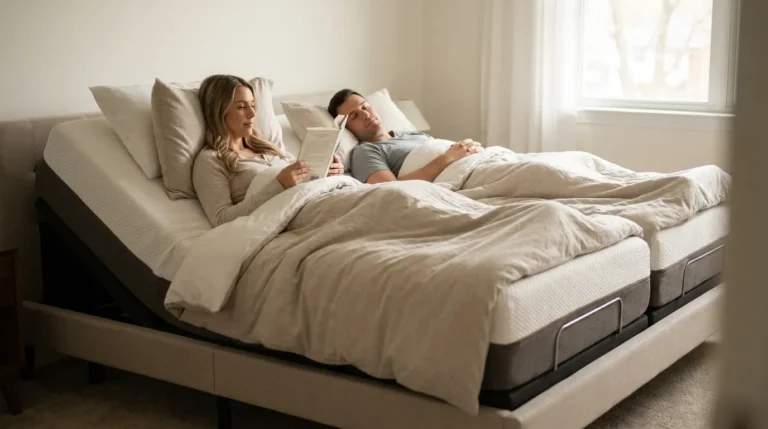
Couples often struggle when one partner needs leg elevation and the other prefers a flat surface, because a shared single-motor base forces a compromise that usually leaves someone uncomfortable. Leva Sleep’s Split Queen and Split King adjustable bases address this directly, since each side operates independently with whisper-quiet German motors, so one partner can sleep in zero-gravity position while the other remains flat.
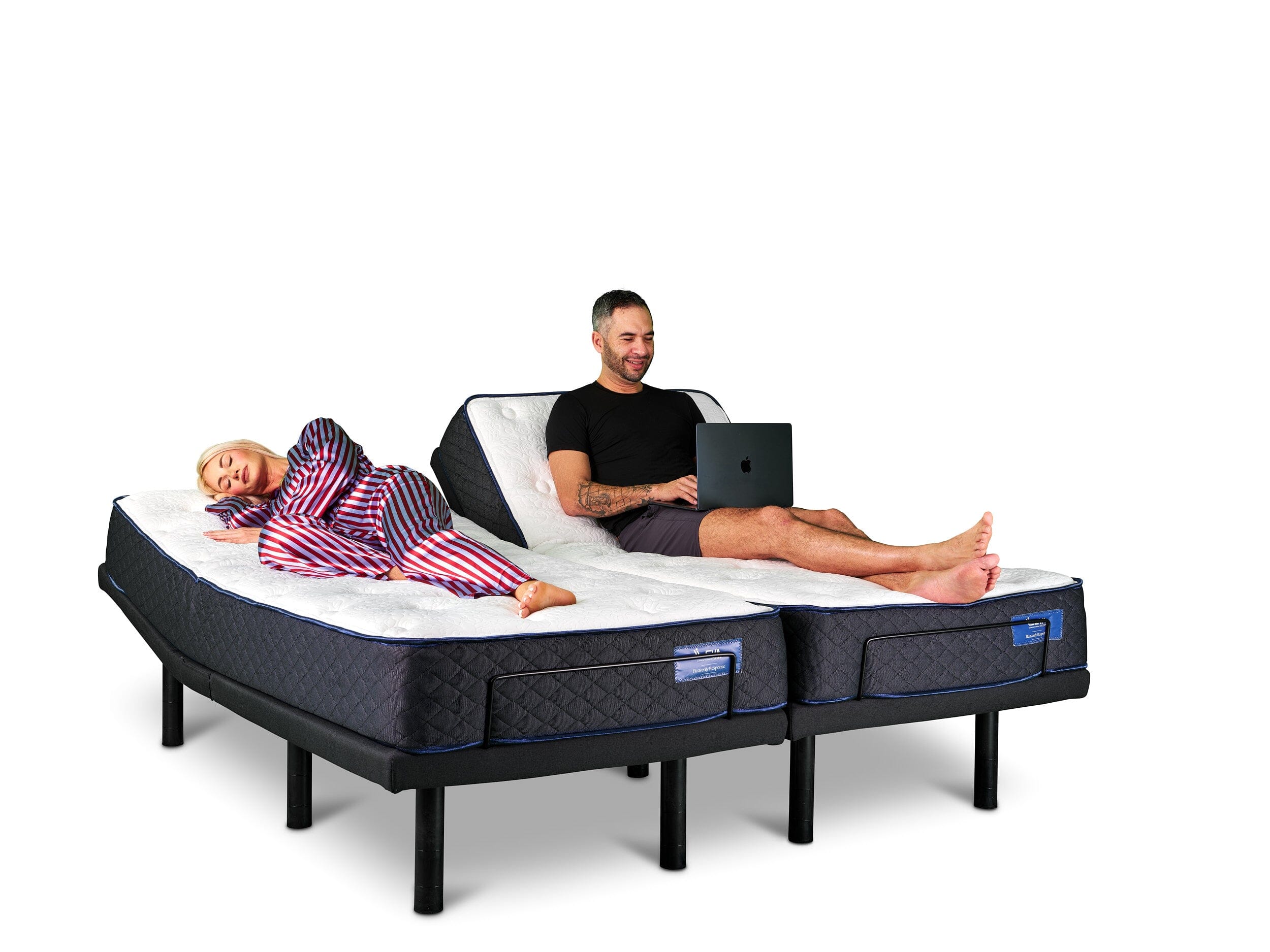
The Leva Sleep app gives full control over each side’s elevation, massage settings, and custom sleep positions. Leva’s Split Queen configuration is uncommon in the Canadian market and offers split-base benefits in a more space-conscious footprint. All systems are locally assembled in Ontario and Alberta, and in-house white-glove delivery includes bedroom setup, product tutorials, and old bed removal.
View Leva Sleep’s split-base configurations with independent elevation controls per partner and Split Queen and Split King options for Ontario and Alberta delivery.
Practical Buying Considerations for Canadians
Canadian couples evaluating adjustable beds for circulation support can use the following checklist before purchasing.
Independent leg control: Confirm that each side of the base raises independently. A single shared motor cannot support two partners with different elevation needs.
Motor noise: Loud motors disrupt sleep during position changes. Check whether the manufacturer specifies motor type and a noise rating.
Mattress compatibility: Adjustable bases require flexible mattresses, such as all-foam or hybrid pocket coil designs. Innerspring mattresses with rigid borders are not compatible. Leva designs its mattresses specifically for use with its bases.
Delivery and setup: Large adjustable bases usually need professional assembly. Confirm whether white-glove delivery is available in your province and what services it includes.
Value within your price range: Direct-to-consumer brands that assemble locally and avoid retail markups often provide more configuration choices and lower prices than traditional luxury competitors, which can matter for couples balancing medical needs with budget.
Is an Adjustable Bed Good for Circulation?
An adjustable bed supports circulation by elevating the legs above heart level during sleep, using gravity to assist venous return when the calf muscle pump is inactive. This position reduces venous pressure, limits overnight fluid pooling, and may ease swelling associated with chronic venous insufficiency. It does not treat arterial disease, DVT, or heart failure, so people with diagnosed vascular conditions should seek medical advice.
How Should I Sleep to Improve Blood Circulation?
Sleeping on the back with legs elevated 4–6 inches above heart level, supported under the calves rather than the ankles, provides consistent gravity-assisted venous return. Left-side sleeping with a pillow between the knees reduces pressure on the inferior vena cava and supports pelvic alignment. Stomach sleeping compresses abdominal veins and should be avoided by people with venous insufficiency or leg swelling.
Couples managing circulation concerns together benefit most from a split adjustable base that allows each partner to maintain a preferred position independently. Leva Sleep’s systems, backed by over eight years of adjustable bed experience and more than 25,000 Canadian customers, provide that independence without the typical luxury-brand price premium. Compare Leva Sleep’s Split Queen and Split King configurations with independent elevation, quiet motors, and in-house white-glove delivery across Ontario and Alberta.
Frequently Asked Questions
Can an adjustable bed help with ankle swelling at night?
Elevating the legs above heart level during sleep uses gravity to assist venous return when the calf muscle pump is inactive, which can reduce fluid pooling in the lower extremities and decrease morning ankle swelling. An adjustable base maintains a stable, consistent elevation angle throughout the night, which stacked pillows rarely achieve. For couples where only one partner experiences swelling, a split adjustable base allows that partner to sleep elevated while the other remains flat, avoiding compromise or separate sleeping arrangements. Persistent swelling that does not resolve with consistent elevation should be assessed by a physician, because it may indicate an underlying vascular or lymphatic condition.
What is the best adjustable bed position for varicose veins?
Vascular specialists generally recommend sleeping on the back with the legs elevated 4–6 inches above heart level, supported under the calves rather than the ankles, to reduce venous pressure and assist drainage. The zero-gravity position, where the torso and legs are both raised so the thighs sit at about 128° to the torso, distributes gravitational load more evenly and further reduces cardiac preload. Some clinicians also recommend left-side sleeping because it reduces pressure on the inferior vena cava. An adjustable base with independent head and foot elevation lets users fine-tune the angle that provides relief without hyperextending the knees or creating pressure points. Adjustable beds do not treat varicose veins and do not replace medical or surgical intervention.
Are adjustable beds safe for seniors with poor circulation?
Most adults with age-related venous insufficiency or mild lower-extremity swelling can safely use leg elevation on an adjustable base as a conservative measure. Certain conditions, including peripheral artery disease, severe heart failure, and acute deep-vein thrombosis, act as contraindications for leg elevation, so a physician should be consulted before use. Seniors with limited mobility may also benefit from head elevation, which assists with getting in and out of bed and can reduce acid reflux. Leva Sleep’s whisper-quiet motors and app-based controls make position adjustments accessible without physical strain, and in-house white-glove delivery helps ensure the system is set up safely in the bedroom.
Do I need a special mattress for an adjustable bed?
Adjustable bases require a mattress that flexes without damage, typically all-foam or hybrid pocket coil construction. Traditional innerspring mattresses with rigid border wires are not compatible and will be damaged by repeated articulation. Leva Sleep designs its mattresses specifically to work with its adjustable bases so the mattress flexes correctly at the head and foot sections without creating pressure points or losing structural integrity. Leva also offers purpose-built bedding accessories, including fitted sheets with deep pockets and extra elastic, plus duvet clips, designed to stay in place when the bed is elevated.
How does a split adjustable base prevent sleep divorce for couples?
A split adjustable base divides the bed into two independently controlled halves, each with its own motor and elevation settings. One partner can sleep in zero-gravity position with legs elevated for circulation support while the other sleeps flat or at a different angle entirely, without either person feeling the other’s adjustments. Leva Sleep’s Split Queen and Split King configurations use whisper-quiet German motors so position changes rarely wake a sleeping partner. The Leva Sleep app allows each person to save custom positions, set vibrating alarms, and make micro-adjustments without disturbing the other side. This independent control often allows couples who previously slept in separate rooms because of differing comfort or medical needs to share a bed again.