Written by: Matthew Timmins, Founder and Managing Director, Leva Sleep | Last updated: July 18, 2026
Key Takeaways from 2026 Canadian Buyers
- Canadian buyers in 2026 report that zero-gravity positioning on adjustable bases reduces morning stiffness and lower back discomfort compared to flat beds.
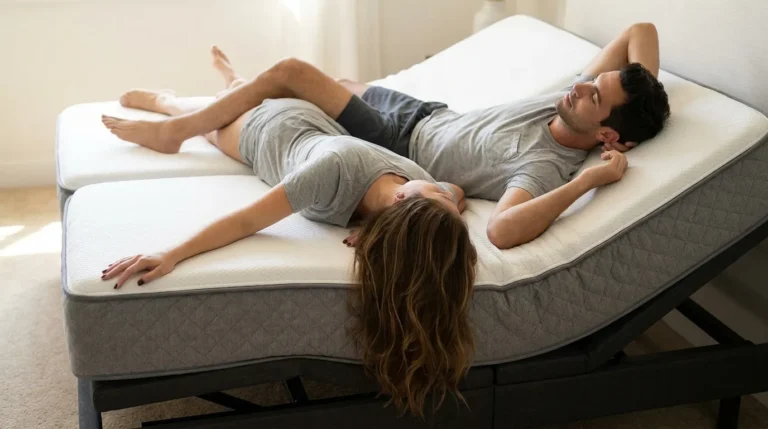
- Split configurations let couples set independent elevations, so neither partner has to compromise when their needs differ.
- Targeted lumbar support bars and gentle head and foot angles provide meaningful relief for conditions like degenerative disc disease, sciatica, and spinal stenosis.
- Side sleepers benefit most from gentle 5–10 degree inclines paired with flexible memory foam or hybrid mattresses that maintain spinal alignment.
- Leva Sleep offers split configurations, whisper-quiet motors, and white-glove delivery tailored for Canadian couples seeking back pain relief. Shop adjustable bed packages to find your ideal setup.
Real-World Back-Pain Relief: What Canadian Buyers Say
Aggregated 2026 Canadian buyer feedback highlights several consistent outcomes. Many report reduced morning stiffness within the first week, better sleep continuity for couples with differing needs, and meaningful relief from zero-gravity positioning for lower back conditions. The anonymized excerpts below reflect the range of experiences.
- “I have had lower back pain for six years. Within three nights of using the zero-gravity preset, I stopped waking up at 2 a.m. to stretch.” — Ontario buyer, 54
- “My husband snores. His side goes up slightly, mine stays flat. We are both sleeping through the night for the first time in years.” — Alberta couple, late 40s
- “The lumbar support bar made a noticeable difference for my disc issues. I did not expect it to matter that much, but it does.” — Ontario buyer, 61
- “I am a side sleeper and I had to experiment. Steep inclines did not work for me, but a gentle 8-degree head lift with foot elevation helped my sciatica without throwing my shoulder out.” — Alberta buyer, 47
- “We tried a single king base first. One of us was always compromising. The split configuration changed everything.” — Ontario couple, 58 and 62
- “Delivery and setup were seamless. The team adjusted the leg height on the spot and walked us through every feature.” — Alberta buyer, 67
- “I was skeptical about the price, but comparing it to what the big-box stores charge for similar features, this was 35% less.” — Ontario buyer, 43
- “My physiotherapist recommended sleeping with knees slightly elevated. The adjustable base holds that position all night, while a pillow never stayed put.” — Alberta buyer, 55
- “Morning stiffness is mostly gone. I still have bad days, but the baseline has shifted.” — Ontario buyer, 70
- “The anti-snore mode is the feature I did not know I needed. My partner has not elbowed me awake in two months.” — Alberta buyer, 52
Shop Leva Sleep’s adjustable beds and explore split configurations designed specifically for Canadian couples with differing sleep and pain needs.
How Zero-G Positioning and Lumbar Support Ease Back Pain
The relief buyers describe above stems from specific biomechanical principles. The zero-gravity position, with the head raised about 10–15 degrees and knees slightly above the heart, flattens the lower back against the mattress, supports neutral spinal alignment, and reduces the arch that often causes morning stiffness and lumbar strain. This position can reduce lumbar strain compared to lying flat.
Dr. Danielle Wall, MD, an internal medicine physician and sleep advisor, notes that slight elevation of the head and legs can reduce strain on the lower back and help maintain the natural curvature of the spine, which becomes increasingly important with age. Dr. Raj Dasgupta, a quadruple board-certified physician specializing in pulmonary and sleep science, states that adjustable bases help align the spine and take pressure off the joints while also keeping airways open by elevating the upper body.
Lumbar support features extend these benefits beyond preset positions. Targeted lumbar bars raise a section under the lower back to provide extra support and customization for back pain relief in zero-gravity mode. This adjustability matters because spinal curves vary significantly between individuals, so a single preset angle rarely suits everyone. Leva Sleep’s higher-end bases include adjustable lumbar control for this reason, allowing users to dial in support that matches their specific spinal curve instead of relying on a one-size-fits-all setting.
Elevating the knees by 15 to 30 degrees relaxes the hamstrings, reduces the tugging sensation on the lower back, and provides sciatic nerve relief for patients with sciatica or herniated discs. For degenerative disc disease, the ability to adjust sleeping position throughout the night lets patients find their most comfortable angle, which often changes with daily activity level and inflammation.
Split Configurations for Couples with Different Pain Levels
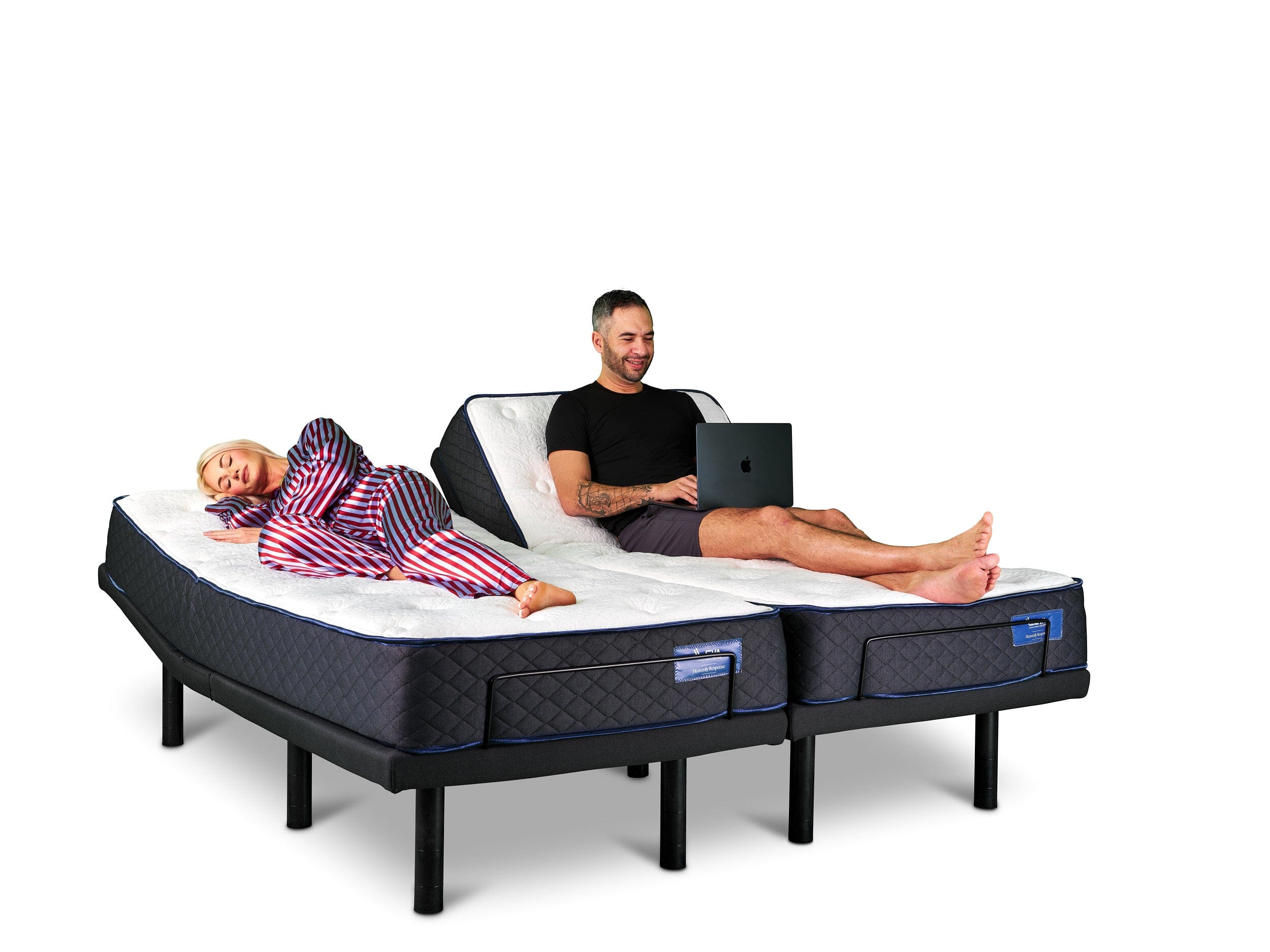
A Split King adjustable bed uses two Twin XL mattresses and two independent adjustable bases placed side by side, so each side moves on its own, while a standard King adjustable base moves the entire mattress as one unit. Leva Sleep extends this principle to Split Queen configurations, which remain rare in the Canadian market, and this makes independent adjustability possible in smaller bedrooms.
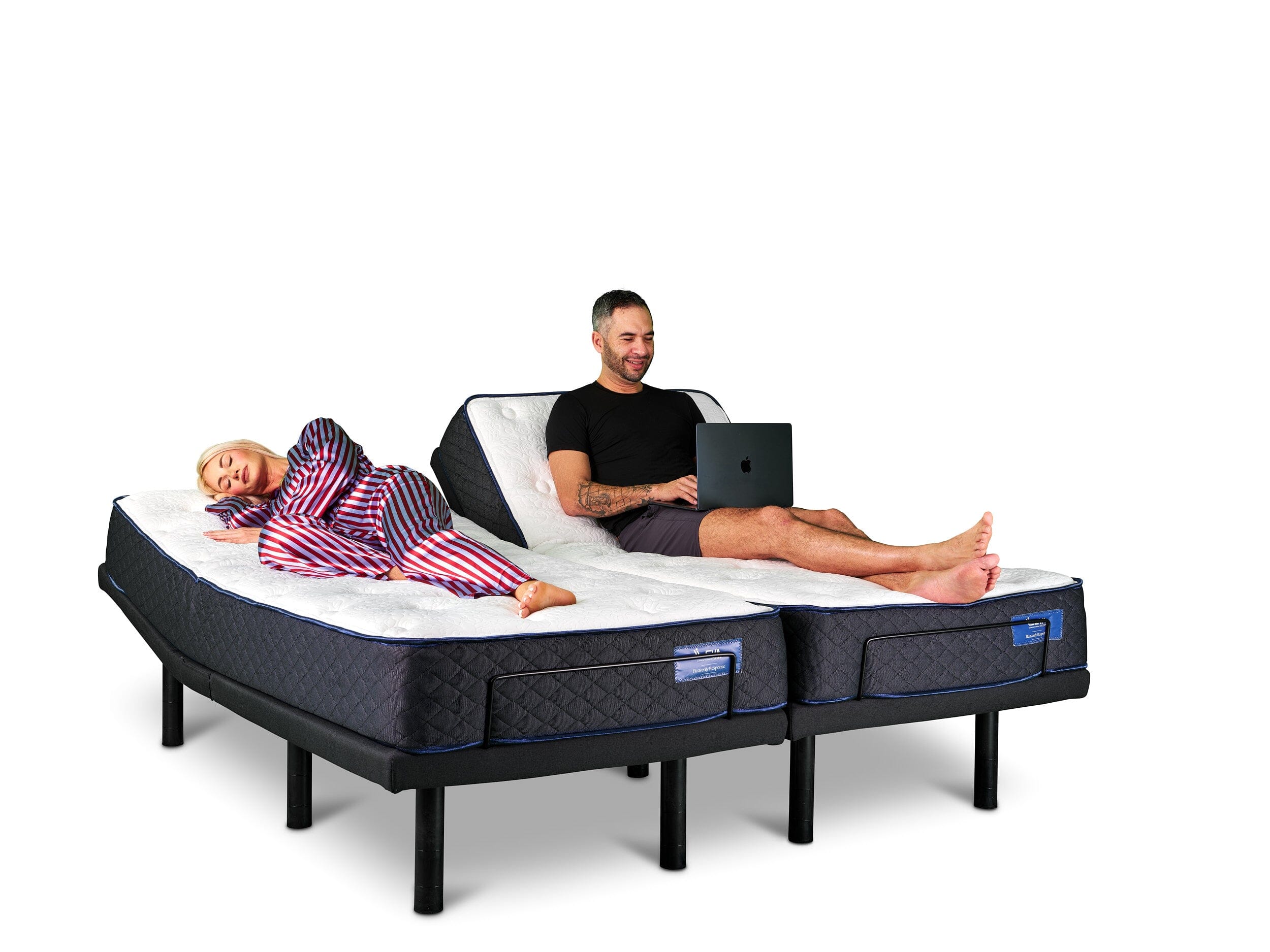
Split king configurations deliver zero motion transfer because each mattress and base operates independently, unlike a regular king where adjustments and movement affect both sleepers. Bryte reports that split king mattresses deliver 74–82% better motion isolation than single kings.
Buyers comparing Douglas versus Leva adjustable bed options frequently cite independent adjustability as the deciding factor. Douglas offers a single-base configuration without the split-control architecture that couples with divergent pain levels often require. Leva Sleep’s 15–20 adjustable models, compared to the 3–5 typically found at general retailers, give couples enough range to match a base to each partner’s specific clinical need. One side can use zero-gravity for lower back decompression while the other remains flatter for shoulder pressure relief.
Elevating the head of the bed 15 to 30 degrees on a split king is clinically recommended for reducing snoring and mild obstructive sleep apnea, and only the affected partner needs to adjust their side.
Shop Leva Sleep’s adjustable beds to find Split King and Split Queen configurations with independent controls for each partner.
Side-Sleeper Needs and Mattress Compatibility
Side sleepers make up a large share of Canadian buyers, and their experience with adjustable bases differs from back sleepers. Raising the head section shifts weight onto the lower shoulder and hip for side sleepers, and steep inclines used all night can cause the body to slide downward, rotate the pelvis, and leave the neck at an angle relative to the shoulders.
Side sleepers should keep head inclines to gentle angles of 5–10 degrees and pair the base with a flexible memory foam or hybrid mattress to maintain spinal alignment. For side sleepers, a slight head lift reduces crushing pressure on the bottom shoulder, while foot elevation creates a cradle that prevents the top leg from sliding forward and twisting the lower spine.
Mattress compatibility plays a central role in whether an adjustable base helps or frustrates. Traditional innerspring mattresses with interconnected coil systems are generally not recommended for adjustable bases, because repeated flexing can damage the coil structure over time. Natural latex and hybrids with pocketed coils flex and recover shape cleanly at hinge points. Leva Sleep designs its all-foam and hybrid pocket-coil mattresses specifically to articulate with its bases, which removes the compatibility guesswork that buyers face when purchasing a base and mattress from separate retailers.
Common Downsides Buyers Mention in Reviews
Canadian buyers in 2026 also report recurring limitations alongside the benefits, and these trade-offs deserve attention before purchase.
Fitted sheets frequently pop off the corners of adjustable bases when the head or foot sections move, so many buyers switch to deep-pocket sheets or sheet straps. Leva Sleep addresses this with purpose-designed fitted sheets that have extra elastic and deep pockets, sold as part of its integrated sleep system.
A loud motor can wake side sleepers and their partners because they tend to change positions more often than back sleepers, and frames should use whisper-quiet motors under 40 decibels. Leva Sleep uses whisper-quiet German motors to reduce this disturbance.
Split king setups create a 2–4 inch gap between mattresses that 60% of couples find problematic for maintaining physical closeness. This gap represents a real trade-off of independent adjustability. Leva Sleep’s Split Queen configuration reduces the gap compared with a Split King while still delivering independent control, which makes it a practical middle ground for couples who value both proximity and personalization.
Delivery and Setup: How Retailers Compare
Delivery experience consistently stands out in 2026 Canadian buyer feedback. Buyers who receive standard or drop-ship delivery often report assembly challenges, missing components, and no guidance on how to use features. Those who receive white-glove service describe higher satisfaction and faster time to relief, because the base arrives configured correctly from the first night.
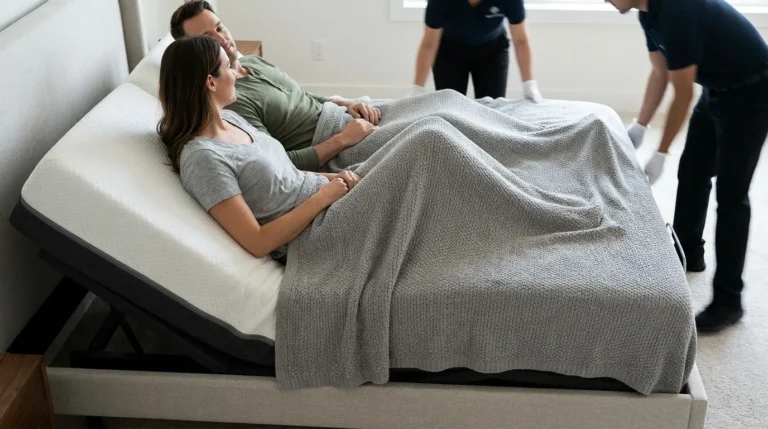
Sleep Country and general furniture retailers usually offer curbside or threshold delivery for adjustable bases, leaving assembly and setup to the buyer. Leva Sleep’s in-house white-glove delivery, available for a fee in Ontario and Alberta, includes bedroom delivery, full assembly, leg-height adjustment, a product tutorial, and removal of the old bed. Buyers in the 55–70 age range often cite this service as a deciding factor, given the weight and complexity of split adjustable systems.
Price and Value for Canadian Buyers in 2026
Complete split king adjustable setups in Canada range from about $2,000 for budget configurations to $5,000 or more for premium options with high-end mattresses and advanced bases. TEMPUR-Ergo and comparable luxury configurations often exceed this upper range.
Leva Sleep’s vertical integration, which means it designs, assembles, and delivers its systems without retail intermediaries, produces a 30–50% cost advantage over comparable competitors. A buyer comparing a TEMPUR-Ergo split configuration with a similar Leva Sleep setup receives comparable lumbar support, independent adjustability, and whisper-quiet motors at a substantially lower price point. The savings come from local assembly and a direct-to-consumer model that removes markup layers rather than from reduced quality.
Feature-by-Feature Pros and Cons for Back Pain Relief
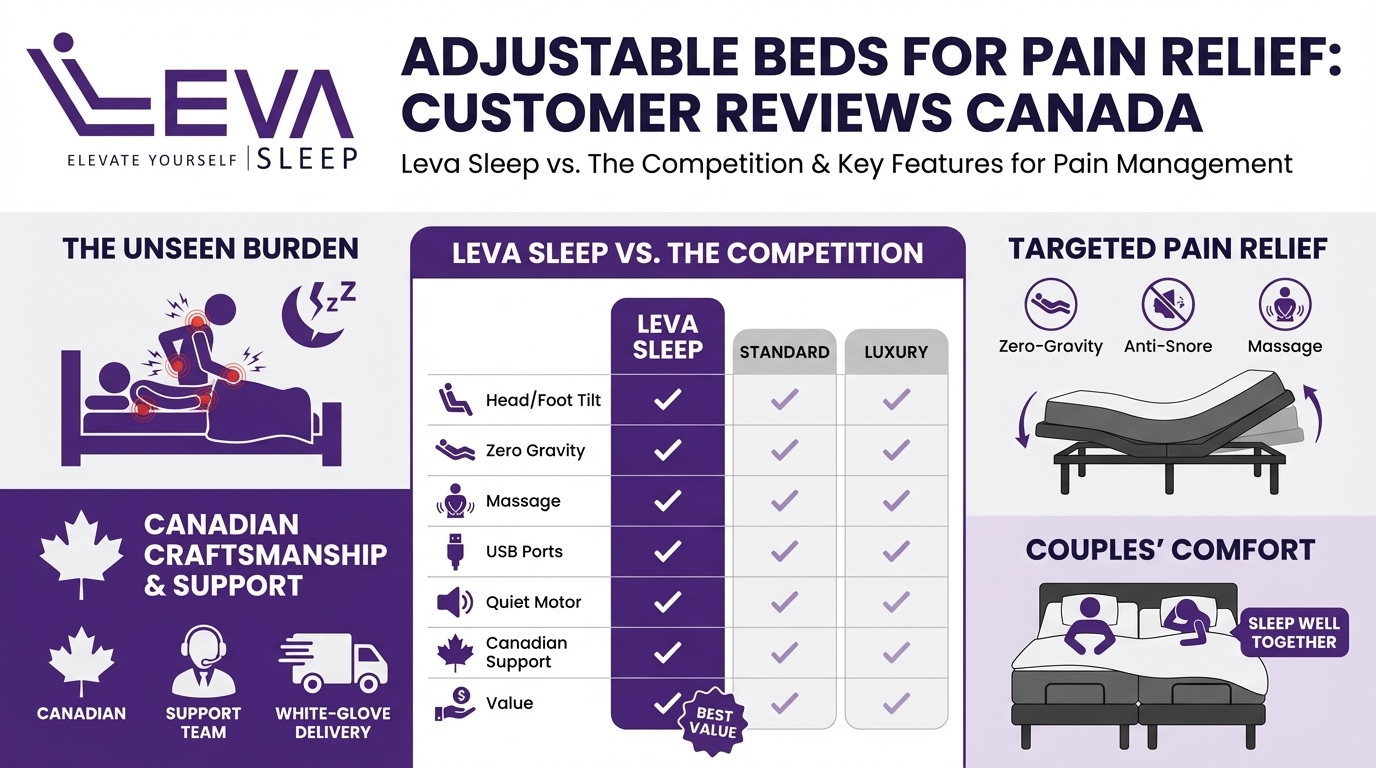
| Feature | How It Works | Leva Sleep Approach | Reported Limitations |
|---|---|---|---|
| Zero-gravity positioning | Reduces lumbar strain compared with lying flat and is the most-cited relief feature in buyer reports. | Preset and fully adjustable angles on all base models. | Not preferred by all sleepers, and stomach sleepers should avoid elevation. |
| Lumbar support bar | Provides targeted support under the lower back, which buyers with disc conditions often describe as extra relief beyond preset inclines. | Adjustable lumbar control on higher-end models. | Requires correct positioning and does not replace clinical treatment. |
| Split independent control | Lets each partner adjust their side separately, with significantly better motion isolation than a single king (see split configuration section). | Split King and unique Split Queen configurations with app control. | Creates a 2–4 inch centre gap that 60% of couples say affects closeness. |
| Motor noise | Quiet motors help prevent sleep disruption, especially for side sleepers who change positions often. | Whisper-quiet German motors. | Buyers should verify noise level before purchase regardless of brand. |
| Sheet compatibility | Standard fitted sheets often pop off corners during elevation. | Purpose-designed sheets with deep pockets and extra elastic included in the sleep system. | Buyers who skip an integrated system should budget for specialty bedding. |
| Mattress compatibility | Traditional innersprings can be damaged by repeated flexing. | All-foam and hybrid pocket-coil mattresses designed to articulate with Leva bases. | Buyers should verify compatibility before pairing any existing mattress with a new base. |
| Delivery and setup | Drop-ship delivery leaves assembly to the buyer, while white-glove service correlates with faster relief and fewer setup issues. | In-house white-glove delivery in Ontario and Alberta for a fee. | White-glove service adds cost, and buyers should confirm availability by postal code. |
| Price | Luxury competitors often charge over $5,000 for split configurations. | Pricing 30–50% lower than comparable competitors through vertical integration. | Budget configurations under $2,000 often lack lumbar support and independent control. |
Before purchasing, evaluate any adjustable base against this checklist:
- Does the base offer independent adjustability for each partner, or does one adjustment affect both sides?
- Is the motor quiet, and can you verify this before delivery?
- Is your existing mattress, or the mattress you plan to purchase, compatible with articulating bases such as all-foam or pocketed-coil hybrids?
- Does the retailer offer white-glove delivery and setup, or will assembly fall to you?
- Are specialty sheets and accessories included, or will you need to source them separately?
- Does the base include adjustable lumbar support, or only preset incline positions?
- Is a Split Queen configuration available if a Split King is too large for your room?
Frequently Asked Questions
Do doctors recommend adjustable bases for back pain?
Many physicians and physical therapists recommend adjustable bases as a comfort tool for managing chronic lower back pain, particularly for patients with degenerative disc disease, spinal stenosis, sciatica, or osteoarthritis. The zero-gravity position, with head and knees slightly elevated, reduces lumbar disc pressure and allows surrounding muscles to relax. The American Academy of Sleep Medicine recommends slight elevation of the head and knees to ease lower back strain. An adjustable base still does not qualify as a medical device and does not treat underlying spinal conditions. Patients with spinal fusion, osteoporosis, or severe disc herniation should consult an orthopaedic specialist before using an adjustable base, because improper positioning can worsen certain conditions.
Are adjustable bases worth it for couples with different sleep needs?
For couples where one partner manages back pain, snoring, acid reflux, or sleep apnea while the other has different or no positional requirements, a split adjustable configuration is often reported as worth the investment. A single shared base forces both partners into the same position, which rarely works when needs diverge significantly. Split configurations with independent controls remove this compromise and allow each partner to use zero-gravity, anti-snore, or flat positioning independently, with the motion isolation improvement discussed earlier. The main trade-off is a 2–4 inch centre gap between mattresses, which some couples feel affects physical closeness. Leva Sleep’s Split Queen option reduces this gap compared with a Split King while maintaining full independent control.
What are the main limitations of adjustable bases for back pain?
Several limitations appear consistently in buyer feedback and clinical guidance. Side sleepers who use steep head inclines overnight risk spinal misalignment, shoulder pressure, and body migration toward the foot of the bed, so gentle angles of 5–10 degrees are recommended for this sleep position. An adjustable base cannot compensate for a sagging or incompatible mattress, because poor mattress support undermines spinal alignment regardless of base angle. Standard fitted sheets frequently pop off during elevation and usually require specialty bedding. Budget bases with loud motors or limited preset positions restrict the fine-tuning that produces meaningful relief. Back pain with leg numbness, tingling, or sudden onset still requires professional medical evaluation rather than positional adjustment alone.
How does Leva Sleep compare to Sleep Country or Douglas for adjustable bases?
Sleep Country and general furniture retailers typically carry a small selection of adjustable base models as add-on products alongside their primary mattress inventory, and they usually provide standard delivery. Douglas offers a direct-to-consumer adjustable base but without split-configuration options or the breadth of features such as lumbar support, pillow tilt, anti-snore mode, and app control found in Leva Sleep’s lineup. Leva Sleep carries a broader range of adjustable models, designs its mattresses and accessories to work specifically with its bases, and offers in-house white-glove delivery in Ontario and Alberta. Its vertical integration supports pricing that remains below comparable luxury competitors. For couples who specifically want split configurations, Leva Sleep’s Split Queen stands out as a unique option that most Canadian retailers do not offer.
How long does it take to notice back pain relief from an adjustable base?
Canadian buyer feedback in 2026 indicates that most users notice a change in morning stiffness and lower back comfort within the first week of consistent zero-gravity use. Full adjustment, which includes finding the optimal angle for a specific condition and adapting to a new sleep position, usually takes two to three weeks. Relief appears most consistent among back sleepers using zero-gravity presets, while side sleepers often need more experimentation with gentle inclines and may take longer to find a configuration that helps without creating new pressure points. Buyers who pair a compatible mattress with their base from the start report faster and more consistent relief than those trying to adapt an existing incompatible mattress.
Conclusion: How Leva Sleep Fits Canadian Buyers in 2026
Across 2026 Canadian feedback, a clear pattern emerges. Adjustable bases with zero-gravity positioning and lumbar support deliver meaningful back pain relief for many users, especially back sleepers managing degenerative disc disease, spinal stenosis, or sciatica. Couples who choose split configurations often report the strongest outcomes, because they remove positional compromise and reduce partner disturbance that can undermine sleep quality for both people.
Several limitations still deserve attention. Side sleepers need gentle angles and compatible mattresses. Standard bedding often fails on articulating bases. Budget bases with loud motors or limited adjustability tend to underdeliver. No adjustable base replaces professional medical care for acute or severe spinal conditions.
For Ontario and Alberta couples weighing these trade-offs, Leva Sleep’s mix of split configurations, including the unique Split Queen, whisper-quiet German motors, purpose-designed mattresses and bedding, and in-house white-glove delivery addresses the main barriers that Canadian buyers report. With pricing below comparable luxury competitors, the value proposition rests on structure and integration rather than short-term promotion.
Shop Leva Sleep’s adjustable beds and find the split configuration, lumbar support features, and white-glove delivery experience that many Canadian couples with chronic back pain describe as genuinely life-changing.