
Written by: Matthew Timmins, Founder and Managing Director, Leva Sleep | Last updated: June 26, 2026
Key Takeaways for Pillow Tilt and Lumbar Support
- Pillow-tilt motors rotate a hinged head plate independently of the main head section, so you can fine-tune neck and skull angle while the torso stays elevated.
- Lumbar motors extend a contoured plate upward from the base frame to fill the natural lower-back gap that forms during flat or semi-reclined sleep.
- Both features work properly only with a flexible mattress, with enough responsive foam or pocketed micro-coils to allow full plate travel without bridging.
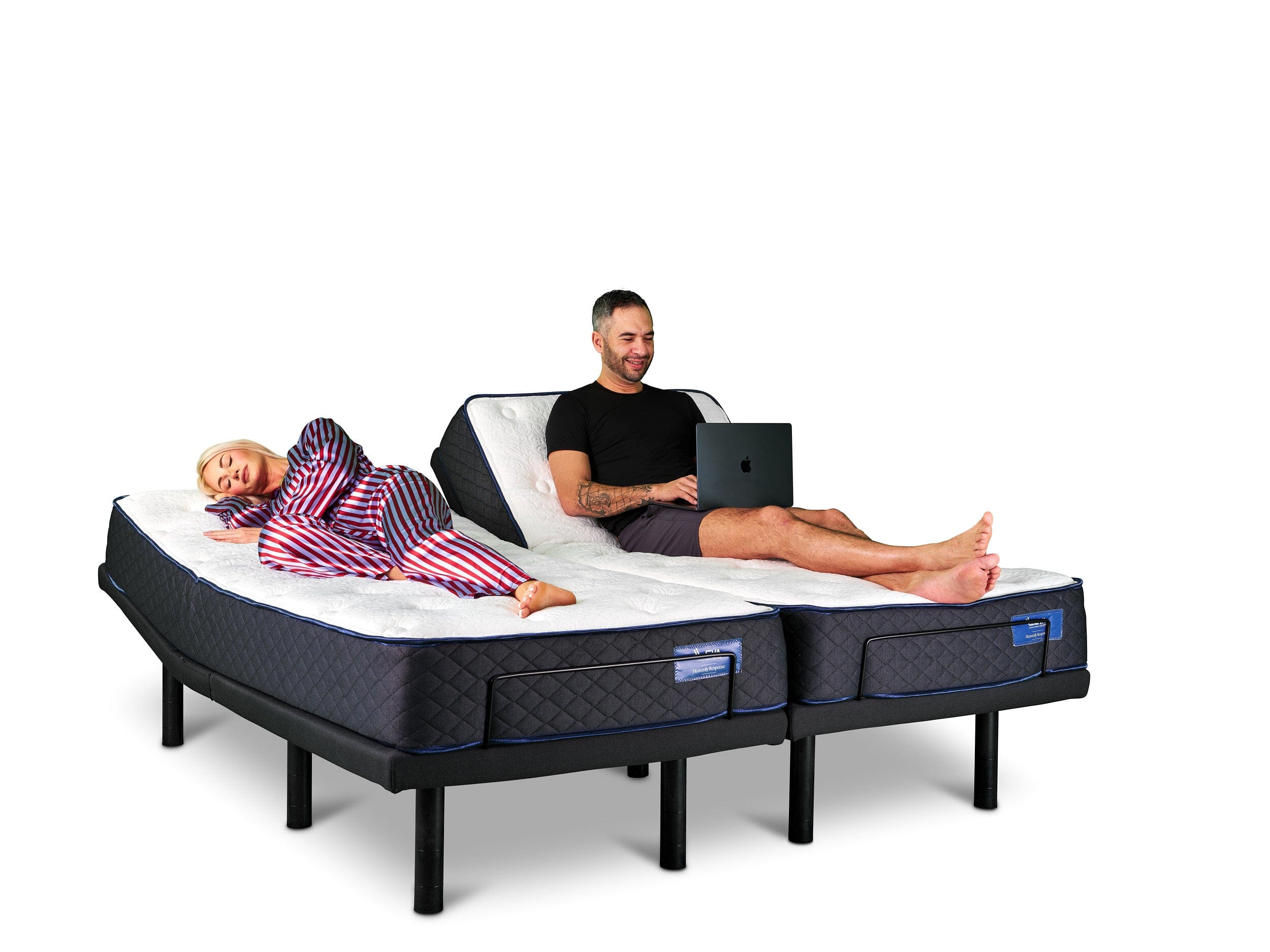
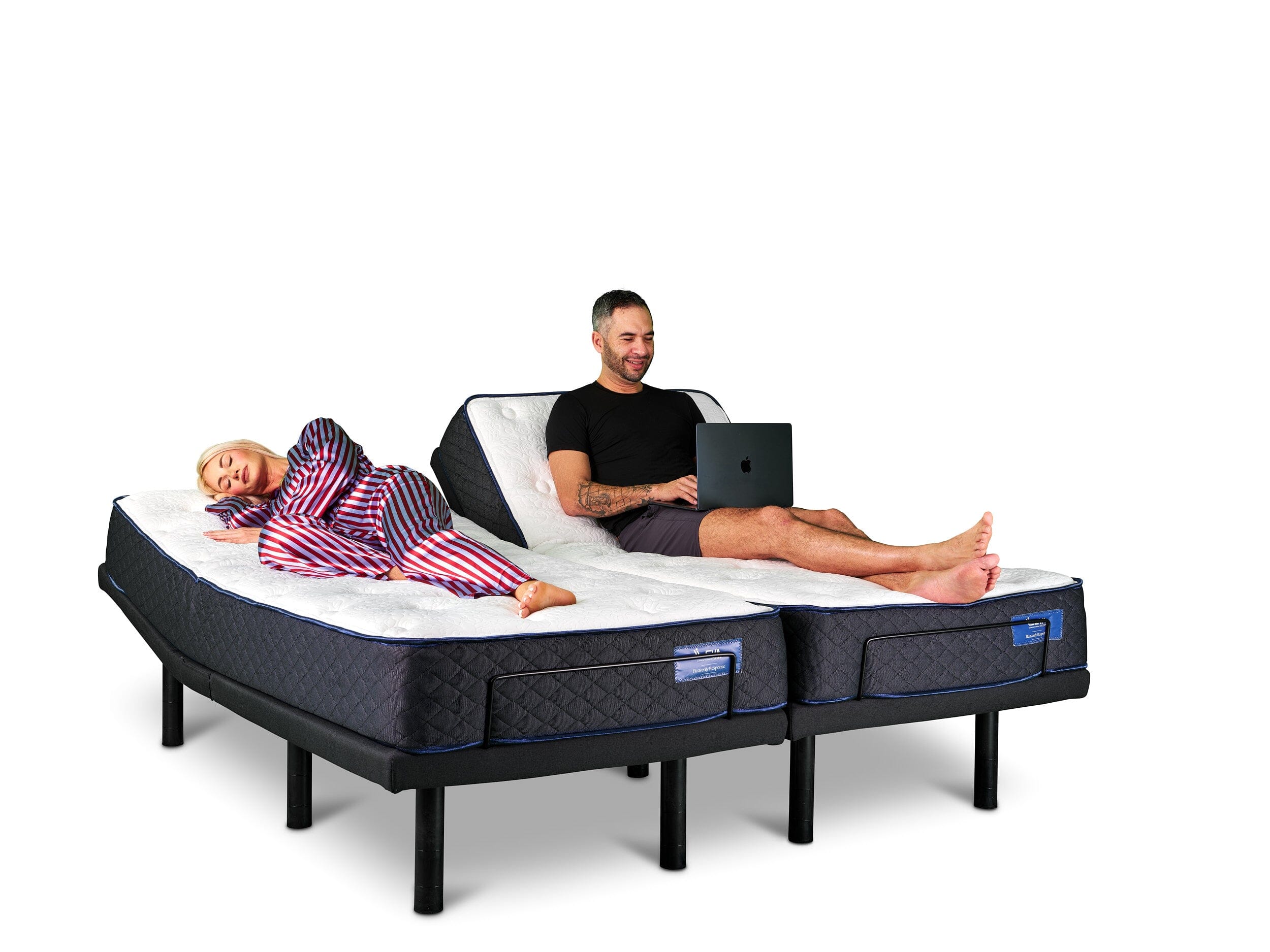
- Split configurations such as Split Queen or Split King let each partner adjust pillow tilt and lumbar support independently, so couples can share one bed without compromise.
- Leva Sleep’s white-glove delivery team calibrates leg height and presets for spinal alignment; explore complete packages at Leva Sleep adjustable bed packages.
How Pillow Tilt Works on an Adjustable Bed
Pillow tilt is a secondary motorized function built into the uppermost section of an adjustable base head panel. It operates independently of the primary head-elevation motor, so the main head section can lift the upper body while the pillow plate fine-tunes the angle of the neck and skull.
Diagram 1 — Side-view of pillow-tilt mechanism at rest and at tilt.
Alt text: Labelled side-view illustration showing an adjustable base head panel with the primary head hinge at the shoulder line and a secondary pillow-tilt hinge, with arrows indicating the rest position and the tilted position of the pillow plate, and the cervical spine shown in neutral alignment.
The mechanism works in four sequential steps.
- Motor placement. A compact DC motor sits on the underside of the head panel near the top edge of the base frame. On Leva Sleep bases, this motor uses a whisper-quiet German drive unit.
- Pivot joint activation. When the motor receives a signal from the remote or app, the mechanism activates a pivot joint that begins to lift the uppermost plate.
- Plate movement. The pivot joint raises the uppermost plate, which sits directly beneath the pillow, while the lower portion of the head panel stays still. The plate then travels through a controlled range of motion.
- Resulting head angle. The pillow plate tips the skull slightly forward relative to the torso and counters the backward head drop that occurs when the main head section elevates for reading or television. This movement brings the cervical spine back toward its natural curve.
Decision-factor callout — Pillow Tilt
- Mattress flexibility. The foam or hybrid layer directly above the pillow plate must stretch and compress without resistance at the hinge. As noted in the key takeaways, rigid innerspring constructions can bridge the pivot joint and block full plate travel.
- Body-height alignment. The pivot joint is designed around users of average height, so very tall or very short sleepers may sit slightly away from the ideal hinge point. Leva Sleep’s white-glove delivery team adjusts leg height and can advise on head-panel positioning during setup.
- Common misconception. Pillow tilt is not the same as head elevation. Raising the entire head section lifts the torso and head together as one unit, which often tilts the head backward relative to the body. Pillow tilt corrects this by moving only the top plate and bringing the head forward toward neutral cervical alignment. At higher angles, head elevation without pillow tilt usually creates the forward head posture many people notice while reading in bed.
Ready to see these features in a complete sleep system? Shop Leva Sleep’s adjustable beds and explore split configurations with independent pillow-tilt controls.
How Adjustable Lumbar Support Targets the Lower Back
Adjustable lumbar support uses a separate mechanism from head or foot elevation to focus on the lower spine. It targets the lumbar vertebrae by extending a contoured plate upward from the base frame into the mattress zone.
Diagram 2 — Side-view of lumbar plate at rest and at extension.
Alt text: Labelled side-view illustration of an adjustable base mid-section showing the lumbar motor housing recessed into the frame rail, the lumbar plate in its flat rest position, and the same plate extended upward, with the lumbar spine shown bridging a gap at rest and in a supported curve at extension.
The mechanism operates in four steps.
- Motor and plate housing. A dedicated motor sits within the base frame at a fixed point that aligns with the lower-back zone of an average adult. The motor drives a scissor-lift or cam mechanism attached to a curved lumbar plate.
- Extension range. The plate extends above the base frame surface through a controlled range. This movement fills the natural lumbar gap that appears when a person lies flat or reclines, while avoiding excessive arching of the spine.
- Lumbar targeting. The plate presses into the mattress from below at the lumbar region for users of average stature. The upward pressure then travels through the mattress and supports the inward curve of the lower back.
- Frame integration. The lumbar motor connects to the same control board as the head and foot motors, so the app or remote can adjust all zones together or separately. On Leva Sleep’s Split Queen base, each side adjusts independently.
Decision-factor callout — Lumbar Support
- Mattress requirements. A very thick or very dense mattress can soften the effect of the lumbar plate because the foam absorbs the upward extension before it reaches the sleeper. All-foam mattresses usually transmit lumbar pressure effectively.
- Sheet slippage. Lumbar extension creates a gentle bow in the middle of the mattress, which can pull standard fitted sheets loose. Leva Sleep’s purpose-built fitted sheets use deep pockets and reinforced elastic to handle this movement.
- Motor noise. A grinding or clicking sound during lumbar adjustment usually points to debris in the lead screw or a loose actuator bracket, rather than motor failure. Leva Sleep’s in-house service team can diagnose and resolve this during a follow-up visit.
Combining Pillow Tilt and Lumbar Support for Neutral Alignment
Diagram 3 — Combined side-view showing reading or TV position with head elevation, pillow tilt, and lumbar extension active at the same time.
Alt text: Labelled side-view illustration of a person reclined at 45° on an adjustable base with the head section raised, the pillow plate tilted 12° forward, and the lumbar plate extended 3 cm, with coloured lines tracing the cervical, thoracic, and lumbar curves in neutral alignment, and a second unlabelled figure beside the first representing a partner on the opposite side with different elevation settings.
Using head elevation, pillow tilt, and lumbar support together lets the base address three distinct spinal zones at once.
- Head elevation raises the thoracic spine and can reduce acid reflux pressure.
- Pillow tilt restores the cervical angle that head elevation alone tends to disrupt.
- Lumbar extension fills the lower-back gap that appears when the torso reclines above roughly 30 degrees.
On a Leva Sleep Split Queen base, one common scenario looks like this. Partner A, who has lower-back pain, sets head elevation to 35 degrees, pillow tilt to 12 degrees, and lumbar extension to 3 cm through the app. Partner B, who prefers a flat surface and sleeps warm, keeps elevation at 0 degrees and activates the cooling pad on their side. Both partners stay in the same bed without mechanical interference between their settings.
Troubleshooting box
- Height conflict between partners. If one partner is much taller than the other, the lumbar plate on a shared non-split base cannot align correctly for both bodies. A split configuration such as Split Queen or Split King solves this because each motor sits in its own position.
- Audible motor noise during combined adjustment. Running three motors at once draws more current and can trip the base’s internal circuit. Adjust one zone at a time, with a brief pause between commands. Ongoing tripping should trigger a service call.
Both features come standard on select Leva Sleep packages. Shop Leva Sleep’s adjustable beds to compare which models include independent lumbar and pillow-tilt motors on each split side.
Results You Can Expect from Proper Setup
Buyers who configure pillow tilt and lumbar support correctly often report three clear outcomes within two to four weeks of steady use.
- Neutral spinal curves in the morning. The cervical and lumbar regions keep their natural inward curves through the night instead of flattening against a hard surface or arching over a raised head section.
- Reduced morning stiffness. Lower-back stiffness on waking often relates to the lumbar gap that forms during flat or semi-reclined sleep. Consistent lumbar plate support can reduce both the duration and intensity of this stiffness for many users.
- Couples staying in the same bed. A Split Queen structure often lets couples with very different comfort needs share a bed without compromise. Pillow tilt and lumbar support extend that independence from elevation angle to spinal alignment.
These outcomes depend on a suitable mattress, accurate body-height alignment of the pivot joints, and regular use of app presets. Leva Sleep’s white-glove delivery team configures initial presets during setup and provides a full product tutorial so couples start their first night with settings already tuned to their heights and preferences.
Frequently Asked Questions
Is an adjustable base with lumbar support worth it?
People who experience lower-back stiffness, lumbar pain, or who sleep elevated for medical reasons such as acid reflux or mild sleep apnea often benefit from a lumbar motor. The plate adjusts in real time, so users can increase extension while reading in bed and reduce it when shifting toward sleep. For couples where only one partner needs lumbar support, a split base such as Split Queen or Split King keeps the feature from affecting the other partner’s comfort. The value depends on pain severity and whether a compatible flexible mattress is already in place or purchased with the base.
What mattress flexibility works with pillow tilt and lumbar motors?
The mattress must flex and compress at each pivot point without bridging, meaning the comfort layer cannot stay rigid and flat across the hinge. All-foam mattresses are often compatible. Hybrid mattresses with individually pocketed micro-coils also work well because each coil compresses on its own. Traditional Bonnell or offset innerspring constructions, which link coils together, resist the focused bending needed at the pillow-tilt hinge and lumbar extension point. Leva Sleep designs its own all-foam and hybrid pocket-coil mattresses to flex at the correct zones for its base models, which removes compatibility guesswork for buyers choosing a complete package.
How loud are the German motors used in premium bases?
Premium DC motors used in high-end adjustable bases, including those in Leva Sleep’s lineup, usually operate in the 30–40 dB range during movement, similar to a quiet conversation at a distance or a refrigerator hum. This level is substantially quieter than the AC motors in many entry-level bases, which can reach 50-60 dB. The whisper-quiet specification matters most for couples where one partner adjusts position at night without wanting to wake the other. Motor noise above about 45 dB during normal operation often indicates a mechanical issue such as a loose bracket or debris in the drive mechanism, not a limitation of the motor type itself.
Does Leva Sleep’s white-glove delivery include height adjustments for differing partner heights?
Yes. Leva Sleep’s white-glove delivery service includes leg-height adjustment as a standard part of setup. The delivery team adjusts the base legs to the preferred bed height, which also affects how the lumbar and pillow-tilt pivot points line up with each partner’s body. For split configurations, the team can advise whether the fixed pivot positions will align correctly for both partners based on their heights and can configure app presets for each side before leaving. This service also includes removal of the old bed, full assembly, and a product tutorial that covers all motor functions and app features.
Conclusion: Choosing Pillow Tilt and Lumbar Support with Confidence
Pillow tilt and lumbar support function as dedicated motorized mechanisms, not cosmetic extras. A pivot-mounted head plate and a cam-driven lumbar plate work together to address the two spinal zones most affected by elevated sleeping positions. Pillow tilt restores the cervical angle that head elevation alone can disturb, and lumbar support fills the lower-back gap that appears when the torso reclines.
Before purchasing, focus on three checks. Confirm mattress flexibility at the pivot zones, confirm body-height alignment of the lumbar plate for each sleeper, and decide whether a split configuration is necessary for different partner needs. A white-glove setup service that calibrates these variables on delivery removes much of the trial and error that can limit the technology’s benefits.
Shop Leva Sleep’s adjustable beds to explore split packages with independent pillow-tilt and lumbar motors, whisper-quiet German drives, and in-house white-glove delivery across Ontario and Alberta.